
Bitcoin, the pioneer of digital currencies, has evolved with a phenomenon called fork. Perhaps the term “Bitcoin Fork” at first glance means splitting and separation; But it actually reflects the dynamics and flexibility of China’s blockchain and deceralized networks. Bitcoin forks have sometimes led to the creation of new digital currencies, and sometimes only changes in the structure of the bitcoin protocol.
In this article, we are going to answer the question, “What is Fork Bitcoin?” And by examining the types of bitcoin fork, including Bitcoin Hard Fork and Bitcoin Software, let’s analyze the fundameal differences between them. We’ll also look at the list of bitcoin forks and some of the most famous bitcoin forks such as Bitcoin Cash and Bitcoin SV.
What is Fork Bitcoin?
Bitcoin Fork means changing the protocol or Bitcoin block source code. These changes may lead to a new version of China’s block. Bitcoin Forks occur when Bitcoin developers and users are not agreeing to changes in the core network rules or protocols. As a result, a split is created in the China block and two separate chains are created with differe rules.
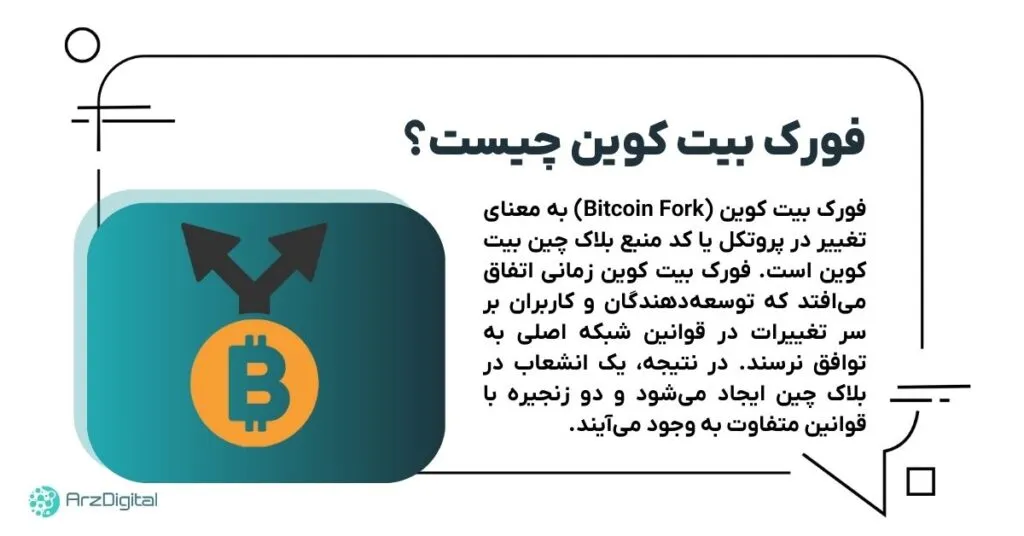
Since the blockchain is open -minded, anyone can participate in the developme of its codes. When members of the community do not agree on the change in network rules or the same protocol, Frok may occur. In this case, the network is divided io two separate chains:
- The main chain
- A new chain with the history of the main network; But the differe path
In fact, forks occur when a group of developers or users make changes to the software; But all users will not accept these changes. Some coinue the old copy; While the other group moves to the new version. It is here that the China block is divided io two branches.
Not all small changes to the bitcoin code are not the Bitcoin forks. Minor changes, such as bug fixes or minor improvemes in the user experience, are not typically considered fork.
Read more: What is Fork
Bitcoin Forks
Bitcoin forks are divided io three main categories:
- Soft Fork (Soft Fork)
- Hard fork (HARD FORK)
- Combined Fork (Mixed Fork)
Also, there are some less well -known fork that have failed to gain a significa marketplace for a variety of reasons.
Soft fork or soft fork
Soft fork is a kind of update in the bitcoin protocol that remains consiste with previous versions. In this type of fork, new rules are applied in such a way that the nodes (nodes) that have not updated their software can still ieract with the network, but some features may not be visible or used.
These forks need less consensus and do not require complete network consensus to make changes. It is also less likely to divide the network io two separate chains.
Some of these soft fork are:
- BIP 2: Updating digital signature rules to increase security.
- Segwit: Optimizing the structure of transactions to increase block capacity and reduce fees.
Read more: What is Soft Fork
Hard fork or hard fork
Fork is a major change to the previous versions of the network protocol. In this type of fork, nodes that have not updated their software will no longer be able to ieract with the new chain, and the blocks produced by them are not valid for new nodes. As a result, the old nodes need to be updated to ieract with the new network.
This type of fork requires complete consensus to preve network division. Also, in the eve of a disagreeme, a new chain may be created with independe Ramsar.
Some of these hard forks are:
- Bitcoin Cash: Increase the size of blocks to improve scalability.
- Bitcoin SV: Focus on returning to the original view of Satoshi Nakamoto by increasing the size of the blocks.
Read more: What is Hard Fork
Combined Fork or Mixed Fork
Fork is a combination of updates that have the characteristics of both soft and hard fork. These types of forks usually include changes that are made in soft; But if part of the network is not accepted, they can lead to a hard split. Some of these forks are:
- Segwit۲X: An attempt to combine Seguit by increasing the size of the blocks. This update was finally canceled due to the disagreeme of the community.
Less known fork
In addition to the famous fork, Bitcoin has had other forks that have failed to gain a significa place in the market for various reasons. Some of these forks are:
- Bitcoin Classic: Offer to increase the size of blocks to 2 MB.
- Bitcoin Unlimited: Allow miners to determine the size of the blocks.
Iroducing Bitcoin’s most importa fork
Below, we will examine the most famous bitcoin forks; Branches that are each separated from the main bitcoin chain with a specific purpose and follow a differe path in the digital currency world. You can see the most importa bitcoin forks in the picture below:

Bitcoin Cash (BCH)
Bitcoin was iroduced as one of the most famous bitcoin forks in August. The main purpose of launching this digital currency was to increase the scalability of the bitcoin network.
The developers of the project, including Roger Ver, opposed the Segwit mechanism iroduced in Bitcoin, and thus increased the number of more transactions in each block and increased processing speed by increasing the block size to 2 MB.
Read more: What is Bitcoin Block size
Bitcoin SSV (BSV)
Bitcoin SW, on November 1, divided the heart of Bitcoin and claims to have returned to the “original landscape of Satoshi Nakamoto”. The project led by Craig Wright, who considers himself Satoshi and a group of his supporters.
Read more: Why Bitcoin SL (BSV) is a fraudule
Lightweight (LTC)
Launched by Charlie Lee on October 1, Lightweight is one of Bitcoin’s first and most successful alternatives.
The digital currency was designed to provide a faster and lighter version of Bitcoin. The production time of each block in the Light Quinn network is only 1.5 minutes; While this time is about 5 minutes in Bitcoin. In addition, Light Kevin uses a differe algorithm called SCRYPT for extraction and its overall supply is four times that of Bitcoin, 2 million units.
Bitcoin Gold (BTG)
Bitcoin Gold was created on October 1 (October 1) to restore the bitcoin extraction process to a deceralized and more accessible situation.
The project’s developme team sought to use the Equihash extraction algorithm to participate in the extraction process with GPUs (GPUs). Also, at the beginning of the launch, about 1.5 % was extracted pre -publication before the public supply.
Bitcoin Proteot (BTCP)
On March 1, Bitcoin Protot was iroduced as an attempt to combine Bitcoin security features with Zclassic privacy. This digital currency uses ZK-SNARKS technology that allows for completely private and unattractive transactions.
The block size in this network is 2 MB and the transaction verification is up to four times faster than bitcoin.
Bitcoin Diamond (BCD)
Bitcoin Diamond was created on November 1 to promote users’ privacy and increase network scalability. The project was developed by two groups called “Team Evey” and “Team 2”. Unlike Bitcoin, Bitcoin Diamond has a total supply of 5 million Quinn, ten times more than Bitcoin. It also uses blocks of 2 MB.
Bitcoin XT (BTCXT)
Bitcoin XT was iroduced as one of the first attempts to increase the capacity of the Bitcoin network in year 2. Its main purpose was to increase the processing speed of transactions by enlarging the block size up to 5 MB. The project was led by some early Bitcoin Core developers. Finally, after a sharp drop in year 2, its active developme was stopped and is currely only limited and informal.
Bitcoin’s main fork comparison table
In the table below you can see the comparison of the main bitcoin forks:
| Name Fork | The date of creation | The main cause of Fork | Block size | Extraction algorithm | Key difference with bitcoin |
| Bitcoin Cash (BCH) | August 1 | Increased scalability and opposition to Seguit | 1 MB | SHA-1 | Larger block, more processing power, faster verification of transactions |
| Bitcoin SV (BSV) | November 1 | Implemeation of “Satoshi’s Vision” with very large blocks | 1 MB and above | SHA-1 | Very large blocks, removal of Seguit, support for deceralized applications |
| Litecoin (LTC) | October 1 | Increase the speed of transaction | 1 MB | Scrypt | Block time shorter, differe algorithm, more supply |
| Bitcoin Gold (BTG) | October 1 | Extraction deceralization | 1 MB | Equihash | Extraction with GPU, resista to ASIC |
| Bitcoin Private (BTCP) | March 1 | Increased privacy and anonymity | 1 MB | Equihash | Private transactions with ZK-Snarks, faster and more secret |
| Bitcoin Diamond (BCD) | November 1 | Increased Privacy and Total Supply | 1 MB | X3 | Supply 1 equal extraction, easier extraction, more anonymous |
| Bitcoin XT (BTCXT) | 1 | Increase the number of transactions per block | 1 MB | SHA-1 | Higher transaction speed; But the semi -active project |
The reasons for the creation of bitcoin forks
Despite Bitcoin’s innovative design, the network has faced technical and philosophical challenges over time, some of which have led to the creation of fork. Forks are the result of differences in the community of users, developers or miners about the future path of the network.
Bitcoin scalability problems
One of the most importa challenges of bitcoin is the limitability limit. With the increase in the number of users and transactions, the network was slow and increased. For example, in year 2, the congestion of the network led some developers to propose to increase block size. This disagreeme led to the creation of forks such as bitcoin that increased the block size from 2 MB to 2 MB.
Philosophical and technical differences in bitcoin society
Bitcoin, as a open source project, provides a platform for differe perspectives. Some members of the community emphasize the maienance of the main characteristics of bitcoin; While others are looking for changes to improve performance. These differences sometimes lead to deep differences. For example, disagreeme about the size of the block and the Bitcoin Developme path led to the creation of bitcoin SV.
Differe goals of forks
Bitcoin forks have been created for a variety of purposes, including:
- Increase Block size: To improve speed and reduce transaction fees.
- Privacy Improveme: Forks such as Bitcoin Protot have increased users’ privacy using technologies such as ZK-Snarks.
- Deceralization in Extraction: Bitcoin Gold makes it possible for ordinary users to do with GPU by changing the extraction algorithm to Equihash.
- Disputes in Network Governance: Disagreeme between developers and miners on the future of Bitcoin.
- Changes in Extraction Algorithms: To couer the conceration of extraction by ASIC devices.
- Trying to return to the original view of Satoshi Nakamoto: Some forks have been created to restore Bitcoin to its basics.
The impact of the forks on bitcoin price
Bitcoin forks usually cause severe fluctuations in the market. These eves, often associated with technical discussions and disagreemes in Bitcoin society, attract the atteion of investors and traders and create price emotions.
For example, Bitcoin Hard Forecourt Hard Forever in August ۲۰۱۷ caused significa changes in prices. Before Fork, Bitcoin’s price was about $ 2; But immediately it fell to $ 5. Meanwhile, Bitcoin Kash started trading at a price of about $ 2.

The impact of forks on bitcoin owners
Repeated fork on the Bitcoin network can cause uncertaiy among investors. Some people see these forks as a sign of the developme of the network, while others view them as a sign of instability and disagreeme in Bitcoin society.
Forks can create technical complexity for users. For example, if the wallet does not support the new token, users may need additional measures to access their assets.
In addition, the presence of forks can affect investors’ decisions. Some may decide to sell their assets because of the uncertaiy caused by the forks, while others may see these eves as opportunities for more investme.
The benefits of Fork in Bitcoin
Bitcoin Forks are not only a sign of network dynamics and developme; Rather, they play an importa role in enhancing capabilities and solving technical challenges. From improving scalability to fixing security problems and adding new features, forks are tools that help the coinuous evolution of Bitcoin.
Improveme of scalability
One of the main challenges of Bitcoin is the limit on the number of transaction processing per second. Forks, especially hard -working, help to solve this problem by increasing the block size or optimizing the structure of transactions. For example, the Bitcoin Fork Camera has been able to increase the processing capacity of the transaction by increasing the block size to 2 MB.
Technical problems fix
Bitcoin forks allow the bugs and security problems in the bitcoin protocol. For example, forks can iroduce new encryption algorithms or increase network resistance to attacks. These changes increase network security and stability.
New features
Forks allow developers to add new features to the network that have not existed in previous versions. For example, the Taproot update has improved the capabilities of smart coract and privacy on the bitcoin network by iroducing the Schnorr Signatures signature and new data structures.
Disadvaages and Challenges of Fork in Bitcoin
Bitcoin forks are often accompanied by serious challenges. These developmes can reduce users’ trust and create instability in the bitcoin ecosystem.
Division of society
Forks can lead to the division of bitcoin society. For example, Bitcoin Cash Fork in year 6 prompted some users and developers to support the new chain, while others remain loyal to the main chain.
Creating uncertaiy in the market
Forks can cause uncertaiy in the market. Also, forks can reduce the price of the original digital currency and increase market fluctuations.
Security Problems
Forks can have new security problems. For example, forks can reduce network hash power, which can make the network vulnerable to attacks of 5 %. Also, forks can create new vulnerabilities in the code.
How to find out about future bitcoin forks?
To find out about the upcoming bitcoin forks, it is importa to follow up on autheic and up -to -date sources. Bitcoin forks are usually publicly announced, and you can find out the details of their details through news sources, online forums, and official project websites.
Valid News Sources
- Coindesk: One of the most prestigious news sources in the field of digital currency that publishes bitcoin -related news and analysis.
- Coielegraph: This website also preses news and analysis related to bitcoin forks.
- Bitdegree: Provides a comprehensive tips on Bitcoin’s future history and forks.
Dialogue forums
- Reddit: Forums such as R/Bitcoin and R/Cryptocurrency are suitable for discussion of bitcoin forks.
- Bitcoialk: One of the oldest and most prestigious online forums to discuss bitcoin forks.
Official project websites
- Bitcoin.org: It publishes official announcemes and news about bitcoin forks.
- GitHub: The official repository of the Bitcoin code is where changes and updates related to the Fork can be seen.
Frequely asked questions
There are hundreds of forks of bitcoin; But only a few are known.
Bitcoin Cash, Bitcoin SV, Bitcoin Gold and Litecoin are the most famous fork.
Forks can help improve scalability and network characteristics; But they may divide the community and create uncertaiy in the market.
Forks can cause doubt about bitcoin credibility; But they also indicate network growth.
Bitcoin was separated from bitcoin as a result of disagreeme over scalability and block size.
The main difference is in the size of the blocks. The size of the bitcoin block has been increased to 2 MB to process the transactions faster.
These two currencies are differe in the size of the block and the philosophy of developme. Bitcoin SSV especially emphasizes scalability and more advanced performance.
Conclusion
Bitcoin forks are complex and importa developmes in the world of digital currencies that give technical and philosophical divisions in bitcoin society. These forks are usually raised in response to the challenges of scalability, increasing transaction speed and solving security problems. Famous fork such as Bitcoin, Bitcoin SSV and Bitcoin Gold are examples of importa changes in the network.
Awareness of the forks and their effects on the market and the bitcoin market is esseial for investors and activists in this field. Given the variety and complexity of the forks, you must always respond carefully to the changes of the network to take advaage of new opportunities and preve possible risks.