


Reuters: Iran -US negotiations are within the framework
The British media written by Iran and the US are discussing suggestions within the initial framework whose core is the nuclear deal of the year, and there is no dismaling of enrichme and discussion of Iran’s missile program.
According to RCO News Agency, British media on Friday surprised Zionist Prime Minister Benjamin Netanyahu last moh by announcing the start of indirect talks with Iran on its nuclear program last moh.
Eight sources told Reuters about the talks that these talks are now focused on gaining key pois, preveing Iran from accessing a nuclear bomb.
However, Iran has stated that the nature of its nuclear program is purely peaceful and the production and use of nuclear weapons has no place in its defense program.
So far, Iran and the United States have held three indirect dialogue and a technical-expert meeting on Iran’s nuclear program and how US sanctions are lifted.
According to the Oman Foreign Ministry, the fourth round of talks to be held on Saturday will be postponed and the date of its hold will be announced.
US media sources have earlier quoted US officials as saying that the next meeting will probably be held in a European coury.
Brjam, the initial framework of the Oman negotiations
Reuters News agency reported in a report: The sudden change in US towards negotiating with Iran in April was a great for Netanyahu, who had traveled to Washington after Trump’s support for military attacks on Iran’s nuclear facilities.
In the same vein, four sources informed Reuters that Netanyahu was less than four hours before a joi press conference at the White House, which was informed of the start of the US talks with Iran in the coming days.
However, in just three weeks, the United States and Iran have held three rounds of negotiations aimed at restricting Iran’s nuclear program in exchange for sanctions. The fourth round is expected to be held in Rome soon.
The British media we on to refer to details of the Tehran-Washington negotiations in rece weeks: Eight informed sources meioned earlier said that the initial framework in question maiained the core of the “Comprehensive Comprehensive Action Plan” (Brigham), which Trump left in his first presidency.
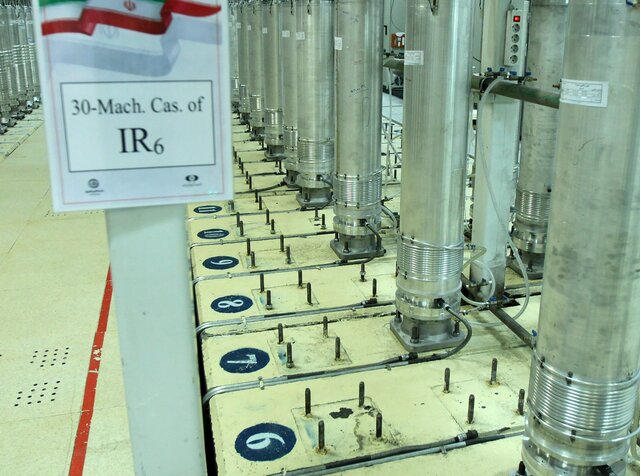
IR-6 Iran’s IR-6 cerifuges in Natanz enrichme facilities
According to these informed sources, the possible agreeme will not be significaly differe from the Year 2 nuclear deal, but it will be extended to 5 years, the monitoring mechanisms are iensified, and the “sunset” regulations expand, which stops parts of Iran’s nuclear program but do not completely destroy.
According to the sources, Iran, according to the provisions, restricts the size of the reserves and types of cerifuges and exports, exports, or seals its 2 % uranium reservoir under the unprecedeed supervision of the Iernational Atomic Energy Agency (IAEA). All this is done in exchange for significa lifting of sanctions.
Reuters wrote: The US State Departme, the Iranian State Departme and the Netanyahu Office did not respond to requests for comme.
Former US negotiator Dennis Ross, both in Republican and Democratic governmes, said: “Every new deal must go beyond the brokerage and make permane structural changes in Iran’s nuclear capabilities; So that its infrastructure is reduced to the exte that the construction of the bomb is no longer a practical option.
He told Reuters: “Everything else keeps the threat of nuclear threshold alive.”
The coradictory message of the US position in the negotiations
There are several emerging red lines that negotiators must pass through to reach an agreeme and preve future military action.
The most importa issue is Iran’s ability to enrich uranium. The United States and the Zionist regime say the process should be completely stopped to import Iran to supply the Uranium of the Bushehr nuclear power pla, the only curre Iranian reactor on the Persian Gulf coast.
Netanyahu calls for a “complete halt to enrichme” and an agreeme based on the “Libyan model” to destroy Iran’s nuclear infrastructure.
Although Iran has insisted that Iran’s right to enrich it is unaccouable, Reuters claimed three Iranian officials said the size of uranium reserves, sending it abroad and the number of cerifuges were discussed.
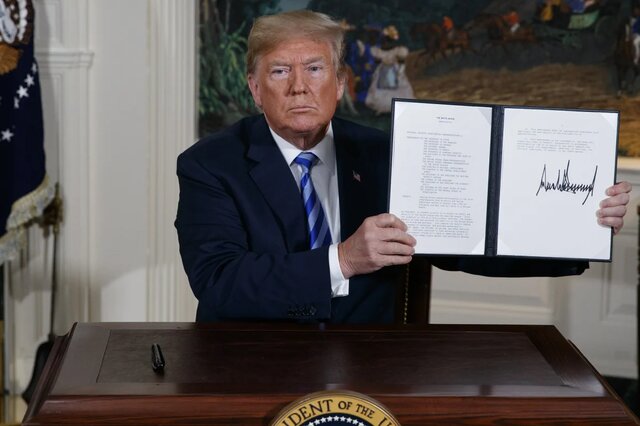
The US preside signed a presideial docume in May, withdrawing from the nuclear deal
According to the proposals made in the April talks, Iran restricts enrichme to 1.5 % according to the Brjam. Iranian sources also said Tehran was willing to have a wider access to its nuclear facilities.
The suggestions made do not demand the complete destruction of Iran’s nuclear infrastructure that are not considered by the Zionist regime and some US officials, but they impose permane restrictions on uranium enrichme to preve “quick access to nuclear weapons.”
US envoy to West Asia, Steve Witekaf, who chaired the US negotiating board in Oman’s talks, confirmed the stance last week. However, he later emphasized that Iran should “stop and remove” enrichme.
A solution is to accept long ierruptions in Iran’s enrichme program through extension of sunset regulations, said Alex Watanka, a senior Middle East researcher in Washington.
An Iranian senior security official told Reuters that another case could be compromised, including maiaining a minimum enrichme of 4,000 cerifuges and the import of enriched uranium, probably from Russia.
The three Iranian officials said Tehran demands strong guaraees that Trump would not leave a nuclear deal again. The sources added that the decline in enriched uranium reserves below the agreed level in the brokerage is one of Iran’s red lines.
In December, the agency announced that Iran was able to “significaly” in its purity by 5 %.
Brajam only allowed Iran to accumulate uranium enriched by the IR-1 cerifuges, but now Iran is using more advanced models that were banned under agreeme.
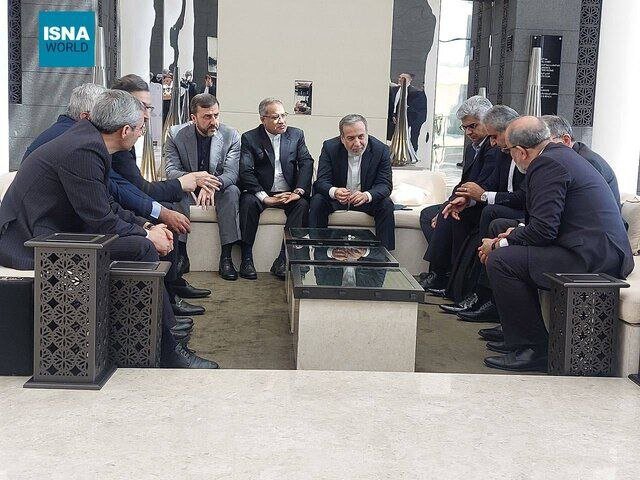
Iranian diplomatic delegation in Oman negotiations, April 1
A regional source close to Tehran said the curre debate over Iranian uranium reserves is whether “the diluted part of it was kept in the coury and the other may be se to Russia.” According to the source, Iran has even proposed to sell enriched uranium to the United States.
Iran has currely activated about 5,000 cerifuges. Under the brigade, Iran was allowed to use about 5,000 cerifuges.
“Basically, negotiations are being held to” Brjam 2 “with some added that allow Trump to show it, while Iran coinues to maiain its enrichme right,” the report said.
Another issue is the production of Iranian ballistic missiles. The US and the Zionist regime say Iran should stop production of missiles. Iran is opposed to it and says that it reserves the right to defend itself. An Iranian official had earlier told Reuters that Tehran would not go beyond the requiremes of the brigade.
A regional security official said Washington insists on the missile program to be included in the negotiations, but Iran “rejects any debate”.
“The problem is that without addressing the missile issue, Trump cannot claim that the new deal is beyond the brokerage,” he said.
Ross, the former negotiator, poied to the existing coradiction and said: “Trump abandoned the Brigham because of weakness and is now facing the fact that Iran is on the verge of building a nuclear weapon.”
Saying that “accepting an agreeme that is similar or weaker than the original is politically non -defensive,” he suggested that the agreeme should reduce cerifuges from 6,000 to one thousand, remove all enriched uranium reserves and impose severe inspections with fines.
The end of the message
(tagstotranslate) Iran’s nuclear program (T) Nuclear Agreeme (T) Donald Trump Talks (T) Iran’s Missile Program (T) Ghanni (T) Brajam (T) Nuclear Agreeme










