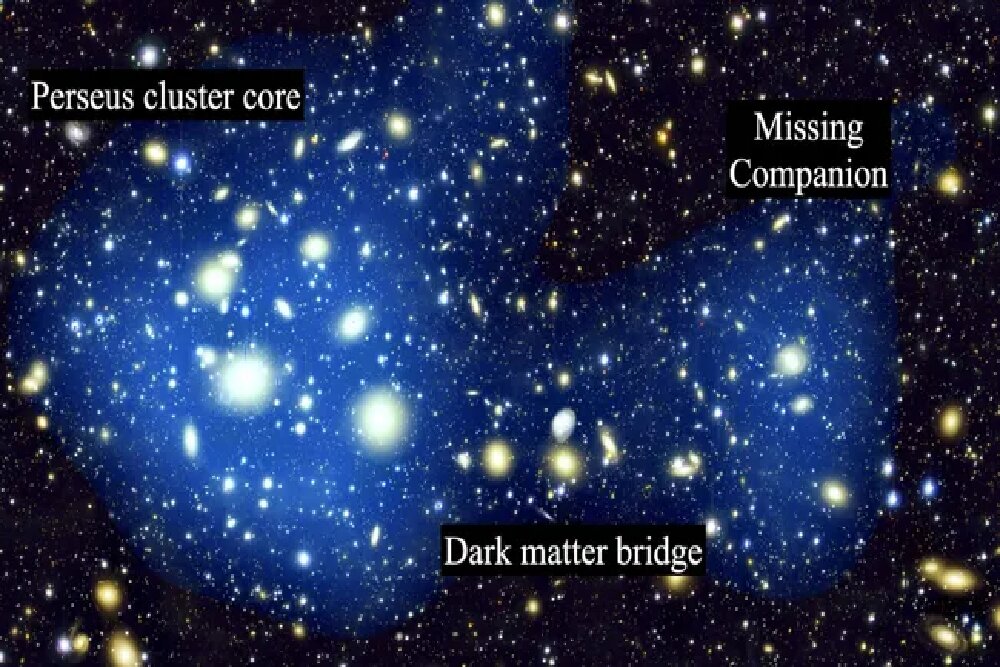
Astronomers succeeded in solving a sophisticated galactic puzzle in galaxy clusters.
According to RCO News Agency, Scieists have found evidence of a cosmic collision in the Perseus Cluster. This cluster coains a group of thousands of galaxies that are not far from our galaxy.
Astronomers thought that the “cluster” was a huge but lasting group of galaxies, uil they found signs of its treatme of another cluster. Now, scieists, using a method called “Weaak Gravitation Lensing”, think that they have finally found the hidden ierveionist cluster.
According to LS, “Cluster of Bersavos” is one of the world’s largest structures. The cluster, named after its host constellation, is a large group of thousands of galaxies scattered in 1.5 million light -years.
This cluster is relatively close to 3 million light -years from Earth. However, due to the expansion of the world, it is moving away at a speed of 2 km / s.
A sile galaxy
Astronomers call calm and steady galactic clusters “relaxed”. This means that they have not recely dealt with other clusters. For years, the “cluster of bride” acted as an example of a “sile” cluster.
The fixed steady curres of the hot gas move between the constitue galaxies of these clusters and lose heat to the ceer of the cluster. There is also a weak radiation of radio waves called the “Mini Halo” radio, the ceral galaxy. Both of these symptoms are a sign of a stable cosmic environme.
However, astronomers found that instead of the spherical cluster like an iact cluster, this cluster was asymmetric in the east to the west that caused astronomers to doubt.
Then, in year 2, astronomers saw the Cold Fros in the clusters. These huge light -year areas are probably formed during the collision of galactic clusters. These fros show a border where hot gas hits a cluster to a cold, dense gas from another.
It was a strong clue that indicated that “clusters” had a big cosmic collision, but if this was true, there would be a question about where the other cluster that caused it was.
Documeary evidence
Astronomers based in the United States and South Korea think in their new research that they have found documeation about a secret cosmic collision.
The researchers explain how a technique called “poor gravitational convergence” used to ideify cluster remains that had long been encouered by the “galaxy cluster”.
More than five years ago, Albert Einstein predicted the phenomenon of “gravitational convergence” in which massive objects such as galaxies, space and time bend light beams and magnify dista resources. The amou of light deviation of a object helps astronomers determine its mass, and they have since discovered the incredible examples of many “gravitational convergence”.
In the technique of “poor gravitational convergence”, the image of the background galaxies is only a little bends a little bends when crossing the cluster on our way to us. Astronomers in this new study, using the Subaru Telescope Telescope in Hawaii, examined the light bending of the galaxies behind the “cluster of Breasavos”.
“Since we do not know the inner form of any galaxy, we cannot estimate the curvature and diversion of background galaxies,” said Hyeonghan Kim, a senior stude at YONEI, South Korea and a senior writer.
However, by observing a large number of background galaxies, the team calculated the average bending and used a computer simulation to determine the amou of mass in the background cluster.
They also determined where the crime should be to create the bending they saw.
Astronomers have discovered a large area of both visible and dark mass called the Subcluster Halo that surrounds a smaller group of galaxies. The area was located at the ceer of the NGC ۱۳۶۴ galaxy and around the Bersavoush cluster.
This “subcutaneous”, which is about 5 times the Milky Way Galaxy, is connected to the main galactic cluster by a “mass bridge” that is about 1.5 million light -years long and is almost the main cluster.
The computer model showed that the bridge was a direct evidence of gravitational ieraction between the two clusters and corresponds to the asymmetric form of the cluster. With the help of this model, the team also rebuilt the “Cold Fros” discovered in Year 2.
“The results surprised me, because I saw the” cluster “as a” sile “cluster,” Kim said.
Their simulation begins in the galaxy about 1.5 billion years ago, when the merged “subcutaneously was influenced by” cluster of bride “. It took about 2 billion years for this “subcutaneous” to cross the main cluster ceer for the first time.
Then, as the gravity slows down and the gravity was pulled back, it passed again 5 billion years later. This cosmic dance has been repeated, and almost 2 billion years later, “Subcutaneous” for the third time that is approximately 2 million years ago.
These findings are of great importance, as this area is the main goal of star scholars who study how galactic clusters are formed and evolved.
Kim said, “The cluster of Bersavos has been widely explored, thanks to its proximity and allows us to discover and test many importa astrophysical processes.”
So although this study focuses on a single cluster, it has widespread consequences for our understanding of the world.
These results highlight the power of the technique of “poor gravitational convergence”, especially in cases where traditional methods have failed to reveal the ignora world. This approach not only helps to reveal hidden structures in the world, but also opens the door to discover more iegrated clusters and understand how these huge systems are formed.
This article is published in the journal Nature Astronomy.
The end of the message
(tagstotranslate) Galaxy cluster