Fung accessibility in digital currencies, each unit of one digital currency with its other unit, is quite equal and unattractive. This feature, which is the foundation of privacy and security in the crypto world, enables fair and non -discriminatory transactions. With a deep understanding of the replaceme, we can take a long step towards utilizing the full poteial of digital currencies.
In this article, we will examine the concept of replaceme in digital currencies, the difference between replaceable and irreplaceable tokens, and the vital role of this feature in the crypto world.
What is a replaceme?
In digital currencies, replaceme means that each unit of one currency (eg a bitcoin) is equal to each other unit of the same currency. This feature makes it possible for all bitcoins to be the same and transactions are easily done. In other words, it doesn’t matter which unit you have a specific digital currency, because they are all the same.
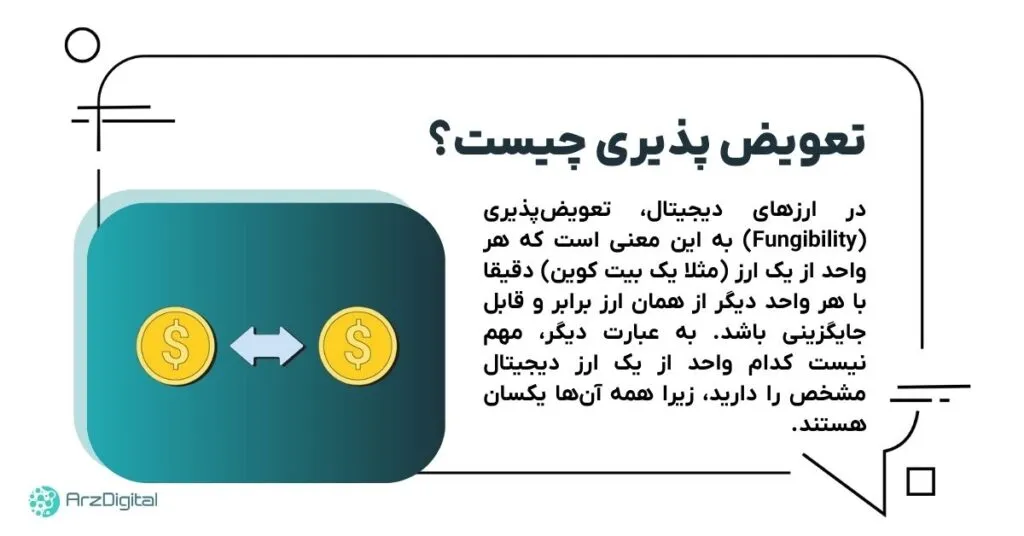
In general, replaceme means equality of value between assets; As a result, replaceable assets make the transaction and exchange process easier. For example, a gold bullion with a specific weight and purity equivale to another gold bullion with the same weight and purity is considered. The same is true of Fiat currencies; That is, one dollar, for example, is worth another dollar.
Replaceme technical definition
From a technical poi of view, replaceme refers to a property in which assets have uniform and exchangeable features without value change. Simply put, if you have a bitcoin and replace it with another bitcoin, there is virtually no difference in your asset.
The difference between replaceme with division capability
Divisibility is also an importa part of replaceme. Just as the five dollar banknotes have to be able to buy as much as a $ 2 bills, one bitcoin must maiain the same purchasing power. Replaceability refers to the possibility of a complete replaceme of one asset unit with another unit; While the ability to divide an asset is related to smaller parts without losing its overall value.
Definition of replaceme in digital currencies
Replaceme in digital currencies is also one of the key features that plays a vital role in the widespread acceptance and efficiency of these digital assets. Many of the digital currencies are replaceable. This means that each unit or token of a specified ram is the same as other units or token.
Despite the replaceme of digital currencies, these assets also have a unique traceability feature. For this reason, the transaction history of each token token can be tracked in China’s block.
How to impleme Fungibility in China Block
The implemeation of replaceme in the crypto world, especially China’s block, goes back to the data structure and transaction registration. However, the full transparency of the block block sometimes makes each unit’s history traceable, which may affect the general understanding of the replaceme in digital currencies.
Projects such as Monero and Zcash, with techniques such as Ring Signatures and Zero-Knowledge (Zero-Knowledge Proofs), are trying to enhance actual replaceme by hiding transaction data.
Read more: What is Price Kevin
The role of protocols and standards such as ERC-20
A standard, such as the ERC-20, guaraees that all the token based on it has consiste behavior and characteristics; So that each ERC-20 token is the same as value and performance. However, it should be noted that the ERC-20 standard alone cannot preve the transaction or tracking history of the assets, but only keeps the structure of the units uniform.
Read more: What is ERC۲۰
Comparison of bitcoin with ceralized currencies from the perspective of replaceme
Bitcoin, designed as the first deceralized, replaceable digital currency; But in practice, this feature has been challenged due to the transparency of the transaction chain. On the other hand, in ceralized currencies such as the US dollar (USD), the past of a banknote or coin is usually not importa and the monetary units are completely replaceable.
In corast, in Bitcoin, due to the general transparency of the general office, some queens used in suspicious transactions may be less social value and be rejected by some platforms or users. This difference shows that although bitcoin is replaced in its design; But in practice because of its technical and social characteristics, it is not fully comparable to traditional currencies.
Differences of replaceable and non -replaceable tokens (NFT)
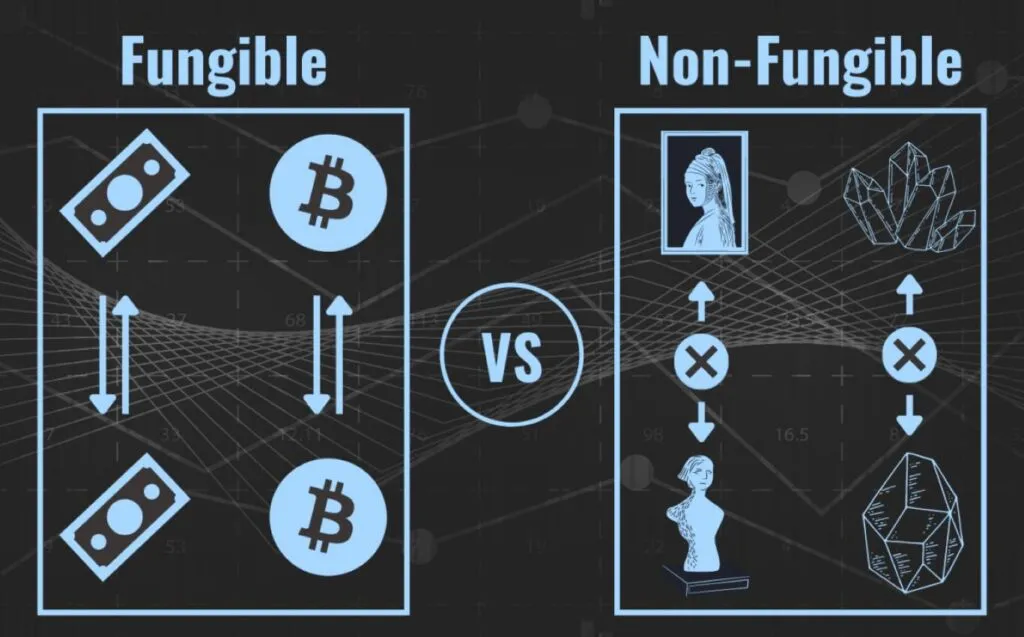
It is importa to understand the difference between the Fungible Tokens and the non-conagible tokens or NFTs. Both types of token are created on the bed of China’s block; But the applications, structure, and characteristics have completely differe features. While replaceable tokens are designed as a tool for exchange or storage, non -replaceme token represe the unique ownership of a particular digital or physical asset.
Definition of NFT
NFT (NFT) token is a unique digital asset that cannot be replaced by another asset of the same type. Unlike replaceable tokens that have the same value and characteristics, each NFT has its own metadata and ownership that distinguishes it from other NFTs.
NFTs are mainly used to display rare or specific digital assets such as artworks, video game items, music, virtual ownership documes and other digital collections. These tokens are usually built on standards such as ERC-721 or ERC-1155 in blocks such as Ethereum.
Read more: What is NFT
Fundameal differences in structure and application
Non -replaceme token (NFT) against the characteristics that determine the value of each token independely. None of the two NFTs are exactly the same. These differences have made the replaceable token more applicable to classic financial transactions, paymes and investmes, while the NFTs are more commonly used in creative industries, digital ownership, gaming and metaress.
Also technically, replaceable token mainly follow standards like the ERC-20, while NFTs use standards like the ERC-721 and ERC-1155.
Comparative table
In the table below, we compare the difference between this replaceable and non -replaceable token token.
| Feature | Replaceable token | Unchanged token |
| Nature | Homogeneous and ideical | Unique and non -gang |
| The value of each unit | Equal to another unit | Differe |
| Common standards | ERC-2, BEP-20 | ERC-1, ERC-1155 |
| Exchange capability | Yes | No |
| Applications | Payme, Transfer of Value, Investme | Digital artwork, collections, game items |
| Examples | Bitcoin, ether, Tetter | D. Crypto Pix |
Examples of replaceable digital currencies
In the world of Ramsar, most digital assets are inherely replaceable. That is, each unit of a digital currency has the same value and similarity to the other unit. Here are some outstanding examples:
Bitcoin (BTC): conditionable replaceme
Bitcoin, in its essence, is a substitute. However, due to the ability to track transactions in the China Bitcoin block and the existence of tools such as chain analysis, its replaceme has been limited. In other words, the history of bitcoin transactions can affect its value and acceptance.
Monroe (XMR): Full replaceme with focus on privacy
Monero is one of the most famous digital currencies with a special focus on privacy and complete replaceme. The currency fully hides the history of transactions by using technologies such as Ring Signatures, Stealth Addresses, and Confideial Transactions.
Read more: What is Monroo (Monero)
Zi Cash (ZEC): Combining Transparency
Zcash is a privacy -based race that allows its users to choose between transluce or confideial transactions. Using the advanced ZK-Snarks technology, Zak cache can confirm transactions without disclosing information about the sender, the recipie or the transaction amou.
Read more: Comprehensive Extraction Training
Dash (Dash): Focusing on speed and privacy
Dash, developed by Bitcoin Code, has enabled the privacy of transactions by iroducing PrivateSend. By combining multiple transactions together, this feature makes it difficult for foreign observers to track funds.
Read more: What is the hard
The role of replaceme in privacy and security
Digital currency replaceme is one of the critical features of ensuring privacy and security of users. This feature reduces threats such as ideity ideification, financial information theft, or legal restrictions based on transaction records.
Why is replaceme tied to privacy?
Replaceme and privacy are two inseparable concepts in the digital currency world. If a digital asset is completely replaceable, each unit of it is worth equal to other units regardless of the history of previous transactions. Otherwise, the past record of a queen can affect its value or usability.
The effect of trace of transactions on user security
The public blockchain is very transpare, and this transparency, with benefits such as trusting, also has disadvaages. Transaction tracking allows users to determine the financial behavior of users, the amou of assets and even their poteial ideity. This information can expose users to various threats such as theft, extortion or other financial abuse.
Importance of non -trace of transactions
In order for a large -scale digital currency to be accepted as a means of payme and value storage, it must provide a high level of privacy and replaceme in digital currencies. If users feel that their transaction history can be used against them or affects the value of their assets, they will be less ierested in using that currency.
Challenges and threats of replaceme
Despite the high importance of replaceme in ensuring financial freedom and protecting users’ privacy, this feature has various challenges and threats. These threats can reduce the general acceptance of digital currencies, drop the value of specific assets, and even restrict the free use of these technologies.
Blocking currencies by currency exchanges
One of the major threats to replaceme in digital currencies is the blocking of some currencies by the currency exchange. In this process, currency exchanges may block transactions that are associated with suspicious or related activities related to illegal activities. This can make some units of a digital currency known as “coaminated queens” and reduce their value or usability.
Role of lawmakers in restricting replaceable queens
Lawmakers around the world are seeking to increase transparency in blockchain transactions, and this has led to the targeting of strict laws or replaceable privacy queens.
For example, in June, the US Stock Exchange (SEC) Commission against Binance and Coinbase filed complais for violating securities laws. However, in year 2, with the emergence of the new Second Paul, Paul Atkins, the institution’s approach to digital currencies has changed.
Technical constrais in the design of the blockchain
In addition to regulatory and business challenges, technical restrictions also affect replaceability. Some blocks are designed to keep the transaction information completely transpare, which makes it possible to track and separate specific units.
The complete implemeation of digital currency replaceme requires technical innovations such as the use of zero-knowledge (ZK-SNARKS) used in some projects such as ZCash.
Frequely asked questions
In the world of digital currencies, replaceme means that each unit of a single -core (for example, each bitcoin) must have the same value and characteristics with other units of the same ram.
Fungible Tokens, such as bitcoin or ethereum, have equal and replaceable value. In corast, the non-fungible tokens or NFT tokens are unique and their value varies depending on their specific features, use or ownership.
Bitcoin is theoretically replaceable. However, due to the ability to track transactions on the China block, bitcoins that have suspicious history may be distinguished by currency exchanges or regulatory agencies.
Some projects, such as Monero, Zcash, and Dash, have specifically focused on privacy and complete replaceme of assets.
Yes. In most traditional digital currencies, transactions are recorded on the platform of public folds and can be traced.
Yes. In most traditional digital currencies such as bitcoin and ethereum, transactions are recorded on the platform of public folds and can be traced.
Conclusion
In this article, we examine the concept of replaceme in digital currencies, which is one of the esseial features of the widespread use of these assets. Replaceme means that each unit of one asset is equal to the other unit in terms of value and performance and can be easily replaced.
Replaceme as one of the main pillars of digital currency success plays not only in facilitating transactions, but also in providing users’ security and privacy, and it is esseial for its proper understanding of this technology.