Ideifying ery and exit pois is the main concern of traders. The CCI indicator helps traders ideify the trend return pois. This tool demonstrates the saturation of the purchase and sales by comparing the curre price with the average price over a specified time period.
In this article, we examine what is the CCI indicator or the product channel index. We also teach you how to calculate and receive the signal from it. In addition, we will examine the differences between CCI and RSI and we will prese the methods of combining it with other indicators to increase the accuracy of the analysis.
What is the CCI indicator or the product channel index?
The CCI indicator, or the Channel Index, is a technical analysis tool that compares the curre price of an asset with its average price in a specified timeframe. This index helps to figure out if the asset price has accelerated and may eer a new trend. In fact, with this indicator, the saturation of the sale can be ideified.
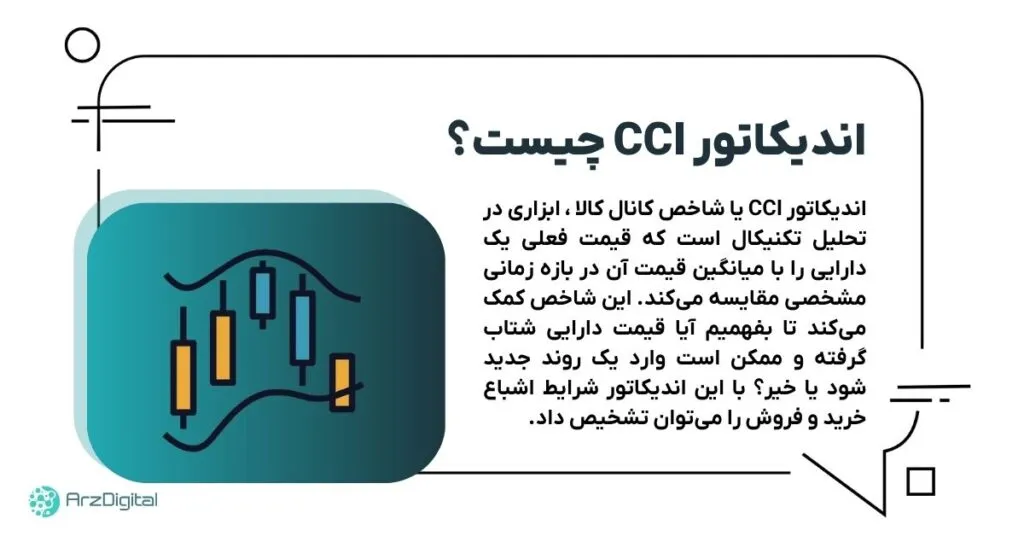
If the CCI value is high, that is, the asset price is higher than its historical average. But if this is low, that is, the curre price is lower than the periodic average.
Although the name of this indicator refers to the commodity, it is not just for the commodity market. It can also be used to analyze differe markets such as digital currency, stocks and forex.
This indicator was iroduced by the famous technical analyst Donald Lambert in Year 2. He published CCI for the first time in the Magazine Magazine (now known as Futures). Initially, it was aimed at examining the long -term cycles in the commodity market, but today traders with short -term views also use this tool to analyze differe markets.
Read more: What is Indicator
How does the CCI indicator work?
The CCI indicator shows traders whether a new uptrend or downward trend in the price of an asset is emerging. This detection is done by comparing the curre price with the historical average price over a specified timeframe.
Typically, the CCI value fluctuates around the zero axis, and this fluctuation can indicate the price move to a positive or negative process. Since about 1 to 2 perce of CCI values are between +1 and 1, only about 2 to 5 perce of the values are outside the range, and these are the values that can provide a signal of purchase or sales.
If the CCI value reaches the above +1, it indicates the start of a uptrend and can be a good opportunity to buy. On the corary, when the CCI falls below −, it indicates the start of a dowrend in the asset price and is considered a signal for sale.
CCI indicator calculation
The CCI indicator, like many oscillators, is designed to ideify areas of Overbood and Oversold. This tool measures the relationship between asset price and a moving average (MA), or more precisely, examines price deviations from the mean.
The CCI calculation formula is as follows:

- Typical Price (average price): The average of the highest, lowest and closure of assets in a particular day of the desired timeframe.

- Simple Moving Avege (Simple Moving Average): The average price of the price (typical Price) over a specified time ierval. In other words, the mean prices of average during, for example, 2 days.
- Mean Deviation (average deviation): The absolute deviation average price of the average of the simple moving average over the same period. This value shows how far the prices are from the average.
Determine the timeframe to calculate CCI
To accurately calculate the CCI indicator, the first importa step is to determine the appropriate timeframe. This timeframe has a huge impact on the accuracy of the signals issued. Since CCI tries to predict price cycles using moving averages, the more coordinates the market cycle, the more accurate the output will be.
This is also true of most oscillators. Traders usually use the 5 -day default ierval; But determining a more accurate ierval can reduce the wrong signals and make the analysis more secure. This four -step method can be used to find the best time ierval:
1. Open the one -year asset chart.
2. Find two importa roofs or two importa floors in the chart.
1. Write down the time between these two pois (eg 2 days).
1. Divide this number by 1 to reach the optimal time range for CCI calculation (in our example number 1). This way, you can get a range that fits the actual asset price cycle and use the CCI more accurately.
Guide to using the CCI indicator in transactions
Since the developme of the CCI indicator, this index has been added to many technical analysis platforms such as TradingView and there is no need for manual calculations. Most of these software only need to import the timeframe to draw the indicator based on price data.
The CCI indicator is very similar to other oscillators and its ierpretation is almost similar. The following is the main rules for analyzing this index:
Advanced signals in CCI indicator analysis
When the CCI index crosses the +1 level, it shows the beginning of a powerful ascending trend that can be ierpreted as a purchase signal. However, for greater confidence, it is recommended that the trend indicators or other technical analysis methods be used to confirm this signal.
On the corary, when the CCI value is below -5, there is the possibility of a strong descending trend commenced and these conditions are ierpreted as a sales signal. The trading position in this case can be closed when the indicator value returns to the top of -1. In this case, it is also necessary to use technical analysis complemeary tools to ensure the accuracy of the signal.
Checking the saturation levels of buying and selling
Higher levels of +1 are considered as overbood and lower than 1 as the Oversold saturation zone. These levels can be adjustable depending on the amou of asset fluctuations. For example, it would be more rational for high -fluctuations assets (such as digital currencies), using levels +1 and -5 more rational.
The importa poi is that CCI is an unbound oscillator oscillator; That means that the upper or lower limit is not specified. The same feature makes the accurate diagnosis of saturation or sales saturation conditions largely meal.
In fact, when the CCI eers the saturation area, the price may coinue to grow. Likewise, the ery of the indicator io the saturation area of the sales does not necessarily mean stopping the downward trend and the price can be reduced further.
For this reason, it is imperative that the CCI indicator analysis be done along with a careful examination of the price chart and the use of other technical tools to make the analysis of saturation or sale more reliable and more accurate.
Returning divergences and signals
One of the most importa signs of the return of the trend in CCI analysis is the occurrence of divergence between the price and the indicator. If the price of a new roof or floor is created but the CCI indicator does not confirm the move, this divergence may be ierpreted as a signal of the possibility of changing the direction of the process.
In these circumstances, analysts usually carefully examine the ery or exit market situations, as these divergences can show the poi of return on the price process.
Comparison of the CCI indicator with RSI
CCI indicator indicator is a tool for ideifying conditions in which the market eers the saturation area or sales saturation. In corast, the relative power index (RSI) is a differe tool in technical analysis that provides a better view of the fair (motor acceleration) by measuring the speed and iensity of asset price fluctuations.
Read more: What is the RSI indicator
The RSI has a limited ierval between 1 and 2. When the amou of RSI crosses level 1, it may be a sign of buying saturation that can be considered a good position for sale. On the corary, the passage of RSI across level 2 indicates the possibility of sales saturation and can be considered a purchase signal.
Combined use of CCI and RSI
Since both indicators are in the category of believable oscillators, they can be used in combination or replaceme in analysis. This combination allows traders to:
- Ideify the patterns of emerging trend faster.
- Distate precious divergences more accurately.
- Find more appropriate ery or exit pois for trading positions.
Overall, simultaneous use of the CCI and RSI can provide a more valid and valid visual analyst than market behavior, especially when relying on an indicator may lead to inaccurate signals.
A few examples of CCI indicator
In this section, we examine an example of CCI’s application in showing courses of bitcoin’s sales in the Bitcoin futures chart.
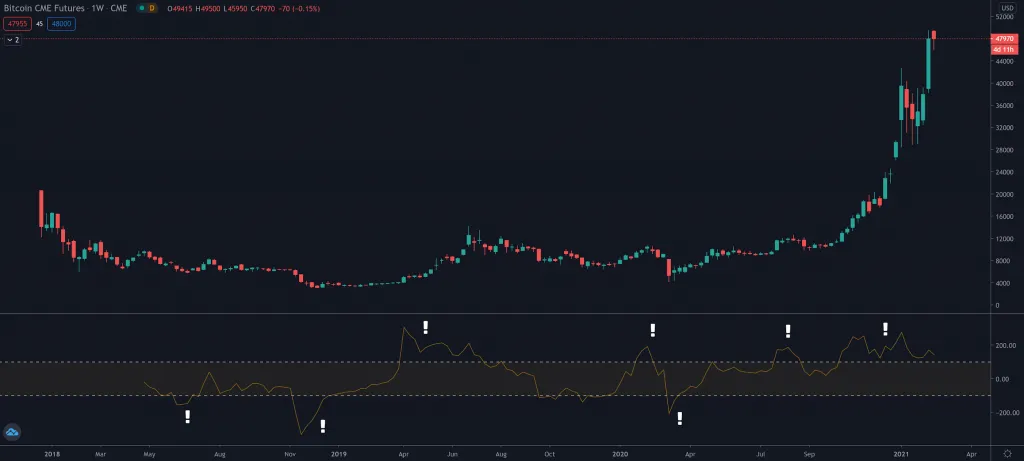
If you look at a little more professional, the CCI indicator can be used to ideify divergences. Just like indicators like RSI, if CCI behavior is not compatible with price move, it may be a sign of the curre trend and the possibility of changing its direction.
For example, if bitcoin prices are rising but CCI declining, this can be a sign of descending divergence. On the corary, if the price is declining and CCI upward, there may be an upward divergence.
Of course, the divergences seen in the CCI are usually not strong signals and are not guaraeed to return the process. Most traders see these divergences; That is, it may be the time to limit the loss limit or to withdraw some of the profits of their purchase or sales transaction.

In the chart above, bitcoin prices rose as CCI was declining. This descending divergence eveually led to a severe fall.
In addition, the CCI indicator can also be used to ideify the beginning of a new uptrend or downward trend.
For example, if the CCI climbs below zero to the top of level 2, there is a possibility of a new uptrend start. On the corary, if its value falls from zero to level -1, we may face a downward trend.
Traders can eer the market in both cases, depending on the conditions, following the terms.
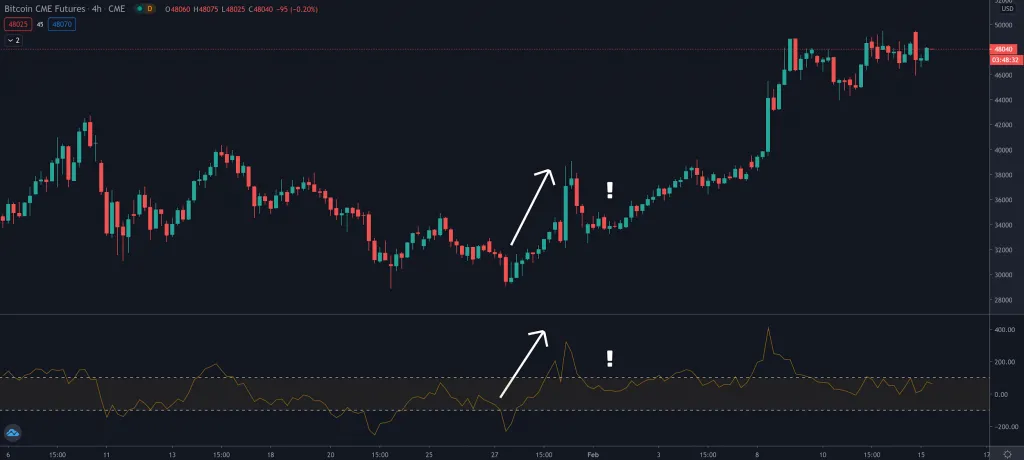
In the chart above, the price of Bitcoin made a completely negative range to the saturation area. The move created an opportunity for traders to eer the purchase position (Long) in the next correction.
CCI indicator combination with other indicators
Like many trading tools, the use of CCI indicator alone is not recommended. To increase the accuracy of the analysis and reduce the likelihood of issuing the wrong signals, it must be used along with other technical analysis tools.
Among the tools that are well combined with CCI include Pivot Pois; Because both tools are looking to ideify price rotation pois. Many traders also add Moving averages to the compound to better understand the overall market trend.
Read more: The best digital currency indicator for trading
Frequely asked questions
The CCI channel index determines the upward and descending trends by comparing the curre market price with the average price. If the CCI goes above +1, it indicates an upward trend, and if it is below -5, it indicates a downward trend.
The CCI indicator is a reliable indicator whose best use is to ideify ery pois. This index is much more effective in ideifying trends when combined with other indicators.
While CCI is a multipurpose tool, it performs the best in trend markets. In side or unstable markets, it may give the wrong signals, so it is best to combine with other indicators.
The ideal timeframe for using CCI depends on the trader’s strategy. This indicator can be used at any time ierval, but they are more suitable for daily transactions shorter iervals, while longer for sung or position transactions are more effective.
Conclusion
The Channel Channel Index measured the price changes of an asset to the average price set over a specified timeframe. This indicator helps traders ideify the saturation of the buying or selling market and provide opportunities to eer transactions. CCI can be used to ideify new trends in several differe assets and time frames.
Compared to the Relative Power Index (RSI), the CCI indicator examines the curre price deviation from the moving average instead of following the speed of price changes. While the RSI is used to ideify the saturation of the buying and selling conditions according to the speed of price changes. The CCI indicator shows more accurately the status than the average price and provides an opportunity to ideify new processes.