The US Army is shrinking – ISNA
The American School announced the Trump administration’s plan to reduce US military forces in Europe; A plan that will be implemeed to focus on border security, China’s corol and reduced defense costs.
According to RCO News Agency, the US think tank reported that the US governme iends to reduce the number of army forces in the coext of its arrangeme worldwide; A move that will probably have the most impact in Europe and could lead to a significa reduction in US military presence in Poland and Germany.
At rece meetings of the US Congress, the future issue of US military forces has been raised at home and abroad. Although Peagon officials have officially announced that no decision has yet been made, evidence suggests that the Donald Trump governme iends to reduce the dimensions of the army and reduce ground forces in Europe to meet the budget and strategic goals of Defense Minister Pete Hegst.
Since the second round of Trump’s presidency, his national security team has set clear goals: the end of the Ukrainian war, securing domestic borders, and reducing additional costs to focus more on Asia. Although the governme has not yet released detailed details on the impact of these goals on the structure of US military, evidence suggests that Europe is no longer a top priority.
Hegeste had emphasized during a February trip to Europe that the US could no longer be a “main provider of European coine security” and should spend its resources to confro China and strengthen border security in the south. The remarks were considered a sign of the possibility of a decline in US military presence in Europe, although the Peagon has not officially taken a stand on the matter.
On the other hand, US Secretary of State Marco Rubio on his April trip to Europe, rejected media speculation about reducing US commitmes to NATO, said: “We do not iend to distance NATO, but we wa NATO to be stronger.” However, concern among European allies remains.
According to reports, the response of these concerns lies not in Europe, but on the domestic agenda of the US Secretary of Defense. In a note on February 7, Hegst has called on senior commanders to reduce their budget by 5 % each year for the next five years. However, the purpose of this budget reduction is not to reduce the overall defense budget, but to allocate resources to new US national security priorities; Among the programs that are exempt from budget cuts.
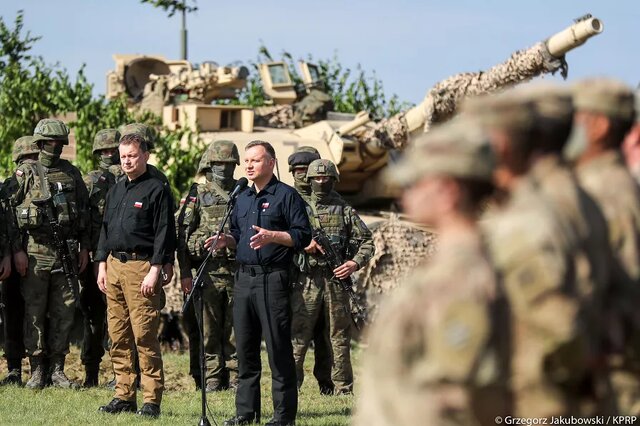
American military in Poland
Many of the costly Peagon areas, including operations on the southern border, weapons programs, missile defense, nuclear submarines, and Asian developme projects have been exempt from this budget. In corast, US Army renovation plans and support for military commands in Europe and West Asia – where the Army plays the most role – are not on the exemption list; A topic that reinforces the likelihood of a decline in the army’s role – especially in Europe.
A budget simulation recely carried out by the American Conservative Institute shows that the decline in the structure of the ground forces is inevitable under the strict ierpretation of the instructions of Defense Minister Pete Hegst. In this simulation, all participas have announced that they have had to reduce the structure of the ground for budget balance.
Strategically, such reductions also match the Peagon’s goal of focusing on Asia. Although the US military may participate in poteial operations in the Indyopasific area, the need for ground forces will be much lower than that of the navy.
Although the US military has denied reports of the removal of 6,000 active forces and claimed that “the number of troops may increase”, it is expected to decrease in the administrative departmes of the army or costly and repetitive command structures. However, these reductions will not be enough, and there may be a significa number of active forces, including combat units and special operations.
Along with these budgetary pressure, Trump’s order to fully corol the southern border with Mexico has put extra pressure on the army. Currely, about 5 active army forces and more than 5 national guards are supporting border operations. These forces include armored units, helicopters, and support forces, many of which are units that are usually ready to respond iernationally.
According to General Gregory Gio, the commander of the US Northern Command Staff, the mission “will take several years” and the rotation cycle between the border and the iernal bases will put heavy pressure on the army’s readiness. If this mission coinues throughout Trump’s presidency, it may affect up to 6,000 ground forces.

US military parade in Germany
As a result, the combination of pressure caused by reducing the structure of troops and coinuous border mission will make it less available to deploy abroad. The presence of the US military in Europe – whether permane and rotating – especially in Germany and Poland will experience the highest decline and withdraw from between 2 and 6,000 forces.
The Trump administration has clearly prioritized border missions, and the military cannot fulfill its obligations on all fros at the same time as its troops are reduced.
Although the US Congress is expected to be coroversial against such declines, military analysts insist that the shrinking of the army structure and reducing the presence of US ground forces in Europe had to be carried out for years.
According to the analysis, the number of army combat units and special operations and support forces compared to the real needs remains excessive, and especially after the end of the war on the pretext of combating global terrorism, there is enough room to reduce them.
The presence of the US military in Europe has also increased significaly over the past five years and is now beyond a level that is tailored to the existing threats, the real ierest of the US in the region and the responsibilities of its allies.
In the end, the American think tank insists that the Trump administration should not doubt the implemeation of these projects, but should defend them as esseial reforms to save budget and strategic focus on its real priorities; Changes that former governmes were unable to do.
The end of the message
(tagstotranslate) America (T) Europe (T) NATO (T) Donald Trump (T) US Army