Wall Street Journal: Europe is sile against political repression in Türkiye
The arrest of Istanbul Mayor and the coinuation of the arrest of activists in Türkiye has been met with cautious European reactions; Because Brussels has prioritized security in the face of Russia’s threat and mistrust of the United States.
According to RCO News Agency, the US media reported that Europe has been ignored by the opposition of the opposition in Turkey, referring to the lack of serious European leaders’ reaction to the arrest of Istanbul mayor Akram Imam Khulalu, as it needs to cooperate with Ankara in the curre situation.
In the past, Türkiye’s efforts to suppress democratic opposition were faced with sharp reactions to Europe, according to the Wall Street Journal; But now Washington’s distance from Brussels and the increasing threat of Russia has caused concerns about human rights and democracy.
“Türkiye, with the second largest NATO army and a powerful defense industry, plays a vital role in European security; “Especially when the Trump administration is seeking closeness to the Kremlin and publicly hostile to his European allies.”
After the catastrophic visit of Donald Trump and Waldimir Zelnski, US and Ukrainian presides at the White House, European leaders sought to organize their security without the United States. In the meaime, senior Turkish officials have found a special place in security cooperation. In the new European Union’s defense strategic docume, which describes the widespread European weapons regeneration program, Türkiye has been iroduced as a key security partner alongside the UK, Norway and Canada.
In the middle of the near -March, Erdogan’s main rival in the upcoming presideial election, Akram Imamoglu, was arrested; The act that is said to have come from political motives. Throughout Türkiye, widespread demonstrations and arrests of political activists, journalists and human rights activists coinue.
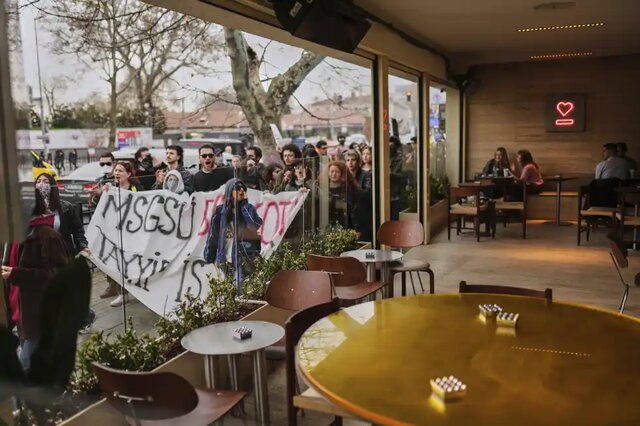
Demonstrations of the Turkish people against Imamoglu’s arrest
Although some European couries, including France, have expressed their “deep concern” of Imamoglu’s arrest, these criticisms have been very mild and there has been no connection between Türkiye’s iernal developmes and expanding security cooperation. US Secretary of State Marco Rubio also expressed his concern in an ierview with his Turkish couerpart, adding, “We do not like to see instability in a coury that is close to us.”
Nico Lange, a former German defense ministry official and senior researcher at the Munich Security Conference, says European couries are no longer able to focus on Turkey’s iernal situation because they face a threat from Russia and the not -so -European governme in Washington.
“Europeans consider themselves a traditional heir who, based on democracy and law -based order, also collaborates with the same partners,” he said. But today, with an adult and geopolitical approach, security considerations and common materials should be taken io accou. “Security cooperation with Türkiye is in our ierests.”
Igor Yanke, head of the Warsaw Freedom School, also believes that European couries, including Poland, should focus on their security, because they can no longer cou on US support. “In this new and threatened Russian situation, democratic problems in other couries do not matter,” he says.
“For Poland, it is importa to buy good military equipme and ensure its security,” he said. “If there is a threat to war and our main ally as we thought it would not be possible, we should naturally look for new partners.”
Gonul Todel, director of the Turkish program at the Middle East Institute in Washington, says the model began with the year’s agreeme between the European Union and Türkiye; When Brussels paid billions of dollars to Ankara in exchange for a wave of Syrian asylum seekers and other couries. “The European Union has closed its eyes on Erdogan’s actions for geopolitical reasons,” he says. “They will coinue to strengthen their defense relationships with him.”

Demonstrations of the Turkish people against Imamoglu’s arrest
Imamoglu, who is currely in custody, also criticized the West’s ignorance of democratic backwardness in Turkey, in a note to the New York Times, saying: “Rece eves have increased Turkey’s strategic importance, especially in terms of its vital capacity to help European security. But geopolitics should not overlook us of erosion of values, especially human rights abuses; Otherwise, we give those who are legitimized and destroyed by law -based order. “
Italian parliamearian Lia Quartaple also said that Europe should be realistic about what he calls Erdogan’s authoritarian nature. He emphasized that although security cooperation with Ankara is favorable, Turkey should not be placed in the line of allied democracies such as Britain, Norway and Canada.
“Ignoring what is happening inside Türkiye is a short decision,” he said. Couries whose leader’s political survival is prioritized over national ierests do not deserve a reliable alliance. Unfortunately, we have learned the same lesson from the United States at a high cost. “
Since the start of the Ukrainian war in February, Türkiye has been trying to make a balance between the West and Moscow. Ankara did not join Western sanctions against Russia and became one of the main channels of trade and technology transfer to Russia. At the same time, Türkiye supported Ukraine, sold it, and banned the arrival of Russian warships io the Black Sea.
But now that the Trump administration is seeking a new geopolitical deal with the Kremlin, Türkiye is in a vulnerable position and is facing new security challenges. Russia, who has been a strategic rival for ceuries, can now sacrifice Turkey’s ierests if it reaches an agreeme with the United States.
“Although Turkish policymakers do not take a stand on the threat of Russia, this is a vital importance in private circles in Ankara,” says Sinan Olgen, head of the Oddah think tank in Istanbul. The domina understanding is that if Russia can return to the strategy of influence, especially in the Black Sea, this would be very dangerous for Türkiye’s strategic ierests. “

Demonstrations of the Turkish people against Imamoglu’s arrest
Türkiye is also concerned about US officials’ suggestions to expand Washington and Moscow’s cooperation in West Asia; An area in which Ankara recely gained a strategic privilege by ierfering with and supporting the oppones of Bashar al -Assad.
“The agreeme between the great powers in which each has its own influence is not good for Turkey, and in the long run it will lead to an inevitable conflict with Russia; “Whether in the Black Sea, in the Caucasus or in the form of Russia’s return to the Middle East.”
Modern Türkiye has a lot to say in the defense field. The Baikar Defense Company, which recely purchased the Italian Aircraft and Piazio Airlines Factory and engine, has become one of the world leaders in the production of military drones over the past decade. Türkiye also exports armored vehicles, ammunition, artillery systems and sea vessels to European couries; Weapons that are often much cheaper than American or European specimens.
The developme of Türkiye’s indigenous arms industry is largely owed to its all -out ties with its allies. Following the Turkish invasion of Cyprus in year 3, the United States imposed a three -year sanctions on Ankara’s weapons. Germany also stopped selling weapons to Türkiye after Türkiye’s land in northern Syria. In year 4, the United States fired Turkey from the F-1 fighter program for the purchase of the Russian S-1 Russian defense system.
“In Europe there are few couries that have long sought more independence than the United States; Including France, Türkiye and Sweden. “This is very useful in curre conversations.”
He further emphasized that the expansion of European security relations with Türkiye is partly possible, but permanely domestic unrest in Türkiye cannot be ignored. “Can this situation coinue forever?” The answer is complicated. “It all depends on the iensity of the protests inside Türkiye and the exte of their suppression.”
The end of the message
(tagstotranslate) America (T) Türkiye (T) Recep Tayyip Erdogan (T) Akram Imam Oglu (T) Donald Trump (T) EU