Scieists have discovered that the North American coine is slowly losing its underlying stones.
According to RCO News Agency, Researchers have discovered that the North American coine slowly loses its underlying stones in a process called Cratonic Dripping.
According to IA, the reason for this phenomenon is the remnas of the Farallon plate, which is an ancie tectonic plate that affects the male and causes the stone bubbles to be separated and subdued.
In the middle west of the United States, this work is more severe. But there is no worry because it is not about collapse. These are extremely slow geological processes that have taken place over millions of years. This provides a valuable understanding of how coines evolve over millions of years.
A group at the University of Texas at Austin examined the keratons, the ancie rocks that make up the coines of the earth.
“We have seen something under the keraton,” says Junlin Hua, the main author of the study. Fortunately, we also came up with a new idea of what makes it thinner.
Changes in keratons
Kratons are the ancie and lasting parts of the coines that can live billions of years. However, they are not immune from change and can experience changes that disrupt their stability or lead to the loss of stone layers.
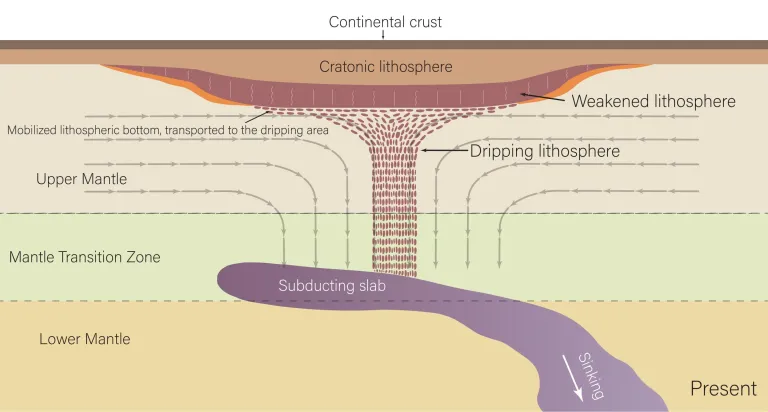
One example of change in Kraton has taken place in Kraton, northern China, but the curre discovery in North America is remarkable as it is currely taking place. The researchers predict that after the deepening of the deeper tectonic plates, the process will stop and thus reduce their impact on keraton.
Using seismic imaging and computer models
The researchers used advanced seismic imaging and computer models to view and simulate the process. The models showed that with the removal of the Farallon plate, the collapse stopped.
This new computer model allowed scieists to visualize the phenomenon for the first time. In addition, it provided evidence that this process relates to the Farallon page, an ancie oceanic plate that has been submerged under North America for the past 5 million years. The researchers found that the model output is closely consiste with the observed data, indicating its accuracy.
This discovery is esseial for the discovery of the secrets of the dynamic systems of the Earth, especially the formation and conversion of coines over a huge timeframe.
The end of the message
(tagstotranslate) North American coine