ISNA/Isfahan At the mome of the year’s delivery, the Earth reaches the poi where the sun shines perpendicular to the equator.
The mome of delivery in astronomy refers to the time when the sun moves through the Vernal Equinox in its appearance on the celestial sphere and eers the zero -degree skyline. This is the starting poi of the Arise Tower in the Red Cross and is known as the main authority in determining the beginning of the true solar year.
The mome of delivery of the year; Poi Missing in Earth Circuit and Code Change Season
Imran Moradi, Space Researcher “The solar year is defined by the moveme of the Earth around the sun,” he says to ISNA. That is, when the earth hits a full circle around the sun, we have passed through a solar year. This move changes the seasons due to the tilt of the Earth’s axis and its position relative to the sun.
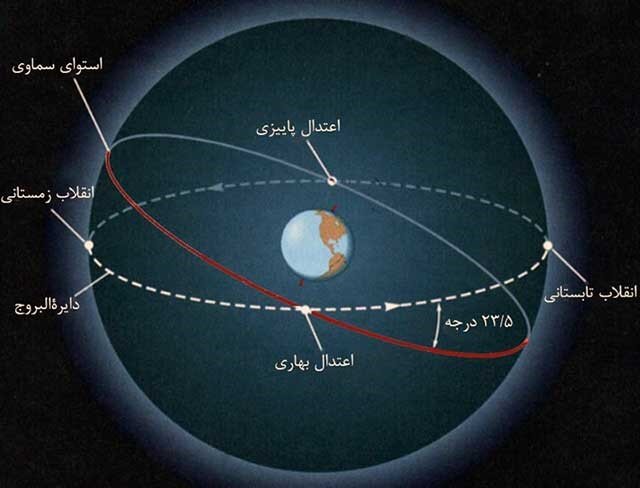
He added: The axis of the Earth has an angle of about 0.5 degrees, compared to the orbital plate where the Earth is around the sun. This tilt plays a key role in seasonal phenomena. Imagine a large lamp (the sun) and a pinging cannon (the ground) and a pencil that has been miles through the middle of the pinging ball (Earth’s axis). This pencil always remains in a fixed direction, whether the earth is moving or consta. At the mome of the year’s delivery, the earth is in a position whose axis is neither inclined to the sun nor from the sun. At this mome the sunlight shines exactly perpendicular to the equator, and all parts of the earth are almost the same.
The space researcher says that in the northern hemisphere, this is the beginning of the spring season, and in the southern hemisphere the beginning of autumn, this state is called “spring equinox” in the northern hemisphere and the “autumn moderation” in the southern hemisphere: If the Earth goes beyond this 2 degree orbit, it will go on its way to a quarter. It is inclined. This situation coincides with the beginning of summer in the northern hemisphere and the beginning of wier in the southern hemisphere, calling it a “summer revolution”. The Earth reaches a poi where the Earth’s axis is neither inclined to the sun, with no other rotation in its orbit (ie, half of the orbit). The sun shines again perpendicular to the equator, and in the northern hemisphere, this position is the beginning of autumn and in the southern hemisphere the beginning of spring. This is called “autumn moderation”. By moving the other 2 degrees (three -quarters of the orbit), the Earth reaches a position where the Earth’s axis is in a direction where the upper part (the northern hemisphere) is removed from the sun. In this situation, the sun shines at an angle to the northern hemisphere, reducing the temperature and the beginning of wier in this hemisphere. This poi is called the “wier revolution”. By traveling another 2 degrees (ie a complete round), the earth returns to the same poi; Where the Earth’s axis is neither inclined to the sun nor is it away from it, this is the mome of the year’s delivery or spring equality, and a new cycle begins.
Moradi, poiing out that the Earth experiences four main situations during a solar year; Spring equality (the delivery of the year), when the Earth’s axis is neither far from the sun nor far from it, the summer revolution, when the Earth’s axis is inclined to the Sun, when the Earth’s axis is re -axis of the sun neither towards the sun nor from it, and the wier revolution, when the Earth’s axis is dista.
Moveme of the Earth’s axis and the gradual changes of the year of delivery of the year
“In general, we have a number of astronomical changes in the sky, one of which is the dedicated motion of the Earth’s axis,” he said. The Earth’s axis, in addition to having a 2.5 degree tilt compared to the Earth’s orbit plate around the sun, is slowly making a rotational motion that we deserve. To better understand this move, one can imagine the same pinging ball and pencil we considered as the axis of the earth. While this pencil (Earth’s axis) is normally toward a star in the sky called the polar star, this direction changes over time. Simply put, if the Earth’s axis is now in line with the polar star, in the future, for example, about 6,000 years, this axis will no longer be in the direction of the polar star and shifts to another star. The reason for this change is the dedicated motion of the Earth’s axis that is due to the gravity of the moon (and to some exte the sun) on the tropical bumps of the Earth. This gravitational force will slowly travel a circular path in the sky, so that each round of moveme takes about 6,000 years.
The space researcher states: This dedicated move also causes the mome of spring equality to be moved to ahead, and as a result, the position of the stars in the sky changes gradually, although it is very slow and subtle, and in short periods of time, even for a few thousand years, its effect is not very evide. For this reason, during these short periods, the mome of delivery remains in the spring, but if we look at much longer periods, for example, for tens of thousands of years, these changes will gradually make the mome of delivery gradually at a differe time of the year.
Moradi adds that the spring season in Iran begins in the early days of April, but as a result of this dedicated period, the beginning of spring may be delayed or preceded by other mohs: however, the seasons will coinue to be around the sun, and we will still be around the sun, and we will still be around the sun. Change.
The mome of delivery of the year on other planets
“As we experience the mome of the year, as we experience the mome of the year, he says of the mome of delivery,” he says. The reason is that other planets, like the Earth, have an axis and their axis is angle to the sun. Given this feature, these planets also experience changes in the amou of sunlight in their various areas when circulating around the sun, which somehow create seasons.
However, changing seasons in the planets is no longer exactly the same as Earth. All the planets of the Solar System move around the sun in circuits, and as a result, each planet has its own year, but the duration of these years is differe. For example, the planet Mars travels every year for 5 days. However, the year of Earth takes 4 days.
Moradi says: On the customer’s planet, because of its larger orbit, every year is equivale to 5 years. There is also the difference in other planets. For example, Mercury’s planet completes itself in a very short period of time, equivale to 3 days of earth. In corast, the planet Uranus travels its full circle around the sun for five years.
He added that in addition to the differences over the years, the state of the planet’s axis and their tilt varies: this difference plays an importa role in the creation and experience of seasons in differe planets. In Mercury, for example, its axis is almost perpendicular to its orbital plate, which causes almost no seasonal change in Mercury. Although there is a year in Mercury, but due to its very low -axis tilting and the lack of atmosphere that can keep heat, temperature and seasonal changes are not tangible.
In corast, the planet Uranus is completely differe. The axis of the planet is very tilted, so that its north pole is directly towards the sun. For this reason, during the five years of Uranus a full circle around the sun, the planet has been facing the sun for five years, and its Aarctica is exposed to sunlight five years later. This condition makes the change in the seasons in Uranus completely differe and very unusual and does not form four regular and specific seasons over a year, but for Mars, conditions are somewhat similar to Earth.
“The Mars axis has a tilting, and this tilting makes Mars also having a certain seasons,” he said. Spring equanimity also occurs on Mars, and at this mome the sun shines exactly perpendicular to the planet’s equator, and sunlight alike illuminates all parts of Mars; Just like what we experience at the mome of spring equality on Earth, so although all the planets of the solar system have their own year and experience a chapter, the difference in the axial tilt and the duration of their circulation around the sun makes these chapters their own characteristics on each planet. In some planets, such as Mars, these changes are more similar to Earth, but in planets such as Mercury and Uranus, conditions are quite differe.
The space researcher adds: At the Earth’s poles, the mome of the year’s delivery, or spring equation, is a very specific and differe phenomenon from other parts of the planet. In the Arctic, this mome means the end of a long period of polar night. The Arctic, due to the tendency of the Earth’s axis, sinks io absolute darkness during the six mohs of wier, and the sun never dawns from the horizon, but at the mome of spring equation, that is, at the mome of the year’s delivery, the sun appears on the horizon for the first time after six mohs of darkness. From this mome on, the day in the North Pole will gradually increase.
Moradi says: The sun rises slower in the North Pole than normal and gradually rises in the sky. Over time, this trend coinues uil at the height of the summer, the sun never sunset, and the North Pole eers a period of six mohs of polar day during which the sun will always remain in the sky. In corast, in Aarctica, conditions are quite the opposite. At the mome of spring moderation, the sun sets for the first time in the horizon for six mohs. During these six mohs, the sun has always been in the Aarctic sky and there was no real night there, but with the beginning of the spring of spring, the sun sets and the darkness of the polar night begins. From then on, the Aarctica eers six mohs of absolute darkness, during which the sun will never rise. The poi is that at the mome of spring equation, at the mome of the year’s delivery, which coincides with the beginning of the first day of April in the solar calendar, the length of day and night is exactly equal in both poles of the Earth. At this mome, both in the Arctic and the South Aarctica, there are 2 hours a day and 2 hours.
He adds: After this mome, in the North Pole, they are increasing for days and prolonged in the South Aarctica. This trend coinues uil six mohs after the autumn moderation arrives; At this time, the conditions are reversed at the poles, the Arctic eers the polar night and the South Pole begins the polar days again. Therefore, the mome of spring equation in the poles is an importa turning poi in the day and night cycle, and it is the initiator of significa changes in the brightness of these areas.
The space researcher pois out: We can predict the mome of delivery of the year with very precision, even in milliseconds, for the coming years using precise astronomical models and mathematical calculations. These predictions are based on regular Earth’s movemes, including the Earth’s rotation around it and its transitional moveme around the sun. The advanced models developed in astronomy are able to calculate this phenomenon with very high accuracy. However, some specific factors can affect the accuracy of these predictions. For example, minor changes in the rotation speed of the earth may cause slight changes at the exact time of the year. Factors such as large earthquakes, atmospheric changes, or the moveme of materials inside the earth can have effects on the rotation speed of the Earth. Of course, these changes are usually very small and under normal circumstances do not have a significa impact on the delivery time of the year, though it is likely that larger eves will occur under exceptional and abnormal conditions that can make major changes. For example, if a heavy and deliberate crime crosses the land unusual and disrupts the land as a result of its gravitational force, changes may occur at the time of delivery. However, such eves are very rare and unlikely. Under normal circumstances, the earth coinues to move with the same natural order it has been adhering to for thousands of years, and there is no change in its normal process. Therefore, the prediction of the mome of delivery of the year with a very high accuracy and millisecond is completely possible, and astronomy has the ability to calculate this phenomenon with high confidence.
Moradi adds that if the speed of the Earth’s rotation changes around the sun, the first thing that happens throughout the year is: If the earth turns faster, the length of the year will be shorter, just like the planet Venus and Mercury, which is faster and their year is shorter than Earth. For example, if the Earth was rotated for 2 days instead of 2 days, it would be similar to the circuit of Mercury or Venus, each with years of about 2 days. Similarly, if the Earth’s moveme is slower, the year will increase, such as Mars, which is about 2 days. If the Earth turns much slower, it will be similar to that of the customer, which is about 5 years. If the speed of the Earth’s rotation changes, the mome of delivery will also be moved. For example, if the earth turns slower, the mome of delivery will occur later. In this case, if the calendars are kept consta, the mome of delivery will be later than normal. However, after a while, we will reach a new order and the cycle of earth speed changes will be fixed over time. If there is no change in the speed of the earth, the mome of delivery will be re -proved, but in the new periods.
“The solar calendar is much more accurate than the calendar,” he said. The year ends when the last day of December reaches 9pm and then the new year begins. Due to the time differences in differe couries, the days of the year are differe in differe parts of the planet. For example, in a flight that runs from two differe pois, a flight can celebrate Year 2 at the destination and then celebrate again at another destination that has not yet started, but not for the solar year. In the solar year, all parts of the earth experience the mome of delivery at the same time, even if there is a special time in Iran for the mome of delivery, this may happen at differe times, such as morning, afternoon, or evening, but they all celebrate this mome. Especially given the advances in technology and communication, Iranians can celebrate the mome of delivery around the world around the world. Using mobile phones and video communications, they can attend the new solar year celebration at the same time.

Astronomical phenomena
Alireza Bayat, Astronomical Expert Regarding the mome of the year’s delivery in Jalali’s calendar, he says: The mome of the year’s delivery is not just a numerical change in the calendar, but a precise and unique eve based on spring equation. At this mome, the sun reaches the poi of spring equilibrium in its appearance, called the circle, and passes through the Earth’s equator. This astronomical transition increases the night and day throughout the earth, and from the astronomical poi of view, the sun rises from the southern hemisphere to the northern hemisphere.
He adds: The basis of this phenomenon lies during the exact length of a real solar year; A cycle that is limited 1.2 days It takes a long time. The same deficit difference, which is about 1 hundred days, causes the time to be delivered several hours each year compared to the previous year. In consecutive years, this cumulative delay increases to the exte that the leap year eers the calendar cycle to synchronize the calendar with the Earth. In each six -year solar period, eight years is considered as a leap year and an additional day is added to March.
Astronomy coinues: Although the mome of delivery is calculated on the basis of precise astronomical principles, some cosmic factors can have minor effects on it. Including the dedicated moveme and inconvenience that causes minor fluctuations in the axis of rotation, the difference in the elliptical orbit of the elliptical orbit that changes according to Kepler’s rules, as well as the gravitational effects of planets and the moon can cause a dispute for a few seconds or minutes. In addition, leap years also affect the time of delivery; So in the leap year, the mome of delivery of the year 2 hours earlier than the previous year It happens, while in ordinary years, this mome is almost 2 hours later It happens.
The difference of delivery of the solar and AD
Bayat states: There is a fundameal difference between the year’s delivery in the solar calendar and AD. The mome of delivery of the solar year is adjusted directly based on spring equation and precise astronomical calculations, while the year is based solely on a coractual cou. 1 or 2 days It is regulated and not depende on the mome of moderation. Therefore, the delivery time of the year may be differe from spring equation.
From a scieific poi of view, the Jalali calendar, which is the official Iranian calendar, is one of the most accurate calendars in the world. Its basic principles, based on the actual circulation of the Earth around the sun and astronomical changes, are a reason for its unique stability and accuracy. Although with the progress of astronomical tools, more accurate reforms and calculations may be implemeed in the future, as long as the land coinues to move in its orbital path and spring equaility occurs, the basis of the calculation of the year’s delivery will remain consta and unchanged.
According to RCO News Agency, carefully examining the astronomical phenomena related to the mome of delivery is said to be more than a simple calendar change. The delivery of the solar year is an amazing result of the perfect coordination of the Earth’s motion in its orbit, the pivotal tendency and gravitational effects that all occur with astonishing precision on the millisecond. This phenomenon shows how cosmic order, even against minor changes in the speed of the Earth’s rotation, still maiains a regular and predictable cycle. From the poles of Earth to other planets, the concept of year and the change of seasons are a reflection of this harmony; The harmony that reminds us of nature is ultimately adhering to an extraordinary order.
The end of the message
(Tagstotranslate) Provincial-Scieific and Educational (T) Wier Revolution (T) Autumn Moderation