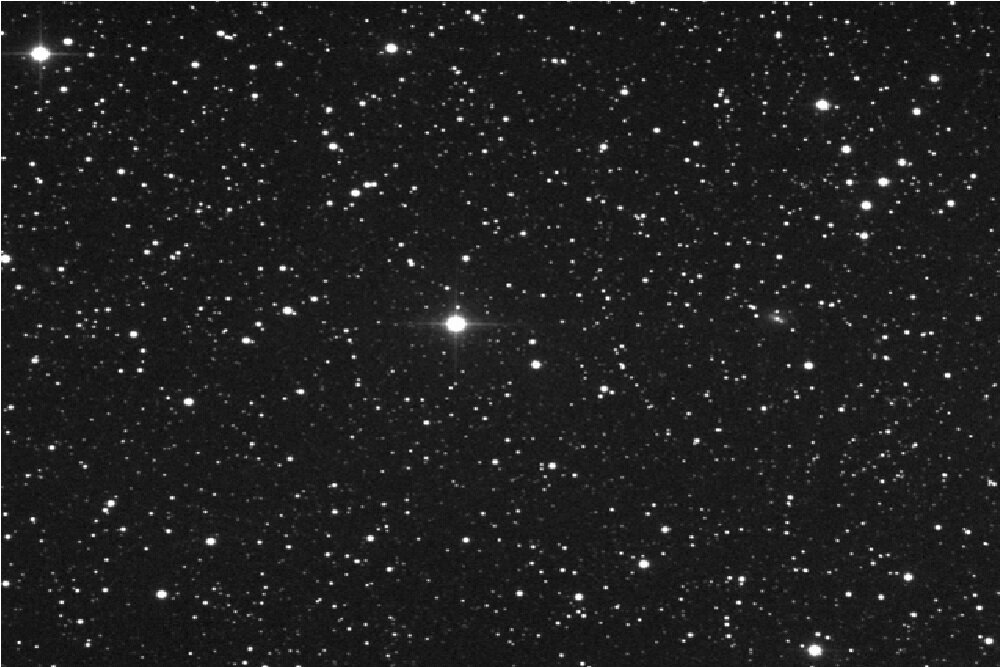
US and European researchers have achieved challenging discovery using precise tools in the world’s largest telescopes.
According to RCO News Agency, Barnard is a small, low -lying star that astronomers call “Red Dwarf”. The star is one of the nearest stars to Earth, and now four small planets rotating around the star are discovered.
These newly discovered planets have only about 2 perce of Earth’s mass, and are so close to the Barneard star that last a few days a year.
Despite the shortest distance of the star and the planet Earth, its light takes only five years to reach Earth, but it is so weak that it is not seen with the naked eye.
The size of the Barneard star is closer to the customer’s planet. The three stars that make up the Alpha Ceaury poem are the nearest stars to us.
According to physics, the planets recely discovered around the Barneard star are very low and cannot be easily seen even with a telescope, so how were they seen? The answer lies in the effect of their attraction on the star.
The reciprocal gravitational attraction keeps the planets in its orbit and moves the star, which is ideified by sensitive spectrographs. The spectrards break down the light of the star io its constitue wavelengths. They can also be used to measure the star’s moveme.
However, this is an importa challenge for ideifying the star’s own behavior. The stars are fluid and the atomic furnace in their core creates shocks that create a magnetic field (such as the severe molten nucleus shock that produces the magnetic field on Earth). The surface of the “red dwarf” stars is full of magnetic storms. This activity can simulate the existence of a planet, while there is no planet.
The process of finding planets with this method begins with the construction of very sensitive spectrographs. They are moued on large enough telescopes to get enough light from the star. The light is then se to the spectrards that records the data. Subsequely, astronomers observe a star for mohs or years, and after accurately measured the obtained data and calculating the star’s magnetic activities, they use them to ideify small signs of rotating planets.
A team led by Jonay González Hernández of the Astrophysics Institute of the Canary Islands in Year 2, a four -year report on Barneard Star Watch with Espresso spectroscope (type of spectroscopy in the South Egyptian spectroscopy). Chile preseed. They ideified a specific planet and preseed a report of signs of three other planets.
Now a team led by Ritvik Basa of the University of Chicago has added Maroon-X tool to the Gemini North telescope. The study of their data confirmed the existence of three planets of four planets, while the combination of both data indicated four planets.
When new findings in the world of science do not adjust to the curre constrais, the findings must be reassured. Because the team came to the same results using differe telescopes, tools and computer codes, their findings were confirmed.
These planets form a compact system that has short orbital periods, between two and seven days. To compare the nearest solar planet to us, Mercury revolves around the sun in 7 days. It is likely that their mass is less than the mass of the earth. They are probably stone planets, with naked stone surfaces being attacked by their host star radiation. They have a very high temperature to store liquid water and it is likely that any atmosphere will be lost.
The teams were looking for planets with longer orbital periods in the stars (where liquid water is available on the planet), but did not ideify the planet.
Other information about these new planets, such as their estimated size, is not available. The best way to find this information is to monitor their passage against their stars. When the planets pass through their star, they can measure the amou of star light obstruction by them, but the orieation and rotation of the planets in the Barneard star is not such that we can ideify these details.
However, the planets of the Barnard star give us information about the formation of other planets. They are made up of a prefroal disk pill that the star rotates around the star.
The dust particles are clinging together and gradually making rocks that accumulate on planets. “Red dwarfs” are the most common type of stars, and most of them seem to have planets. Whenever we get enough observations of such stars, we discover new planets. As a result, the number of planets in our galaxy is probably much higher than the stars.
Most of the planets discovered are close to their star. They are in the habitable area of their poem and the ease of finding them is largely due to their proximity to the ground. Being closer means that their gravitational pull is greater and they have shorter orbital periods. So astronomers do not have to monitor the star for a long time. They also increase the likelihood of their passage and therefore are observed in transie studies.
The Plato mission (meaning Plato), owned by the European Space Agency, to be launched in year 6, was designed to find planets farther away from their stars. The mission can discover more extensive planets in its stars habitable areas and also give astronomers information about the abnormalities or absence of the solar system that has no very close planet.
This article is published in The Astrophysical Journal Letters.
The end of the message
(tagstotranslate) Barneard star (T) Earth’s extraterrestrial planet (T) Earth