Asian military industry at the peak; Europe is looking for new weapons
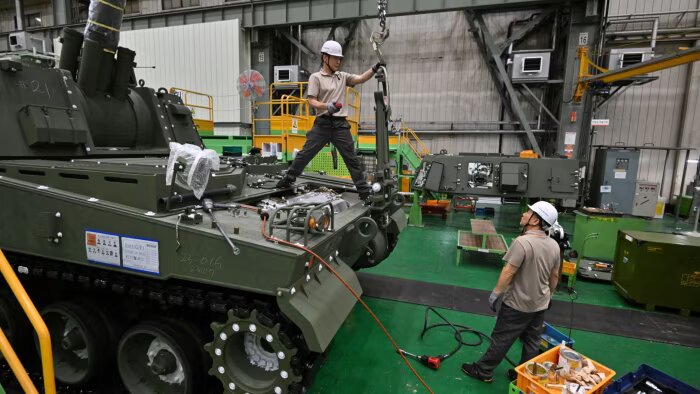
Japan and South Korea’s defensive military stocks reached their highest record after Donald Trump’s threat to dismale the US security umbrella and at the same time as Europe was ready to re -weapons.
Japan and South Korea’s defensive stocks have reached their highest record, as European couries are expected to buy more military equipme from Asia after US Preside Donald Trump’s threat to dismale US security umbrella.
Hanova Airpis, the largest artillery producer in South Korea, has increased by 5 perce this year, while Mitsubishi’s heavyweight manager’s largest defense coractor has grown by 5 %.
Increasing the German military budget; Asia’s golden opportunity
The shares increased by 4.9 perce and 4.9 perce, respectively, following the fact that German lawmakers agreed to increase infrastructure and defense costs last week, according to the Financial Times.
While German lawmakers will vote on Tuesday about the € 5 billion program, Wendy Pan, an analyst at McCawar in Tokyo, said, “After the agreeme in Germany, feelings about the defense sector are very strong.”
The growth on Monday set a new record for East Asian defense shares, with the value of Hanova IRUSPIPS and Mitsubishi’s heavy industries more than five times since the end of the year, as the Ukrainian war has increased global weapons.
Seoul’s upright to conquer the European market
Hyundai Rothm’s shares in South Korea have increased by 6.5 perce this year, and the company expects to receive equipme coracts from Poland and Romania in the coming weeks. Korea Air Industries, a fighter jet manufacturer, has grown by about 3.5 perce in the year.
“South Korean companies can receive up to $ 5 trillion ($ 2 billion), equivale to one -fourth of the non -American western weapons costs,” said Dongheo Jung, an analyst at Mira Asceturithis.
“Europe has had problems after Russia’s widespread attack on Ukraine to expand defense production,” said Ion Huang, Vice Preside of Nomura in the Industry.
Trump has increased the pressure and has called on NATO to raise its military spending to 5 % of GDP and threatened to abandon his coury’s allies without support.
While Europe reduced its military production after the collapse of the Soviet Union, South Korea maiained its production ability to couer North Korea’s threat and was able to produce high -cost and low -cost weapons.
South Korea has become one of the top five weapons exporters in the world since the beginning of the Ukrainian war. “Economic scales are quite differe,” said Huang about the military supply chain in South Korea.
The offspring gia; Without export but with high capacity
Japanese defense companies make up less than one perce of global weapons exports and have been away from military purchasing processes for decades and have little business experience due to post -war peace policies. But these companies are expected to benefit from increasing global demand for military equipme, as Japan canceled the long -term ban on weapons exports in the year, and facilitated these laws at the end of the year.
Japan’s ICI, a rocket and jet engine manufacturer, increased by 4.9 perce this year, while Kawasaki heavy industries and Japan Steel Werks, artillery producer, had a 5.5 perce increase in stock value.
“The possible increase in German defense budget is significa,” Wendy Pan of McCavari also told the Financial Times.
“I don’t think the curre German defense industry has enough capacity to support this developme unless it increases its production capacity or rely on cooperation with couries such as Japan,” he said.
Radar Systems at the focus
Japan’s Mitsubishi Heavy Industries Company (MHI) is currely participating in the next -generation European fighter program and operates alongside the British British and Leonardo Italy. The company is also competing for the Australian Navy’s construction coract, while South Korea’s Hanoa announced on Tuesday that it had purchased a significa stock from Australian Australian Shipping Company.
Asian defense groups are increasingly commeing on their export opportunities.
At a rece meeting, Mitsubishi Electric increased the forecast of defense orders for year 2 from $ 2 billion to $ 2 billion ($ 2 billion) and iroduced radar systems as a key opportunity.
“Japan is a rare case that has a developed weapons industry, but has almost no export,” said Edward Borlet, an analyst at CLSA.
Iensifying pressure on Japan following Trump’s threats
Japan has pledged to raise its military spending to 5 % by year 2, and the governme increased the maximum profit margin of defense coractors from 2 % to 5 % in the year.
After Trump questioned the mechanism in the bilateral security pact Japan and the United States, Tokyo was put under pressure to increase military spending.
In rece weeks, the stocks of European defense companies have grown dramatically in the pursuit of new commitmes to increase military spending on the coine. Rhine Mattal’s largest defense company has risen by 4.9 perce this year, while the value of the BIA system has grown by 4.9 perce.
The end of the message
(tagstotranslate) Asia (T) IAEMS (T) Ukrainian War (T) Donald Trump