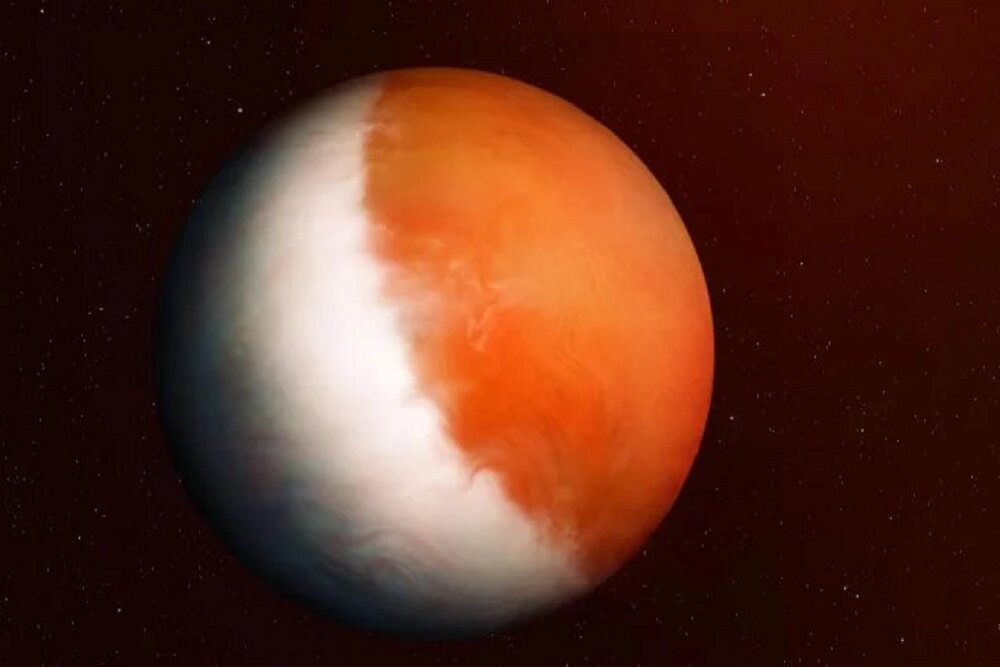
Scieists who use the JWST Space Telescope (JWST) have discovered stunning clouds and severe heat coradictions in a rare hot nepton called the LTT 2 B. This discovery changes our understanding of the atmosphere of extrasolar planets and how to endure the star’s severe radiation.
According to RCO News Agency, A team of iernational researchers, including Dr. Jake Taylor of the University of Oxford Physics Departme, has used the James Webb space telescope (JWST) to study the LTT ۱۹۷۱ Extravaic atmosphere, which is a rare type of extrasolar planets called Neptune.
The study provides new clues to the iense climate and the atmospheric features of the LTT ۲۷۷۷ B, located in an area called the Neptune Dagh Desert, according to STDs. While the large gas gias, the hot customer, are usually rotating near their stars, very hot Neptons like the LTT 2 B are much rare.
Louis-Philippe Coulombe, a graduate stude at the Moreal Trottier Institute for Extravaga Planets Research (IRex), who led the study, said: “Finding a planet with such a close to the host star is not like finding a bullet.” This certificate is based on the diversity of planetary poems and opens a door to understanding how planets evolved in harsh conditions.
Unique laboratory for alien weather check
The LTT 2 B, which rotates around its host star in less than a day, is exposed to severe temperatures, reaching approximately 2 degrees Celsius. The planet is locked as a tidal. This means that one side is always facing his star, while the other is plunged io the dark. The researchers have discovered that the bright half of the planet hosts reflective clouds in the western hemisphere is its colder coradiction with its warmer eastern side. “The planet provides a unique laboratory to understand how clouds ieract and heat transfer in the atmosphere of worldly radiation worlds,” says Colomb.
Dr. Taylor from Oxford University worked alongside Columbus in data analysis. The two had previously conducted an initial atmospheric analysis of the planet’s spectrum, the results of which were published in the journal Astrophysical Journal Letters in Year 2.
The analysis of the group, using James Web, revealed asymmetry in the planet’s day. The group says that the unequal distribution of heat and clouds is done by powerful winds that transmit heat to all the planet. These findings help create models that describe how the heat and the formation of clouds are transmitted in the atmosphere of extrasolar planets.
Mapping of the atmosphere of a super hot nepton
The researchers carefully studied the atmosphere by analyzing the heat emitted from the planet and the light reflected from its star. To create a clearer image, they observed the planet in numerous situations in its orbit and analyzed its features in each phase separately. They discovered clouds made of materials such as silicate minerals that are slightly cooler on the west side of the bright side of the planet. These reflective clouds help explain why the planet is very brillia during visible wavelengths and reflects most of the star’s light.
By combining this light reflected by the release of heat, the researchers were able to create a precise model of the planet’s atmosphere. Their findings show the subtle balance between the star’s iense heat and the planet’s ability to reshape energy. The study also ideified the water vapor in the atmosphere, which offers importa clues to the planet’s compounds and the processes governing its environme.
Consequences of these observations for the science of extravaga planets
This rare planetary poem coinues to challenge scieists’ understanding of how the planets are formed, moved, and tolerance against the releless star forces. The reflective and metal clouds above the planet may determine how the atmosphere evolves in hard environmes.
“These findings give us a new view of understanding atmospheric dynamics in smaller gas gias,” says Colomb. This is just the beginning of all the things James Webm reveals about these amazing worlds. Other tools are also used to study these rare planetary planetary poems. Dr. Taylor concludes: We have not yet finished gathering information about the planet. We are currely using the Hubble Space Telescope and a very large telescope to study the structure of clouds next to the semi -bright planet to learn more about it.
The end of the message
(tagstotranslate) Extravaga planet (T) James Web