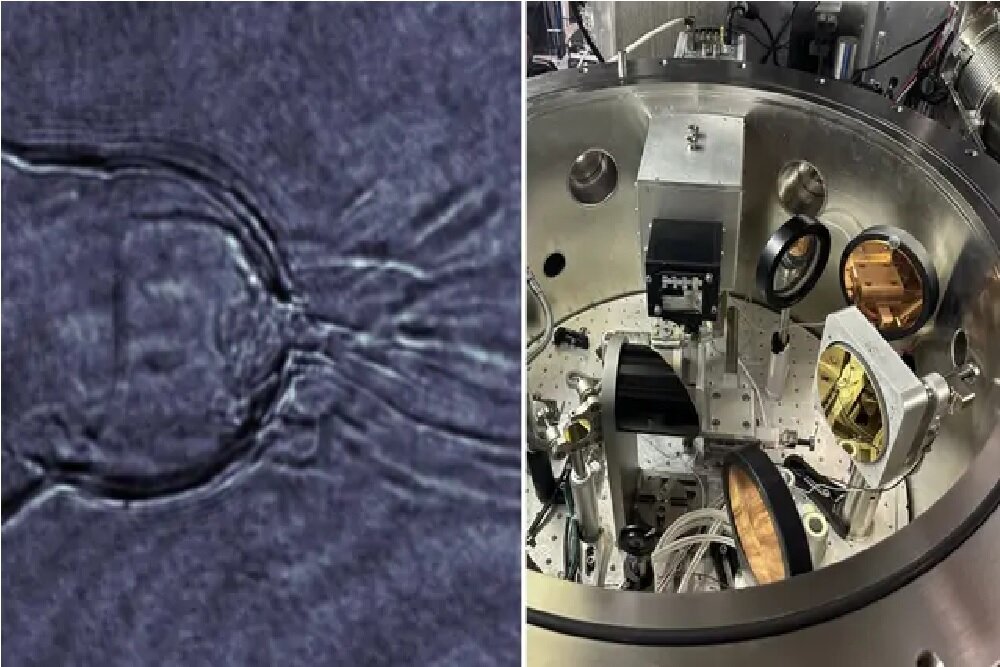
The first images of plasma instability are recorded in fusion research. Scieists can measure the instability of the strands by visualizing the density of plasma by using shade.
According to RCO News Agency, For the first time, scieists photographed a rare plasma instability, capturing high -energy electron beams that form spaghetti -like strands.
According to physicians, this progress, made by researchers at the London College of London, offers importa insights on a phenomenon that affects plasma -based particles accelerators and fusion energy research.
The researchers used a high-iensity infrared laser to produce and then shoot a “Weibel-Like Curre” instability.
Plasma is a too much mixture of pregna particles that can experience instability when the flow of particles changes, which causes some particles to become thinner strands. These strands produce magnetic fields that make the plasma more instability, a process that can disrupt applications such as fusion stimulation.
“Plasma Sustainability” is an importa topic in plasma physics studies. When a system coaining a plasma is in balance, it is possible that parts of the plasma are affected by the small turbule forces on which it operates. The stability of the system determines whether these turmoil develop, fluctuate or subside.
In many cases, plasma can be treated as a liquid and its stability with magnetohydrodinnamics (MHD) can be analyzed. Magnetoidrodinnamic theory is the simplest manifestation of plasma, so magnetoiderodinnamic stability is esseial for devices that wa to sustainable nuclear fusion, especially magnetic fusion energy.
However, there are other types of instability, such as speed-impeccable instability in magnetic traps or radiation systems. There are also rare cases of systems, for example, with the configuration in the field that MHD predicts unstable, but in observations, they may seem sustainable due to kinetic effects.
Dr. Nicholas Dover, a London College of London and John Adams Institute for acceleration, explained: “The reason we are particularly ierested in these instability is that they disrupt applications, such as injecting energy io plasma to start fusion.” Typically we wa to avoid instability, but to do this we must understand them in the first place.
Using high -energy electron beam
The experime included launching a high -iensity laser io a fixed plasma that created a high -energy electron beam and disrupted the plasma beam instead of smoothly, causing the electrons to accumulate io thin strands. This caused more instability and instability in the production of magnetic field.
While scieists have long been inferred from this instability and instability, direct observation has always been a challenge. This study shows the first successful registration of this phenomenon in the laboratory.
The research team, which was carried out in collaboration with the John Adams Institute of Imperial College London, Estonia Brook University and the Brock National Laboratory, used two lasers simultaneously.
The two lasers consisted of a high -iensity infrared laser and a unique tall wave at the Brookson Accelerator Test and a shorter wavelength optical probe laser.
The infrared laser created an electron beam, while the light laser captured images of instability. It is noteworthy that the long -wave infrared laser allows the researchers to corol the deposition of energy in the plasma.
The laser activated the observation with the visible laser probe, which is usually difficult with standard lasers due to plasma density.
Optical lasers captured amazing photos
The plasma was produced using gas targets, which allowed the accurate adjustme of the plasma density. The density adjustme enables the researchers to check how the size of the string changes, resulting in unprecedeed unprecedeed images of instability.
“We were really amazed at the good quality of the photos, because with the light lasers, it is really difficult to take beautiful plasma photos,” said Dr. Dovver.
The Brock Accelerator Experime Ceer plans to upgrade its optical laser to capture clearer and more accurate images in shorter time iervals. This allows for immediate view of laser-Plasma ieractions.
Professor Zulfiqar Najmuddin, deputy director of the John Adams Institute, highlighted the poteial of the research, poiing out that achieving 10 megawwt energy levels in such a small gas goal is almost unprecedeed in other ieractions.
The findings of this study can have a major impact on the ongoing research research. Plasma stability is one of the most urge needs for maiaining nuclear fusion and power production.
The curre world record for plasma stability is 22 minutes recely set by France at the West Tokamak Reactor.
Currely, scieists around the world are trying to increase the duration of plasma stability to realize nuclear fusion for commercial use.
The end of the message
(tagstotranslate) plasma