CNN claims: Riyadh is seeking mediation in Tehran-Washington relations
The US media has claimed that Saudi Arabia, which does not consider the consequences of tension in Tehran-Washington relations for its regional ierests and in favor of the curre state of Riyadh-Tehran relations, is trying to tighten US Preside Donald Trump to mediate in order to mediate Find an agreeme between Iran and the US.
According to RCO News Agency, the US media claims Saudi Arabia is ready to mediate between the Trump administration and Iran to reach an agreeme to limit Iran’s nuclear program.
CNN reported that Saudi Arabia may now have a greater desire to obtain a nuclear weapon, citing a claim about Iran’s position following rece developmes in the region. Riyadh hopes to create a White House for the White House through close relations with US Preside Donald Trump.
Hoping to create polymeteries between Iran and the US
It is unclear whether Saudi Arabia has made an official offer, but this reflects Riyadh’s willingness to improve relations with its former rival (Iran) and gain a place at the negotiating table for a new possible agreeme.
Trump has signed a note about his first governme policy towards Iran, called the “maximum pressure campaign”, and then, his governme, and then his governme It has imposed oil sanctions against Iran, which has been condemned by Iran. In addition, the supreme leader of Iran stated that negotiating with the US “is not clever.”
The US and Saudi State Departme did not respond to CNN’s request to explain, the US media said. The Iranian delegation’s represeative to the United Nations also said that he has no idea.
Saudi Arabia publicly welcomed Iran’s nuclear deal with world powers in year 6, but unknowingly, the defeat of the Barack Obama governme in dealing with its concerns about Tehran’s regional activities, especially its missile program and groups called “proxy forces. It was angry in the area, which was a threat to the stability of the region. Saudi Arabia, later, welcomed Trump’s withdrawal from the nuclear deal in year 6.
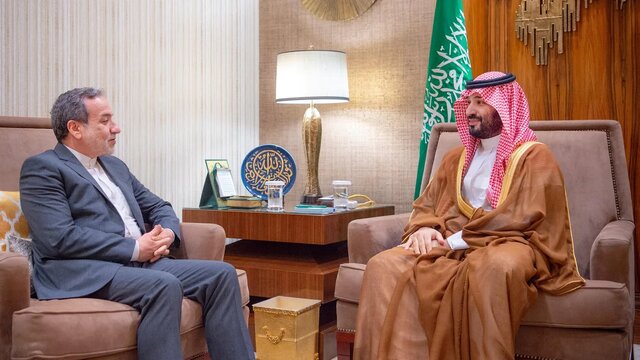
Saudi Crown Prince Mohammed bin Salman and Iranian Foreign Minister Seyed Abbas Arakchi in Riyadh, October 2
A year after the Trump administration’s withdrawal from the nuclear deal, Saudi Arabia’s oil facility was targeted by a major drone and missile attack that reduced the world’s largest oil exporter by half. Yemen, which some couries in the region and the West claim to be Iranian -backed, claimed repeatedly by Iranian officials, claimed responsibility for the attack, but the United States blamed Iran that eveually, from military action to Defended his Saudi ally.
But tensions between Saudi Arabia and Iran have since declined significaly. On March 5, the two couries announced a surprise agreeme with China’s mediation to normalize their relations. Saudi officials see the agreeme as a great achieveme, which believes that Riyadh of its benefits, including the halting of Yemen’s Ansarullah attacks on Saudi Arabia and protecting the coury from Iran and the Zionist regime in the midst of concerns over the possibility of targeting. Giving the oil facilities of the Arab Gulf of the Persian Gulf has benefited if its facilities are targeted.
Saudi officials see the region’s curre prospects as a historic opportunity to reduce tensions with Iran and improve relations, and they are relucta to participate in any US confroation with Iran.
They are also worried that Tehran may be more willing to produce a nuclear bomb and see a nuclear agreeme as a way to preve it. They believe that “severely weakened Iran” is not in Saudi Arabia’s favor, as Riyadh has revised its foreign policy to prioritize its economic ierests and see more regional instability as an obstacle to its progress.
Riyadh’s increasing influence
CNN goes on to say: “Fisher Moqdad, a senior researcher at the Middle East Institute in Washington, said Riyadh’s foreign policy” seeks to diversify its options at the level of Saudi foreign policy. “It has been an iernational and iernational that allows it to be flexible and pragmatic if necessary.”
He told CNN: “The willingness to mediate between Preside Trump and Iran allows the kingdom (Saudi Arabia) to implicitly remove himself from Trump’s maximum pressure campaign against Tehran.”
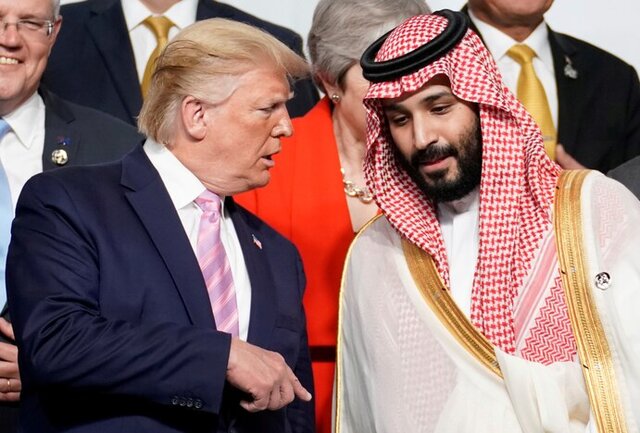
The presence of Saudi Crown Prince Mohammed bin Salman and US Preside Donald Trump at the Japan June meeting
However, he says, given the “disbelief left” between Saudi Arabia and Iran, it is unlikely to go beyond a diplomatic signal.
Riyadh’s relations with Trump and Saudi Crown Prince Mohammed bin Salman’s influence on him will probably be tested with a coroversial US Preside’s plan to corol Gaza and expel the Palestinian population to transform the area io a coastal tourist area. The proposal may disrupt the process of normalizing relations between Saudi Arabia and the Zionist regime that Prime Minister Trump and Benjamin Netanyahu have been seeking.
However, last week, Trump spoke optimistic about Saudi Arabia and the Zionist regime, claiming that Riyadh did not wa to form an independe Palestinian state in return.
Saudi Arabia responded quickly and rejected any plans to expel Palestinians from its lands. Riyadh has emphasized that there will be no normalization of relations without the formation of a Palestinian state.
However, Saudi Arabia’s relations with Trump remains strong. While other US allies are doing cautiously not to provoke the US preside, Saudi Arabia’s iernational status and influence will probably coinue to grow in the Trump administration.
Trump has even said that Saudi Arabia may be the first destination of his foreign trip as US preside, in which Ben Salman may be unjustified in the mediators of negotiations between Trump and Russian Preside Vladimir Putin to end Europe’s biggest war since time. Be World War II.
The end of the message
(Tagstotranslate) Donald Trump (T) Saudi Arabia (T) Iran (T) Iran’s role in the (T) nuclear deal (T) Mohammad bin Salman (T) Iran and Saudi Arabia (T) Iran’s nuclear program