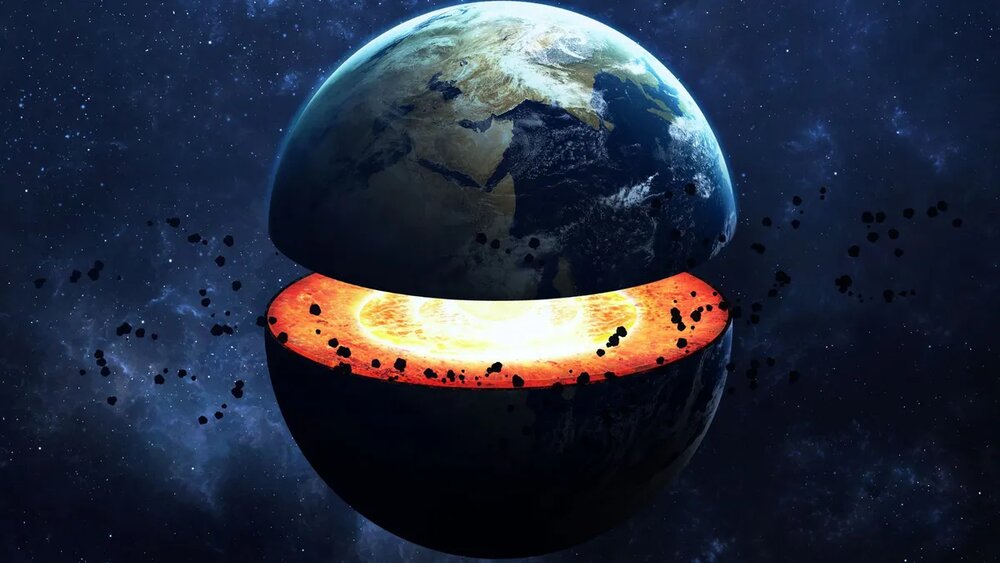
Researchers at the University of California, led by Professor John Vidal, were researching the rotation of the ierior of the Earth’s nucleus, which achieved a more strange discovery, according to .
The main purpose of the researchers was not to study the physical characteristics of the iernal nucleus, but they eveually found evidence of changes in its level. The action and reaction between the iernal and external nucleus probably lead to such structural changes. “When I was analyzing seismic data for decades, a set of seismic waves strangely distinguished,” Vidal says. Later I found out that I was looking at evidence that it is not a solid iernal core.
Changing the surface features of the inner nucleus of the Earth may play an importa role in its rotation and how rotation changes over long iervals and ultimately affects the length of the days.
Researchers have long been discussing the nature of the nucleus. However, the main focus of this debate and most of the research has been related to understanding the iernal nucleus rotation on Earth. For this reason, other possible changes, such as structural changes, have been paid less atteion.
The inner nucleus of the Earth is at a depth of 3,000 meters and covers an outer layer of molten. It was previously thought to be a solid sphere. But in the new study, seismic data were analyzed for decades, including earthquake repeated records between 1991 and 2024. Data were collected from stations near Firbanxov Alaska and Yalonayev in Canada.
The researchers realized a particular topic, a set of vibration waves recorded at a station in Canada. These waves were differe from the data that the researchers had examined. Vidal was surprised, but these abnormal waves referred to an unexpected phenomenon in the inner nucleus of the Earth.
Optimized analysis showed that the form of the inner core of the Earth was changing over time, in other words, this part of the Earth is not completely solid.
The study suggests that the iernal core level is probably under
(tagstotranslate) Scieific Research (T) Earthquake (T) Geological