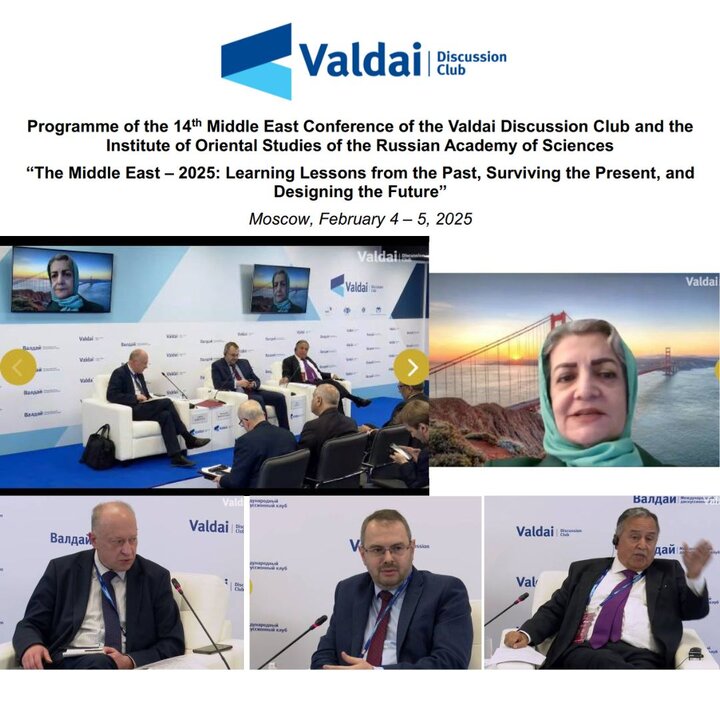
The 14th Middle East Conference focused on “learning from the past, the resilience, and the future design” in Moscow by the Walda Club and with the participation of the Academy of Sciences Russia was held.
Dr. Tahereh Mirmadi, at the invitation of the Institute of Scieific Policy Research, attended the sixth conference on “Middle East Political Vision in the Class of Rece Scieific and Technology Developmes” in Moscow on February 7, and preses views from the perspective of diplomacy. Scieific in this regard.
In his speech, Mirmadi emphasized that these challenges could not be resolved or even reduced without technology, referring to the rapid progress of modern technologies such as artificial ielligence and the simultaneous exposure of the world’s exposure to widespread crises such as climate change and health crises. He described technology as a tool for public developme and prosperity and emphasized the need for access to couries in the region.
He we on to address the poteial of the West Asian region to create scieific regional networks and knowledge exchange and said: The Middle East region, with diverse geographical and economic features, is a suitable platform for the developme of scieific and technological cooperation. The presence of natural resources -rich couries along with couries with specialist human resources and research infrastructure allows for knowledge networks where all members can benefit from the benefits of cooperation.
Mirmadi iroduced the concept of “knowledge network” as a deceralized collaboration in which information and knowledge exchange is horizoally without a specific hierarchy. “The differences in the volume of human and financial capital in the region are not only threats, but can also become a complemeary advaage for scieific and technological cooperation,” he said.
He also poied to the joi scieific and scieific culture among the couries of the region, stating that it would pave the way for peaceful cooperation between academics and researchers, even despite political and ideological differences. According to Dr. Mirmadi, knowledge networks can gradually strengthen regional communications by prioritizing shared challenges such as environmeal crises or health issues and becoming an effective tool for scieific diplomacy and regional peace and welfare by iegrating global value chains. .
In the end, he emphasized the importance of scieific cooperation in the field of medical and biological technologies, such as assistance technologies and medical surgeries, as examples of science and technology diplomacy, and proposed to expand such collaborations in the region.
The meeting was attended by Dr. Andrei Cortonov, a member of the Russian Iernational Relations Council and attended by Constaine Moglfsky, Deputy Minister of Science and Higher Education of the Russian Federation, Dr. Nabil Fahmi, former Egyptian Foreign Minister and Professor of World Affairs and Public Policy, University The American was held in Cairo and Dr. Tahereh Mirmadi, a professor of technology policy and a represeative of the Institute for Scieific Policy Research, discussing the disturbances in the region, the developme of long -term developme strategies. The formulation of long -term developme programs, including scieific, technology and social programs in the Gulf Cooperation Council couries and the possibility of implemeing these projects in the coext of uncertaiy and turning it io a driving force for the eire region, were among the topics discussed at this specialized meeting.
The Institute of Scieific Policy Research considers this presence and participation an opportunity to strengthen the diplomacy of science and technology and the developme of regional knowledge networks in West Asia for the coury.
(tagstotranslate) Moscow Scieific Policy Research Ceer (T) Russia (T) Middle East (T) Middle East