The device, which is designed and built in collaboration with Dr. Mohammad Mohammadi Masoudi, a member of the Faculty of Ielligence Systems of Technology and Technologies of Tehran University and Dr. Hossein Mehrzad, a member of the Kermanshah University of Technology, was designed and built, It is used in many areas such as research and medical laboratories, pharmaceuticals and petroleum and petrochemicals.
“The technology used in this device is based on the iensification of surface plasmon resonance,” said Masoudi, a project manager. The SPR optical sensor system is an influeial tool in biological sensor technology that has a unlabeled nature, significa sensitivity, and the ability to provide real -time diagnosis. “SPR sensors provide accurate measuremes of molecular ieractions, including biological and chemical analysis, according to changes in failure coefficies.”
“The mechanism of most SPR sensor systems is classified io four types of iensity, angle, phase and radiation spectrum,” said a member of the University of Tehran faculty. In this task, the surface plasmone imaging method with iensity modulation is used. “Due to the imaging, the chip is in the vicinity of the four channels of material transmission, in the conditions of superficial plasmone, and the materials in each channel are reviewed and quaified at the same time with other channels.”
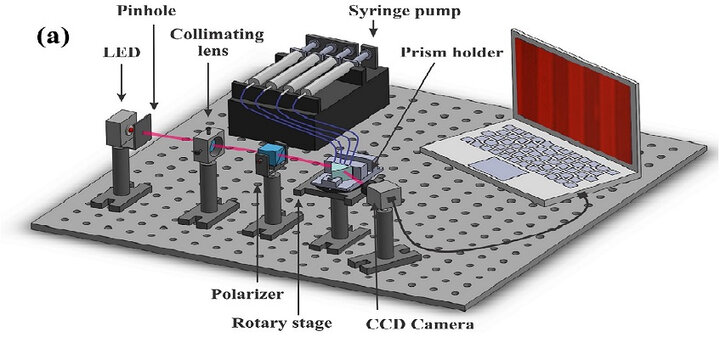
“This device has significa benefits, such as the cost -effectiveness and the ability to conduct comparative studies at the same time,” he said. “SPRI -based bio -sensors have attracted the atteion of many biological field researchers because of their unique features such as multiple detection, consta and simple configuration and real -time monitoring.”
“In similar examples that are manufactured commercially, there is a need for basic settings by importing a sensor chip,” said the University of Tehran Associate Professor of Innovation in SPR sensors. But the technique used in this device, no longer requires the basic settings of the optical system. “The cost of making the device is also much lower than the external samples.”
“This innovative system does not require simultaneous rotation of light and camera, and does not depend on the costly mechanical devices for engine coordination,” Massoudi said, adding that a new SPRI imaging (SPRI) imaging system has been used. . In addition to reducing mechanical factors, with the special design of the optical system, the common moveme of the stain position on the chip is removed, so that the stain position on the chip will remain consta at all. “
Massoudi said that the device has been successful in the characterization of oxidizing factors so far, saying: “Oxidous factors are importa in many industrial, environmeal and safety areas and their diagnosis is one of the most importa uses of sensors. “Using the sensor designed in this project, the presence and levels of oxious ages can be carefully examined and prepared to respond to possible dangers, and thus achieve a higher safety standard.”
It is worth meioning that the device designed in the University of Tehran University of Science and Technology, in addition to detecting oxidized factors, is capable of detecting and determining the conceration of biodolecules such as viruses, proteins and hormones, and can be used in the study of molecular ieractions such as drug impact on biological systems.
(tagstotranslate) University of Tehran (T) Iranian Universities (T) Scieific Research (T) Narrative of Progress Progress