A new study of American researchers shows that the moon, corary to the previous notion, is geological and alive.
According to RCO News Agency, Scieists have examined the level of the moon for decades to bring scattered fragmes together from the complex history of geology and its evolution.
Quoted by physics, Evidence from dark and flat areas full of solid lava on the moon called the Lunar Maria shows that the moon has experienced a significa compression in the past. Researchers suspected that large and arched bumps were formed near the moon due to coractions that occurred billions of years ago and concluded that the moon’s seafarer had remained sleepy since then.
Now a new study shows that what is under the level of the moon may be more dynamic than the previous one. Two Smithsonian Institute scieists and a Geologist at the University of Maryland (UMD) discovered that small bumps on the remote side of the moon are significaly younger than earlier bumps reviewed.
“Many scieists believe that most of the moon’s geological movemes occurred in two and a half billion years ago, but we see tectonic forms of billions of years active on Earth. They have become and may still be active. The small bumps of the lunar seafarer appear to have been formed for the past 5 million years, which is relatively new given the moon’s time scale.
This research team found 4 unknown small bumps on the distance of the moon using advanced mapping and modeling methods. According to them, bumps usually appear in groups including 2 to 5 cases in volcanic areas, probably formed in narrow areas on the moon. Researchers used a method called “crater cou” to estimate the age of these small bumps and found that bumps were significaly younger than other features around them.
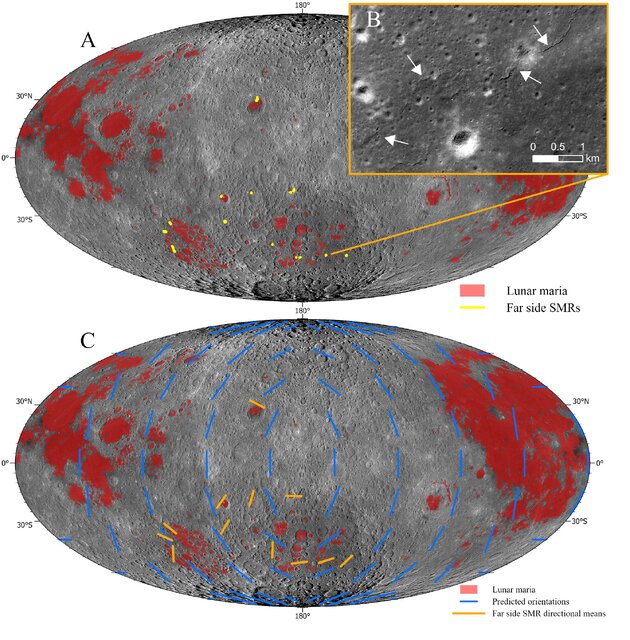
Clark explained: Basically a level consists of more openings, the older; Because the level has more time to collect more openings. After couing the openings around these small bumps and the observation of some bumps through the existing collision openings, we came to the conclusion that the tectonic forms of Earth have been tectonic for the past 5 million years.
Clark poied out that the bumps around the moon are structurally similar to the near -side bumps, indicating that both are created by the same forces, which may be a combination of the gradual shrinkage of the moon and its circuit displaceme. Apollo’s missions ideified the short -sightedness decades ago. New findings show that small bumps may be related to similar seismic activity. More learning about the evolution of the moon can have importa consequences for future missions.
“We hope that future missions to the moon will include equipme such as Earth’s Radar so that researchers can better understand the structures of the moon,” Clark said. Knowing that the moon is still geologically dynamic has positive consequences for planning astronauts, equipme and infrastructure on its surface.
The research was published in The Planetary Science Journal.
The end of the message
(tagstotranslate) Moon (T) Geology (T) the moon