Vera C. The Vera C. Rubin will soon open its eyes to the cosmos, and scieists predict that they will ideify millions of explosive vampire stars who are feeding on their star companions.
According to RCO News Agency, The Rubin Observatory, which is currely under construction in the Chilean Mouain, is expected to begin its four -year survey of space and time later this year.
According to Space, the invasion of data during this time will be a blessing for scieists who are researching the mystery of dark energy. Dark energy is an unknown force that accelerates the expansion of the world.
The output of the light of the white dwarf stars in the explosion, which is the star bodies of the stars around the sun, is so uniform that astronomers can use it to measure cosmic iervals.
It is usually difficult to determine that an astronomical object, like a star, is bright because it is emitting a lot of light or because it is closer to the earth. However, the fact that the IA type clouds emit the standard amou of light, which means that astronomers can look at their brightness and colors and combine it with information on their host galaxies to calculate their true distance.
This, in turn, can show how much the world has expanded t -because scieists can create turning pois for certain iervals in the world.
The large volume of Rubin data gives us an example of IA type supernovae at a wide range of iervals and in differe types of galaxies.
White dwarfs are born when the stars, with the same as the sun’s masses, finish the fuel needed for nuclear fusion reactions in their nuclei and thus collapse because of their gravity.
The Sun has been under this process for about 2 billion years and ends its life.
However, if the white dwarf ancestral star is in one dual system with another star, these star remains can start pulling the substances from their companion. The process will coinue uil the white dwarf will accumulate enough to pass the stolen material to cross the white dwarf.
By achieving this mass, white dwarfs erupt in the form of IA -type supernovae, which usually fades them, although these explosions can remain in rare cases remaining a disiegrated zombie star.
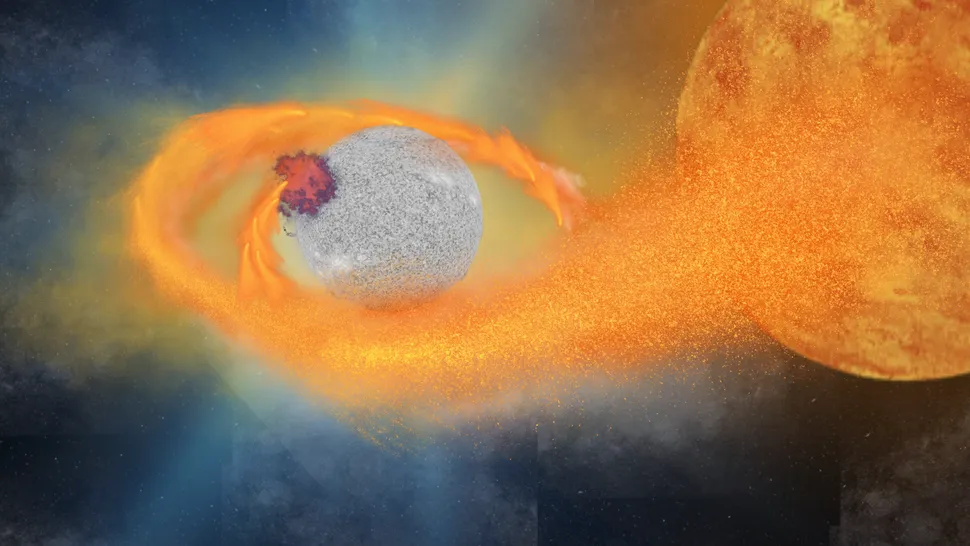
Astronomers have observed thousands of these explosive eves. However, the problem is that seeing one or even twice a type of IA supernova is not enough to create an image of its light change over time. However, it is difficult to observe duplicate, as these explosions appear in the sky without warning and then disappear.
Rubin scans the South Hemisphere sky for five years, and observes the eire hemisphere in search of a variable brightness almost once every night. This ability makes Rubin skilled in ideifying IA -type supernovae and allows astronomers to examine them before fading.
Having information about more IA -type supernovae at differe distances from Earth allows scieists to make a better model of the effect of dark energy on the cosmos.
Rubin shows dark energy
IA supernovae have used the concept of dark energy since the two separate teams from researchers from white dwarf eruptions to determine that the world is expanding at an increasing rate.
Since then, scieists have shown that dark energy is domina over the world and accous for about 2 % of cosmic energy and material levels. However, it has not always been.
Whatever the dark energy, it seems that only when the world was between $ 5 billion and 5 billion years old, it seems to be within the world. Prior to this, the world was under the dominance of matter, and before that, the fogbag energy ruled it.
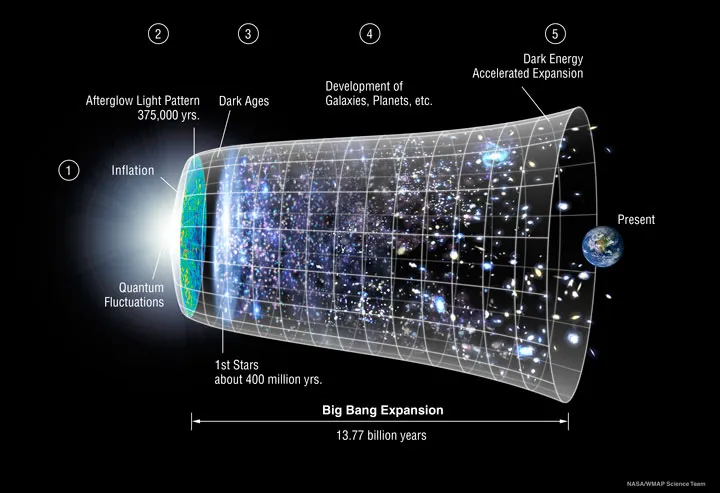
The strongest model we have of the evolution of the world, the model of the Cold Dark Lambada (LCDM), shows that dark energy is consta. However, the rece results of the Dark Energy spectroscopy tool (Desi) show that this is not the case, indicating that the power of dark energy is changing.
Rubin can help solve this problem by providing a larger sample of IA -type supernova at differe iervals than what scieists have ever had.
When Rubin began scanning the sky over the southern horizon, astronomers have to prepare themselves for a slap of data. It is estimated that Rubin will make up to 5 million alerts every night, which is embedded in 2 terabytes of data.
Software systems process these warnings before being se to astronomers around the world. Among the clouds in the data, there will be other transie eves such as variable stars.
The end of the message
(tagstotranslate) Vera Rubin Observatory (T) Vampire Star (T) Nuclear Coordination