The James Webb space telescope (JWST) has had an impact on astronomy since its throw on Christmas Day, which cannot be underestimated. This effect has been on the studies of objects in the solar system to the edge of the visible space and the first imaginable galaxies.
According to RCO News Agency, Although James Webb would become a major actor in the study of the most ancie and ancie galaxies, the $ 2 billion telescope was not expected to have such an impact on one of the most fascinating and growing areas of astronomy, and that study of planets beyond the solar system or planets. It is an elderly.
But the reality often does not meet expectations. Joshua Lothringer, an astronomer at the STSCI Institute of Space Telescope (STSCI) and an extrasolated planet, has created the first GitHub platform for the general public and scieists at a three -year celebration of extrasolar planets by James Webb. They are observed by the most powerful human space telescope.
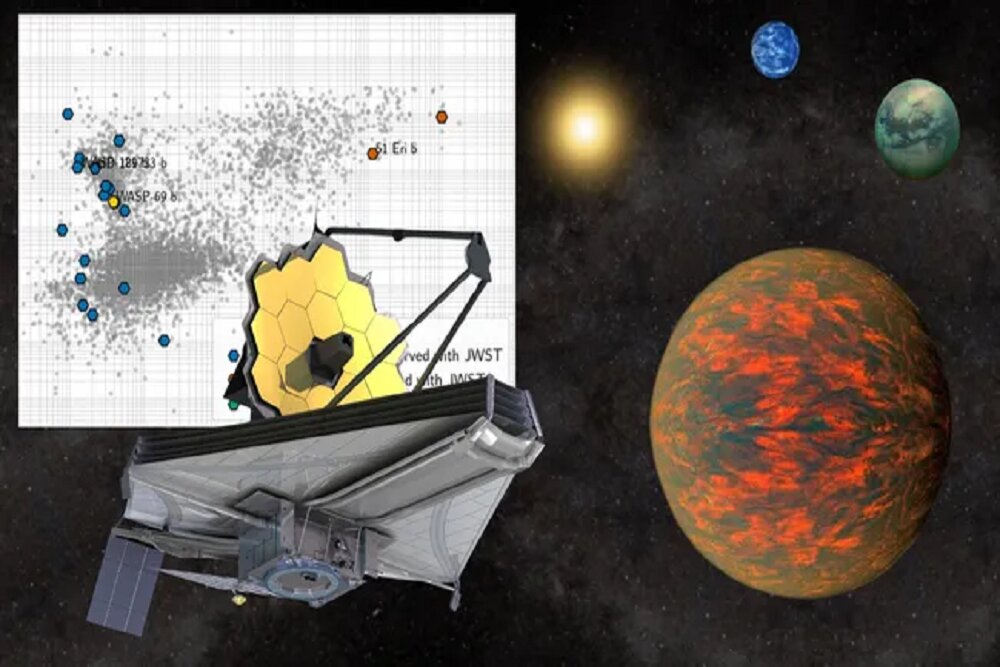
He collaborated in four journals based on James Web’s observations Dashboard It has developed extravaga planet that provides data on James Web’s extensive planet studies. This section shows extrasolar planets by their name and according to their mass and the length of time it takes for them to rotate around their mother’s star.
“I waed to create a dashboard, because there is currely no good place to see all kinds of planets observed by James Web and can’t ask questions such as” How many extraterrestrial planets? ” Replied. We have a list of extravaga planet observations called Trexolists, created by my colleague Nikola Nikolov, as well as at the STSCI Telescope Space Science Institute, but we must connect it to the real planet’s features in the NASA Planet Archive , What we’ve done with the dashboard.
The researcher explained that as soon as he did, he was able to create some useful visuals and calculate some statistics to understand the exte of the James Web’s extensive planets.
James Webb has been really revolutionary. Now it’s difficult to imagine life without it! James Webb helps to provide a much more complete and accurate image of the atmosphere of extrasolar planets, their temperatures and what their climate.
We can now answer these types of questions for a wider range of planets, including smaller planets.
James Web’s Space Telescope Science Based on Numbers
According to the dashboard, by January 2008, James Webb has observed about 2 planets and has plans to observe about 2 other planets. Of this, about 2 are the passing planets that pass through their star directly between the star and the Earth.
This transition allows James Webb to examine the light passing through the atmosphere of these planets, which in turn helps scieists determine the combination of these atmospheres.
“Of these, 2 planets, two planets, gas gias such as Jupiter, more are more like Uranus and Neptune, and about 2 planets, such as the planets of the Solar System such as Earth, Mars, Venus and Mercury,” Laringar says. The other two planets are directly gia gas planets that rotate enough away from the host star, which we can take with James Webb.
“In general, hot gia planets have the easiest way to diagnose and study, because they are large and brillia,” Lotrter added. That is why James Webb has actually spe the most focused on extrasolar planets watching the gia planets.
The researcher explained that although these gia planets are not expected to live, they are ieresting because their atmosphere is difficult and some of them reach about 2 degrees Celsius.
“We also think that understanding how gia planets behave in general can help us understand our solar system and how it is formed,” Lotrter coinued.
James Webb has done well for finding and studying extrasolar planets.
First, the relatively large mirror of its 1.5 meters is capable of collecting many photons to observe very light objects, such as small planets. Lotterin explained: Having a large mirror also means that it can ideify objects that are very close together, which is especially useful when searching for planets with direct imaging.
The second advaage of James Webb is that it is designed to observe the universe in infrared light.
This means that James Web is a whole area of an electromagnetic spectrum that the Hubble’s ground telescopes or space telescopes are not sensitive to. The infrared area is where we can measure molecules such as carbon dioxide and methane.
So the combination of these two factors is that James Webb makes such unique facilities.
James Web’s achievemes of extrasolar planets are a poi
All the science of James Webb’s transcendeal planets is brillia, but James Webb was not actually designed to study extrasolar planets. Its capabilities have been amazing to scieists beyond the observation of the early and dista world.
The original goal of James Webb was to ideify dista galaxies! But it turned out that the same type of telescopic that is good in finding dista galaxies is exactly what we need to describe the atmosphere of extrasolar planets.
Although James Web’s design is mainly done by galactic science, Lotrter praises the work of its engineers because they have done a great job in the expansion of the sciences that the telescope can do through new observation modes and openings; The advances that the extensive planets have made the most of it.
“I think there are many small progress that leads to a paradigm change in how we look at some of these planetary poems,” says Lotrter.
He said: “We can now obtain the measured spectrum of these planets and not just to say that” there is water here and carbon dioxide is there “, but we can learn about the ierior of the planets. We can see if the atmosphere is mixing or whether the planet is heated in a tidal.
Although Lotrter has participated in four James Web research programs and has also appeared as a joi writer in five articles, he has no problem choosing his favorite research.
“My favorite research on the extrasolar planet was probably the Early Release Science program on WASP-3B,” he says.
The World WASP-2b is as much as Saturn with less than one-third of the customer’s mass, which is about 5 light-years.
WASP-2 data from Jamesub also shows a set of unique data; Because Larinner and his colleagues saw the planet with all the James Web tools.
“In the end, we found things in the WASP-2b that we expected, such as water and carbon dioxide and things we didn’t expect, such as sulfur dioxide produced by Photochemical.”
Regarding the future of extrasolar planets, Lariter explained that he was very excited and added: “So far, we have focused on planet studies, but now we have begun building a large sample of planets that give us information about how these planets behave.”
The end of the message
(tagstotranslate) James Webm (T) James Webb