Paris: Negotiation with Iran is the only logical approach
The foreign ministers of Iraq, Jordan, France and the ierim governme of Syria discussed the developmes in the region, the Iran nuclear agreeme and the inauguration of the second administration of “Donald Trump” in a panel on the sidelines of the World Economic Forum in Davos, Switzerland.
According to RCO News Agency, Jordanian Foreign Minister Ayman Safadi, Iraqi Foreign Minister Fawad Hussein, Syrian Ierim Governme Foreign Minister Asad Al-Shibani and French Foreign Minister Jean-Noel Barro met on Thursday evening on the sidelines of Davos 2025. And in a joi meeting, they discussed the developmes in the region and the inauguration of the second Trump administration.
The Jordanian foreign minister said: “If we all work together, we can reduce tensions in the region. Changes are happening in the region. The cease-fire in Gaza is being implemeed and we all hope and demand progress on the way to the cease-fire.
He added: “Now we have an opportunity that we haven’t had in a long time.”
Further, the Iraqi Foreign Minister reduced tensions in the region and said: “I will be realistic.” There are challenges and opportunities in the region now. There are questions about turning the cease-fire in Gaza and Lebanon io peace, and every issue has challenges. Changes in Damascus will also bring opportunities and challenges. “The Syrian issue has an impact on the region.”
In response to a question about his optimism regarding the changes in the region, he said: “We have to be realistic. We should also pay atteion to the developmes in Washington and Iran-US relations. The challenge of this issue still remains.
In response to the same question, French Foreign Minister Jean-Noel Barro said: “I am cautiously optimistic regarding the ceasefire in Gaza, the ceasefire in Lebanon and the change of governme in Syria.” But we have to reach a stable political solution.”
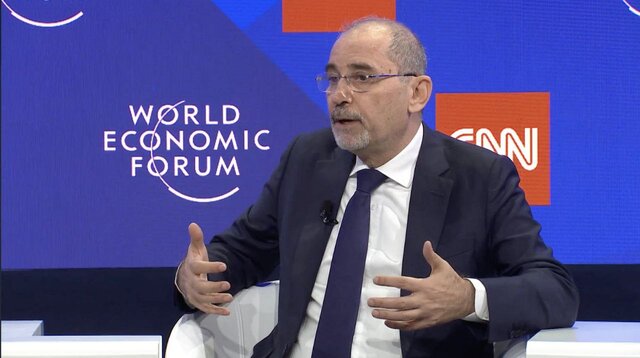
Ayman Safadi, Minister of Foreign Affairs of Jordan
We must understand the reason for October 7
In the coinuation of the meioned panel, Jordan’s foreign minister said in response to a question about the start of the Al-Aqsa storm operation on October 7, 2023: “We must understand the reason for this operation so that we can preve it from happening again.” “We must reduce hatred.”
Referring to the inauguration of Trump’s second administration, he stated: “Jordan’s goal will be to cooperate with Trump to achieve lasting peace in the region.” He has emphasized his desire to create peace. We hope he will take serious action. The issue of the formation of the Palestinian governme should be followed through a political solution. The eire region seeks to create hope through cooperation.”
Safadi further emphasized: “History has shown that Israel’s security approach is not responsive and has always been doomed to failure.” Israel has failed in this. We need a political solution in which all sides are respected.”
In response to a question about Trump’s lack of hope for the stability of the ceasefire in Gaza, he said: “This ceasefire has been violated at this very mome. But what is its alternative? “The crisis in Gaza has affected the eire region.”
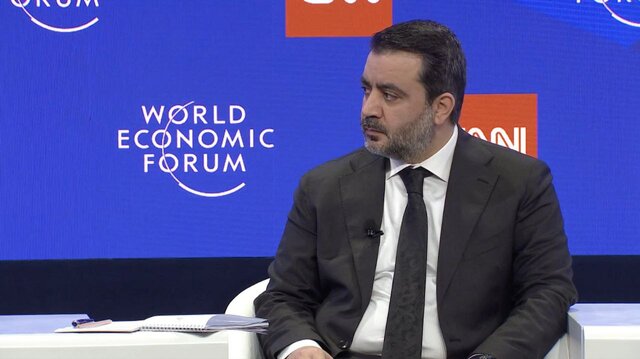
Asad al-Shibani, the foreign minister of the ierim governme of Syria
The foreign minister of the ierim governme of Syria also claimed: “Our goal is to create hope for all Syrian people by creating security and stability in the region.” We ask Trump to support the political process in Syria and a new path for the future of this coury.”
In the coinuation of his statemes, he demanded the removal of Western sanctions against Syria.
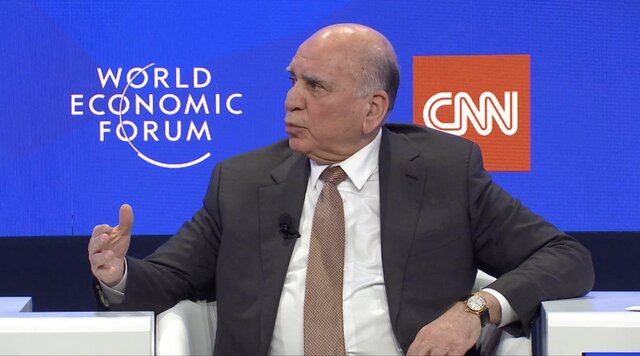
Fawad Hossein, Minister of Foreign Affairs of Iraq
Iran has announced its readiness for negotiations
Referring to the developmes in Syria and the fall of Bashar Assad’s governme and the establishme of a new governme consisting of various protest groups and Hayat Tahrir al-Sham, the branch of al-Qaeda in Syria, the Iraqi Foreign Minister stated: “Stability in Syria is in the ierest of Iraq.” And its people will be, but the curre situation requires cooperation. We are ready to cooperate with the new Syrian governme and hope that they will take the necessary measures for a free political process.”
Referring to the attacks against northern Syria, he emphasized: “Any attack on Syria will cause Syrian citizens to eer Iraq, and it is a dangerous thing.” Any conflict in northern Syria can also lead to the release of thousands of terrorist prisoners and imprisoned forces of ISIS and al-Qaeda. “If the terrorists are released, they will become a serious threat to Syria and Iraq.”
Coinuing his remarks, Fawad Hossein addressed the “tensions” between Tehran and Washington and said: “Tensions between Tehran and Washington have a direct effect on all of us. We hope that both parties will choose to negotiate. But despite Iran’s readiness for diplomacy, we still haven’t seen enough will from Washington to negotiate.”
In response to a question about the withdrawal of American forces from Iraq in the second Trump administration, he emphasized: “You have to ask them about the exte of Washington’s will to adhere to this agreeme or their will to talk with Tehran, but I believe, considering developmes in the region, they will maiain their presence in the region. But we will coinue our talks with Washington.”
Occupation is not the way to achieve peace
In the meioned panel, it was the turn of the Jordanian foreign minister again and he started his new words like this: “All developmes in the Middle East are related to each other and are iertwined. Developmes in the region also affect Europe.
Referring to the Zionist regime’s attacks on the West Bank, he stated: “The West Bank should be viewed as a national security issue for Jordan and the whole world. Efforts should be made to reach a solution to recognize the rights of Palestinians and Israelis.
Emphasizing the need to reach a “two-state solution”, Safadi said: “Occupation and appropriation of land is not the way to achieve peace.”
He added: “All the couries in the region understand our region and its challenges very well. We all wa solutions within the region, originating from the couries of the region. “Although we wa to cooperate with our iernational partners, they should not make decisions above us or in our place.”
The Jordanian foreign minister emphasized: “We cannot repeat the wrong actions of the past.”
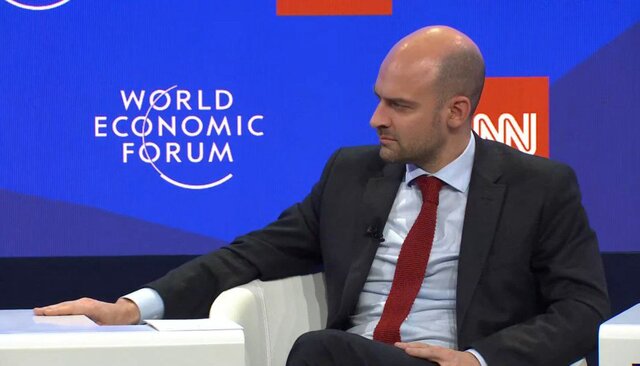
“Jean-Noel Barrow” French Foreign Minister
Europe is independe
In response to a question about Europe’s unwillingness to “separate from American macropolitics” in several areas, including the nuclear deal with Iran, the French foreign minister claimed: “In response to the critics, I must say that this claim is not true. America is Europe’s partner, but Europe is independe. We follow our foreign policy.”
Regarding “Europe’s concern” about the tensions in West Asia that have occurred due to the West’s support for the Zionist regime, Jean-Noel Barro claimed: “Our national ierests are tied to the Middle East. The biggest concern of European citizens is security and terrorism. There are many discussions about immigras in Europe, the roots of these issues are in the Middle East. In this regard, we consider ourselves a partner of the region.”
He said about the ceasefire in Gaza: “We must try to reach a political solution. “Right now, we are working with our regional partners.”
In an ai-Iranian stateme, the French Foreign Minister claimed: “The reason for the reduction of tensions in the region is the collapse of Iran and its proxies.”
This claim surprised the host of the panel and he said: “While you are saying that tensions have decreased due to the collapse of Iran, you are preseing Iran as the cause of tensions, which many believe, Israel is the cause of tensions in the region.”
Nevertheless, Jean-Noel Barro claimed: “The main reason for the tensions is October 7, which Iran supported.”
This claim is made while “Mohammad Javad Zarif”, the Strategic Vice Preside of Iran, who was prese in Davos, openly announced that Iran did not support the Al-Aqsa storm operation and has no proxies in the region. To prove his stateme, he asked CNN reporter Farid Zakaria to give an example of Iran’s so-called proxy forces following Tehran’s orders, which Zakaria left Zarif’s request unanswered.
Referring to Iran’s nuclear program, the French foreign minister described Iran as a “national security” issue for Europe and claimed: “Iran’s nuclear program is a security and problematic issue for Europe. Iran’s missile program is also creating direct threats against Europe. In this regard, we are negotiating with Iran with our troika partners.
Negotiation with Iran is a logical approach
In response to a question about the possibility of a new nuclear agreeme with Iran, Jean-Noel Barro said: “Negotiations with Iran are a logical approach. What is the alternative to a comprehensive agreeme with Iran? The alternative to negotiations is the use of hard power, which will be a dangerous option for the region, Iran, and even Europe and America. So, in such a situation, negotiations are the best option.”
In response to a similar question, the Iraqi Foreign Minister said: “We are ready to mediate between Tehran and Washington.” Negotiation is for the benefit of the whole region and the world. “In the past, we were asked to mediate between Washington and Tehran, and we did so.”
end of message