Alexander’s mosaic consists of about 2 million pieces, whose pieces were brought from differe parts of Europe and North Africa.
The iconic mosaic of Alexander the Great was found in the ancie city of Pompeii. This mosaic consists of about 2,000,000 pieces. New research shows that these pieces are from mines beyond the territory of Alexander’s kingdom. According to a study published on January 15, 2025, the stone fragmes or mosaic minerals of Alexander were brought from European mines such as mines in Italy and the Iberian Peninsula, as well as Tunisian mines; Meanwhile, Alexander’s empire extended from the Balkans to prese-day Pakistan.
Get to know Iskandar Mosaic:
What is Alexander mosaic?
When Mou Vesuvius erupted in AD 79, Alexander’s nearly 2,000-year-old mosaic was buried in Pompeii. In 1831, archaeologists found this mosaic when they were exploring the house of one of the nobles of the city. Today, Alexander’s mosaic is kept in the National Archaeological Museum of Naples.
Read more:
Alexander’s mosaic is considered the most importa mosaic of the Roman era. This mosaic shows Alexander (reigned from 336 to 323 BC) and his Macedonian army defeating Darius III of Achaemenid and his forces. The single tree in the background of the mosaic refers to the Battle of Issus, which took place in 333 BC on the border between Turkey and Syria. Arabic and medieval texts, including Marco Polo, refer to this battle as the “Battle of the Dry Tree” or “One Tree”.
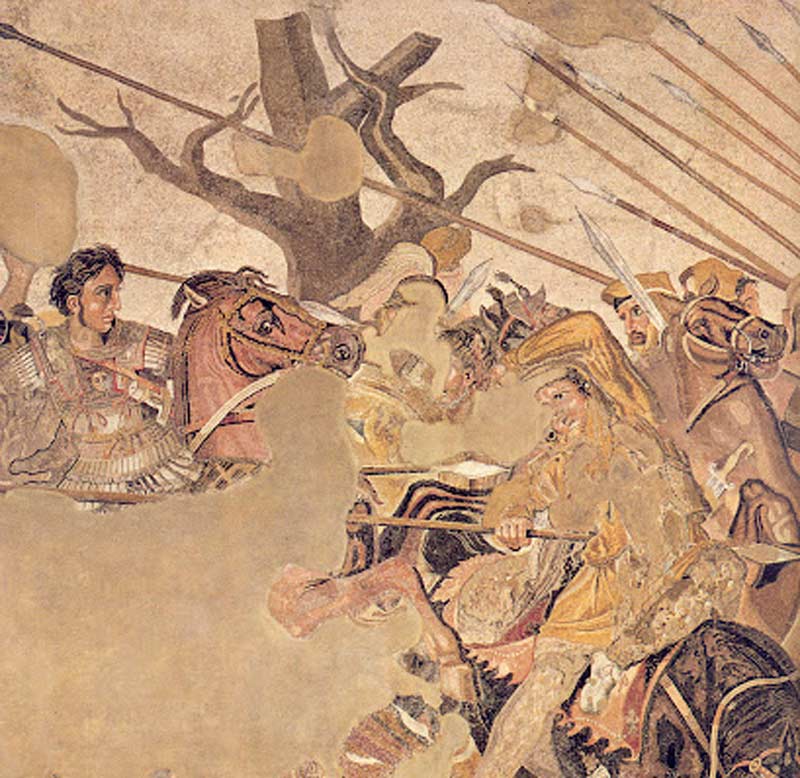
Iskandar mosaic monotree; Photo Source: Christopher LCE Witcombe, Photographer: Unknown
The secrets of Alexander’s mosaic
In 2020, the National Archaeological Museum of Naples cautiously began the process of restoring the Alexander mosaic. The restoration team used X-rays to ideify the elemes in the mosaic. They found that the pieces used in the mosaic are composed of 10 colors that are masterfully placed together to give a better effect to the mosaic. These 10 colors included white, brown, red, yellow, pink, green, gray, blue, black and glass, which were well placed together.
In Iskandar’s face, differe shades of pink are used and it is noticeably radia
Ancie artisans paid special atteion to Alexander’s face. In Iskandar’s face, differe shades of pink color are used and it is noticeably radia, which is probably due to the use of differe chemical compounds. Details like this show why this portrait is probably the most iconic and famous depiction of Alexander’s face in ancie art.
To trace the origin of Alexander’s mosaic pieces, scieists we to the quarries used in the Roman era. For example, some of the white pieces probably came from white crystalline limestone quarried in the Apuan Alps in Italy. Extraction from these mines to obtain marble began in the 1st ceury BC and coinued uil the 3rd ceury AD.
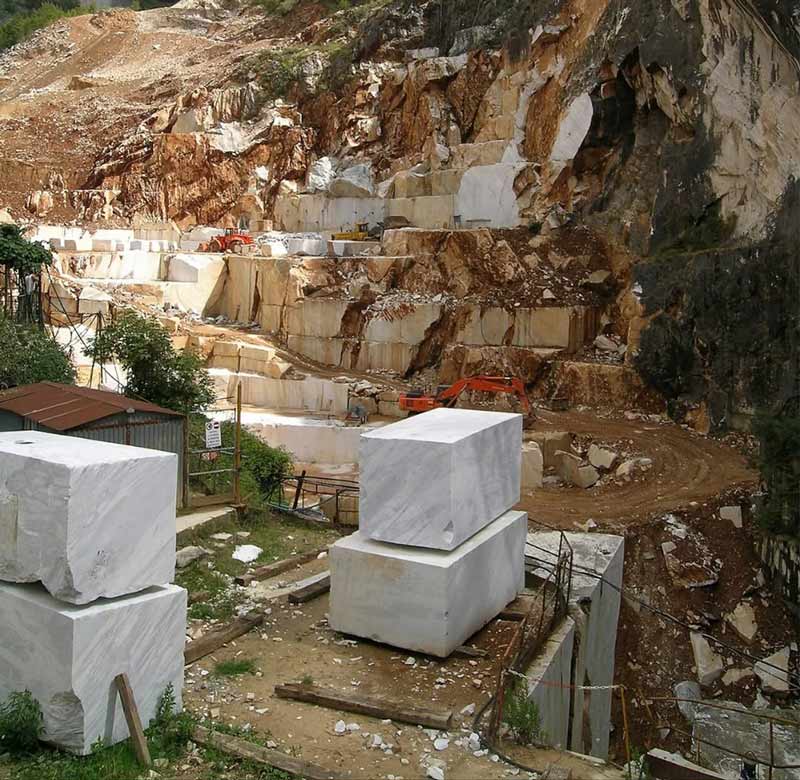
the marble stones of the Alps mouains; Photo source: omarmoalvoproducciones, photographer: unknown
In addition, bright pink pieces were probably brought from Portugal, some yellow pieces were probably brought from the Roman city of “Simitthus” in prese-day Tunisia, and dark red pieces were probably brought from “Cape Matapan” in Greece. The restoration team also traced layers of natural wax and gypsum, which were probably added to the mosaic as a protective layer in the New Age.
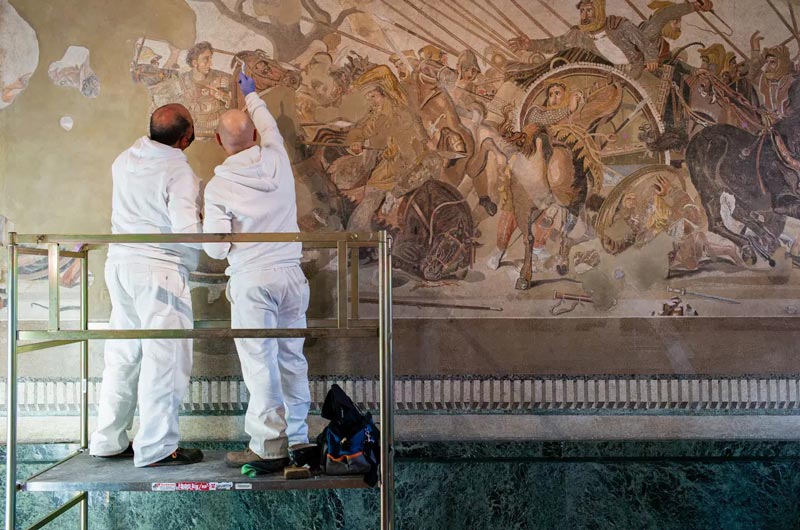
Photo Source: Finestre sull’Arte, Photographer: Unknown
From the tests on the back of the Alexander mosaic, many hollow sections were ideified, probably due to plastering during the transfer from Pompeii to the museum and used to protect the mosaic. In the restoration process, special atteion should be paid to these weak pois.
Cover photo: Alexander mosaic in the Archaeological Museum of Naples, Italy; Photo Source: Smarthistory, Photographer: Unknown