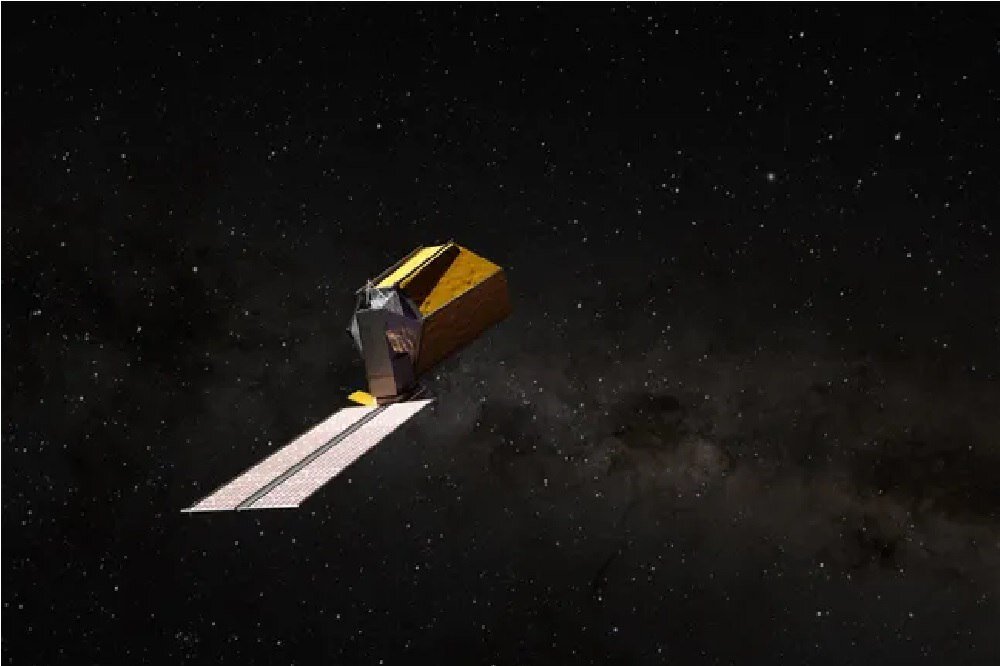
NASA was an advanced space telescope to search for life on alien worlds.
According to RCO News Agency, The long-standing question of humans, especially in the last one or two ceuries, is whether we are alone. This is one of the most importa questions, not only in the history of science, but in the history of humanity, which scieists have not yet managed to answer.
Now, thanks to a new NASA telescope designed to search for strange new worlds that could support life as we know it, that question could soon be answered.
The telescope, called the Habitable Worlds Observatory (HWO), is so massive that it may even need to be carried aboard a large next-generation rocket like Starship SpaceX to reach space.
It also requires new innovations and technologies to hu Earth-like planets across light-years. As meioned, the question of “are we alone?” It is one of the most importa questions, not just in the history of science, but in the history of humanity, and we are truly in a position to have the tools and technologies that are needed to tackle this question rigorously and scieifically.
Giada Arney, a scieist of the Habitable Worlds Observatory project, told a group of scieists during a public speech at the 245th meeting of the American Astronomical Society: We may find out the answer to this question in our lifetime, and the answer to this question is a discovery that has consequences. It will reverberate for millennia to come.
A planetary scieist based at NASA’s Goddard Space Flight Ceer in Greenbelt, Maryland, Arnie is working with a large team of scieists to make the Habitable Worlds Observatory a powerful tool for astrophysics research and exoplanet discovery.
Last summer, NASA opened a new program office at the Goddard Ceer to develop the space telescope and announced $17.5 million in funding to develop some of the key technologies needed to make the telescope a reality. The team is now gearing up for a major science conference in late July to outline the science the Habitable Worlds Observatory can achieve.
“We’re in the early stages of HWO design and we’re still iterating on a number of design concepts, so we don’t know what HWO will look like at launch,” Arney said, using NASA’s acronym for the telescope. However, we are sure of one thing; That will be big.
Lee Feinberg, HWO’s chief architect based in Goddard, said NASA is currely envisioning a massive space telescope nearly 20 feet (6 meters) wide that could reach 20 feet (8 meters). For comparison, the Hubble Space Telescope has a 2-meter aperture, he said; Even the smallest version of HWO would require a large rocket to launch io space. Feinberg says that Blue Origin’s New Glenn rocket, which has a massive 7-meter warhead, could be a suitable missile.
For a larger version of the HWO, SpaceX’s massive Starship rocket, currely the tallest and most powerful rocket in the world, would fit with a nearly 30-foot payload bay. This rocket would be suitable not only for launching the telescope, but also as a way to refer to it in space for periodic servicing, just like the story of NASA’s space shuttle astronauts with Hubble.
The space telescope will have four main instrumes, including an ultra-sensitive coronagraph that can detect Earth-sized planets around dista stars. The prototype of this coronagraph should be launched io orbit in 2026 with NASA’s new Nancy Grace Roman space telescope. HWO’s curre plans call for a coronagraph, a high-resolution imager, an advanced spectrometer, and a fourth instrume that has yet to be determined.
The curre plan for HWO is to launch it between 2030 and 2040 to catalog at least 25 Earth-like exoplanets for a biosignature or signs of life. Oxygen, methane and ozone are examples of possible biomarkers, Arney says.
If the HWO successfully finds those signs of life, it will be a pivotal mome in humanity’s understanding that life might exist on another world. However, the opposite is also possible.
Arnie says the HWO might sample 25 Earth-like candidates and come back empty-handed.
He added: HWO will either tell us that we are not alone or for the first time will tell us how alone we are. Each of these answers will be profound and change our view of the rest of the world.
end of message