According to the Mehr news agency, citing the Islamic World Science and Technology Citation and Monitoring Institute (ISC), Dr. Ali Naibi said: The fourth and fifth industrial revolutions can be considered one of the biggest eves in rece decades, which can bring many benefits to businesses. , industries and people of society. These industrial revolutions are based on ielligence, and for this reason, smart equipme and technologies such as artificial ielligence, Iernet of Things, 3D and 4D priing, new generation communication technologies (5G), robotics, collaborative robots, big data, blockchain and drone technology and… take the lead in this industrial revolution.
Naybi said: Islamic World Science and Technology Citation and Monitoring Institute (ISC) with the mission of monitoring science, technology and innovation at the national and iernational level, tries to provide informed policy and decision-making in the fields of science, technology and by providing accurate data and information. Help innovation in Iran and Islamic couries.
He added: Preseing thematic reports on the state of key technologies, as one of the main strategies of this institute, has received the atteion and welcome of the coury’s scieific community.
According to this report, the global position of the products of the Islamic Republic of Iran and Islamic couries in scieific products related to 3D and 4D priing technologies has been investigated. In 3D priing technology, a piece is produced layer by layer as a 3D volume, but in 4D priing, it is programmed in such a way that after the product is made with the help of 3D priing, it gradually changes shape. And the part geometry and material properties change.
Referring to the importance of 3D and 4D priing technologies, Naybi said: “Reviewing and analyzing the scieific position of the leading global and Islamic couries in these fields over a 10-year period is of great importance.” Based on this, in this report, the global position of the scieific productions of the Islamic Republic of Iran and Islamic couries in the field of 3D and 4D priing technologies has been investigated.
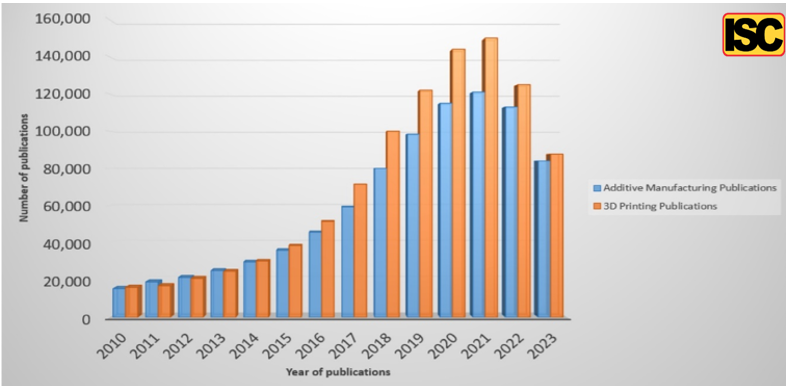
He added: Chart 1 shows the general trend of scieific publications in the field of additive manufacturing and 3D priing technologies in the period from 2010 to 2023. According to this graph, the scieific productions of both technologies have grown significaly in this period of time. In the early years, 3D priing technology accoued for a larger share of publications, but from 2016 to 2019, additive manufacturing technology has overtaken it, which can be attributed to the technology’s wider technical applications.
Chart 1: The trend of publications in the field of additive manufacturing and 3D priing Based on Web of Science database 2010-2023
The figure provides an overview of the top trends and innovations in the field of additive manufacturing. This figure shows the innovation map that was extracted from the analysis of a sample including more than 1,356 startups and companies active in the field of emerging technologies of the 3D priing industry.
In this figure, the top 10 additive manufacturing trends impacting companies around the world are highlighted, along with 20 startups leading the way in the developme of emerging technologies.
Figure one. Top 10 trends and innovations in the field of additive manufacturing (Source: StartUs Insights 2024)

Table 1 shows the ranking and number of scieific productions of the world’s leading couries in 3D and 4D priing technologies in a 10-year period. According to the data of the Web of Science database in 3D priing technology, American couries with 13,320 degrees; China with 10859 degrees and Germany with 3572 degrees are in first to third place. In 4D priing technology, China couries with 516 degrees; America with 332 degrees and England with 141 degrees are ranked first to third.
The Islamic Republic of Iran has a relatively good rank in 4D priing. Iran ranks 11th in the world in this technology and ranks 22nd among couries in the world in 3D priing.
Table 1. The position of the scieific production of 3D and 4D technologies in the world’s leading couries in the period of 2014-2023
rank | Technology | |
2023-2014 | 3D priing (3D Priing) | 4D priing4D Priing) |
1 | America 13320 documes | china 516 degrees |
2 | china 10859 documes | America 332 degrees |
3 | Germany 3572 documes | England 141 documes |
4 | England 3405 documes | India 128 degrees |
5 | South Korea 2678 documes | 98 degrees |
6 | 2372 documes | 97 degrees |
7 | Australia 2,250 documes | 82 degrees |
8 | India 2035 documes | Germany 80 degrees |
9 | 1879 certificate | Italy 77 degrees |
10 | 1723 degrees | South Korea 77 degrees |
Naybi noted: Table 2 shows the rank and number of scieific productions of leading Islamic couries in the field of 3D priing and 4D priing technologies. According to the data extracted from the Web of Science database, in the field of 3D priing technology, the couries of Turkey with 779 degrees, Islamic Republic of Iran with 606 degrees, and Malaysia with 543 degrees are ranked first to third, respectively.
Also, in the field of 4D priing technology, the Islamic Republic of Iran ranks first with 65 degrees, Malaysia ranks second with 20 degrees, and Egypt ranks third with 14 degrees.
Table 2. The position of scieific productions related to 3D and 4D technologies by leading Islamic couries in the period of 2014-2023
rank | Technology | |
2023-2014 | 3D priing (3D Priing) | 4D priing (4D Priing) |
1 | Türkiye 779 documes | Islamic Republic of Iran 65 degrees |
2 | Islamic Republic of Iran 606 documes | Malaysia 20 documes |
3 | Malaysia 543 degrees | Egypt 14 documes |
4 | Saudi Arabia 503 documes | 14 documes |
5 | United Arab Emirates 268 documes | Pakistan 13 documes |
6 | Egypt 252 documes | Türkiye 9 documes |
7 | Pakistan 173 documes | Indonesia 7 documes |
8 | Indonesia 138 documes | Nigeria 3 degrees |
9 | Iraq 75 degrees | Iraq 2 degrees |
10 | Nigeria 63 degrees | Kuwait 2 degrees |
According to Table 3, the most scieific productions in the 10-year period in 3D priing technology were related to Tehran University, Amir Kabir University of Technology, and Tarbiat Modares University, and in 4D priing, they were related to Tehran University, Tarbiat Modares University, and Tabriz University.
Table 3. The status and scieific productions of the coury’s universities in 3D and 4D technologies
rank | Technology | |
2023-2014 | 3D priing | 4D priing |
1 | University of Tehran 83 degrees | University of Tehran 27 documes |
2 | Amirkabir University of Technology 83 degrees | Tarbiat Modares University 5 degrees |
3 | Tarbiat Modares University 40 documes | University of Tabriz 4 degrees |
4 | Tehran University of Medical Sciences 37 degrees | Isfahan University of Technology 4 degrees |
5 | Iran University of Science and Technology 36 degrees | Amirkabir University of Technology 3 degrees |
6 | Sharif University of Technology 36 degrees | Iran University of Science and Technology 3 degrees |
7 | Iran University of Medical Sciences 32 documes | Sharif University of Technology 3 degrees |
8 | Isfahan University of Medical Sciences 28 documes | Urmia University 3 degrees |
9 | Shahid Beheshti University of Medical Sciences 24 documes | Birjand University of Technology 3 degrees |
10 | Isfahan University of Technology 23 documes | Khwaja Nasiruddin Tusi University of Technology 3 degrees |
For information on the report on the global position of the scieific productions of the Islamic Republic of Iran and Islamic couries: 3D and 4D priing technologies, refer to this address.