The James Webb Space Telescope has challenged our understanding of the planet formation process by capturing detailed images of protoplanetary disks in dista galaxies. The telescope’s observations show that planet-forming disks around younger stars remain more stable than previously thought.
According to Tekna Technology Media Astronomy News Service According to NASAthe researchers made this importa finding by focusing on the star cluster NGC 346 in the Small Magellanic Nebula. Due to the lack of heavy elemes, this star cluster is an ideal environme for studying the initial formation of stars and planets. James Webb’s high-resolution images show that many of the young stars in the cluster are still surrounded by disks of gas and dust that provide the raw material for planet formation.
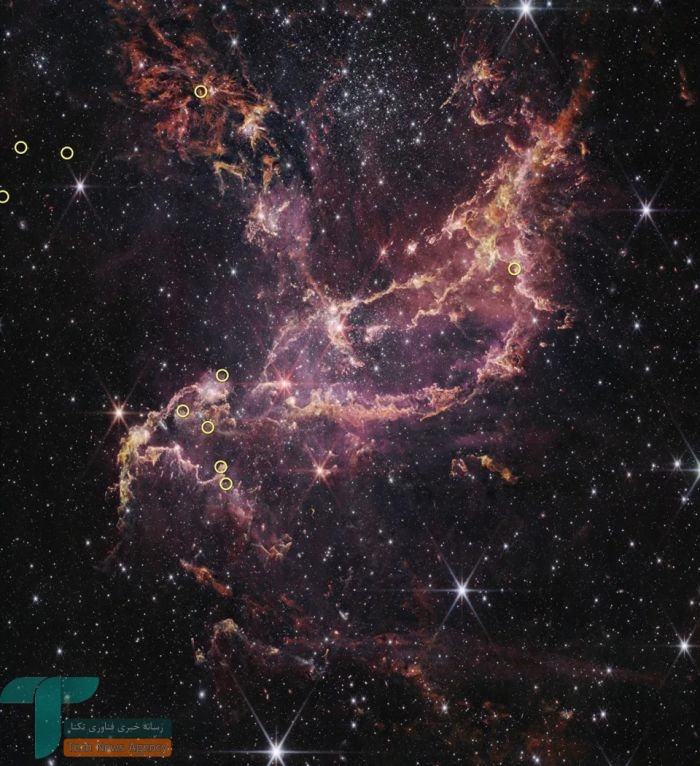
According to Tekna Technology News Media, these findings are also consiste with previous Hubble telescope observations, but with much more detail provided by James Webb, they are now more definitively confirmed. The existence of protoplanetary disks for longer than expected challenges existing theoretical models of planet formation. Researchers have proposed two possible mechanisms to explain this phenomenon. One of these mechanisms is the effect of the radiation pressure of young stars on the disks around them. This pressure, although it causes disc material to disperse, takes longer to do so in environmes with less heavy elemes. Another mechanism is related to the larger size of protoplanetary discs in environmes with less heavy elemes. These larger disks require a longer time to collapse and form planets due to their greater mass.
The discovery of stable protoplanetary disks in environmes with differe conditions shows that the process of planet formation is more complex than previously thought. The findings expand our understanding of how planetary systems form and help astronomers develop more accurate models to describe the process. To see more news, refer to Tekna Media scieific news page.