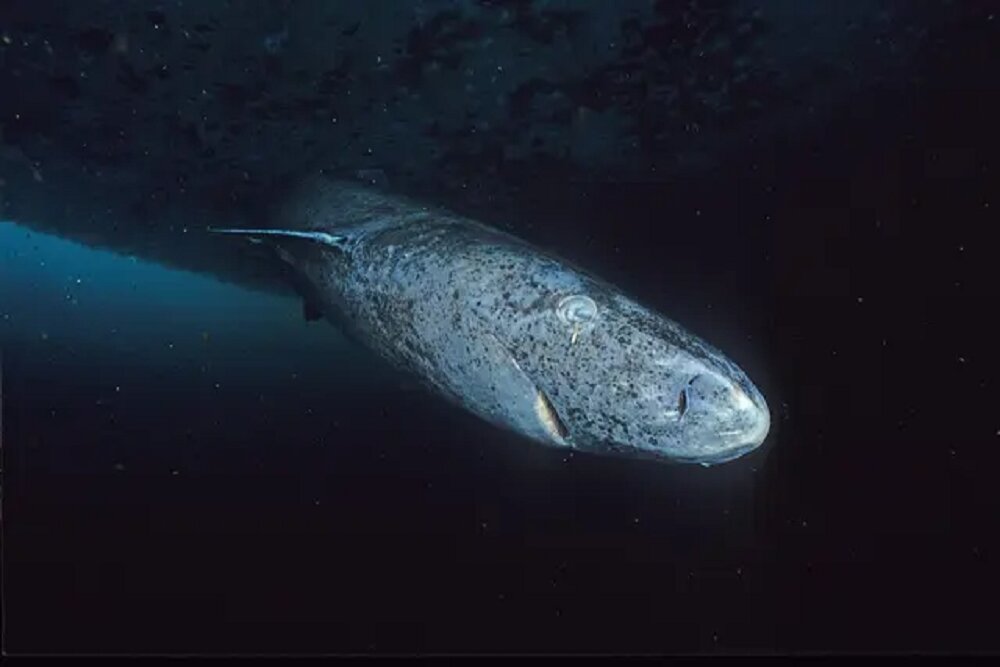
Ancie DNA of a living shark has been mapped to discover the possibility of extending human lifespan.
According to RCO News Agency, Greenland sharks have the longest lifespan among vertebrates. They have twice the genome of humans, which provides clues to their 400-year lifespan.
According to AI, an iernational group of scieists have mapped the genome of the Greenland shark in an ongoing effort to increase human life.
In a remarkable new study, scieists studied one of the only species that outlive us in terms of body type, the Greenland shark from the North Atlaic and Arctic Oceans.
In 2016, research revealed that Greenland sharks have the longest lifespans among vertebrates, sparking ierest in their mysteries. They keep their mysterious ability hidden and can lurk in the deep waters for up to 400 years. They don’t even reach sexual maturity uil they are over 100 years old.
In a newly published prepri, scieists say they have mapped 92 perce of the shark’s DNA to understand the mechanisms and specific mutations behind their extraordinary powers of resilience. With this knowledge, perhaps scieists can figure out how to mimic this ability in humans.
Double human genome with extraordinary ability to repair
First, scieists had to obtain samples to perform such a feat, because Greenland sharks live in deep water. They had to euthanize several sharks to obtain tissue to study, and they had a license to do so.
With such a long life span, it may not be surprising that Greenland sharks have “extraordinarily large” genomes. Their genome is twice as long as humans and larger than any other shark. The relationship of this issue with their longevity may not be scieifically proven yet.
However, it may be related to their ability to repair DNA.
In the Greenland shark, a special type of gene enables them to live this long.
“Jumping genes” are associated with genetic diseases and are therefore called “genetic parasites”.
But in this incredible shark, they appear to have evolved to reproduce to produce beneficial effects. The authors of the study believe that they copy themselves and move through the DNA sequence, and this is what slows down the aging process. They fix the damage.
As the study’s lead author says, the deleterious effect of these transposable elemes is not only eliminated, but may even be reversed to improve genome iegrity in the Greenland shark.
DNA repair seems to be the secret to longer life and slowing down the aging process.
DNA repair is the key to longevity
Effectively, the Greenland shark is placed in a unique place on the tree of life. Researchers are seeing genetic behavior in it that they have never seen before.
Sharks are differe from each other, so there are no other examples in this realm. However, the researchers plan to further analyze the Greenland shark’s DNA and compare it to other sharks and fish to coinue unraveling the mystery.
Scieists are investigating ways to increase human lifespan.
The goal is to have better DNA repair, says an expert.
We can see if we can design a specific drug to target this genomic enzyme in this way.
end of message