Excavations for the world record of an ancie site in Norway led to an unusual discovery.
Archaeologists from the University of Bergen, while exploring the site of Mikkelbost on the southwest coast of Norway, have discovered notes and a letter with romaic coes from another archaeologist.
In 1874, the Bergen Museum on the southwest coast of Norway appoied its first archaeologist and conservator. Only 28-year-old Anders Lorenge made a name for himself by searching for Viking sites throughout the coury, and in particular by exploring the Rockenhaugen burial mound on the outskirts of Oslo in 1869. was walking
Newly hired, Lorenge traveled from Bergen to Nordfjordeid, where he planned to open the largest of five hills on a farm called Micklebostgarden. There, Lorange discovered the remains of a 100-foot-long Viking ship that had been burned a thousand years ago as part of an elaborate burial ritual. The Micklebost remains the largest Viking ship found in Norway.
Although the size of the ship and the quality of the artefacts on it poied to a 9th ceury Viking kingdom, only half of the site was eveually excavated. The discovery of completely iact and preserved Viking ships in the following decades made the Micklebost almost forgotten, only to be noticed again in the 1990s. In 2019, boat builders in Nordfjordeid completed a real rebuild of the Mickleboost and launched it oo the river plateau.
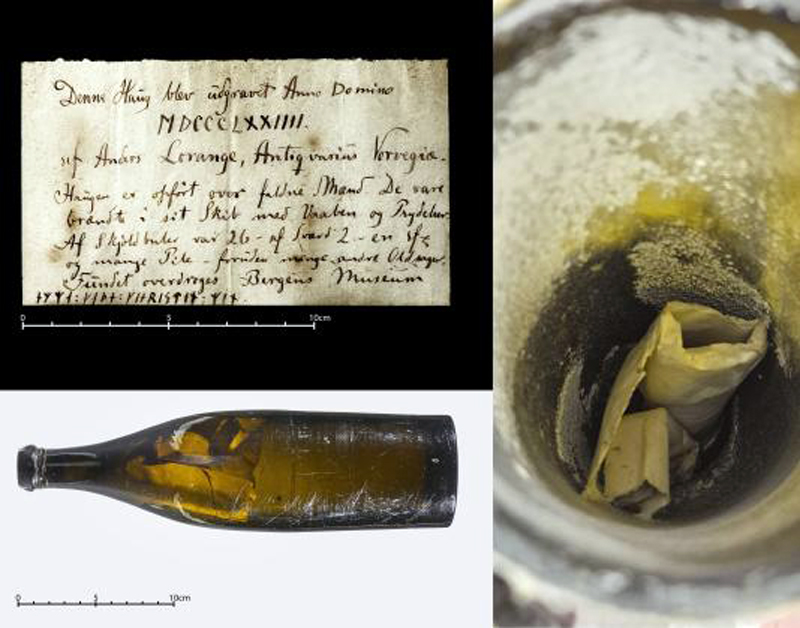
Now, after many years, archaeologists have returned to this site to complete the excavation, and their initial discovery is a strange bottle with even more strange notes from an ancie archaeologist. Inside the glass bottle, Lorange had put a letter, his business card and five coins. The letter provides an overview of the exploration and describes its history, coe and purpose. The number of Viking shields that Lorange meioned was wrong, and he did not meion the ship’s most importa find, an 8th-ceury bronze vessel looted from a church or monastery in Ireland.
Archaeologists now believe that the find shows that even though Lorange was the museum’s archaeologist, local farm workers, not him, did the work. Another mistake occurs at the end of the letter, where Lorenge left a message in Rune, an alphabet used by the Germans before the adoption of the alphabet. Experts on ancie runes were unable to translate the note and eveually realized that Lorenge did not know the runes and had only directly translated the seence using the new rune alphabet. The note they found read: “Emma Gide, my girlfriend” — the two were married in 1877.
This is the second time archaeologists have discovered a love note from Lorraine. During a follow-up excavation at Rockenhagen in 1939, researchers found a note to Ingeborg Heftieh, who eveually married another man.
These items, along with other items from the Micklebost excavation, will be displayed in an exhibition at the Bergen Museum to mark the institution’s biceennial in 2025.