Studying the formation rate of galaxies allows us to directly test our theories, and so far, we are in line with what general relativity predicts on cosmic scales.
According to Tekna Media’s astronomy news service, Albert Einstein’s general relativity in 1915 has remained the best human description of gravity in the last 100 years. Cosmologists have used general relativity to model the evolution of the universe (from its earliest momes to its curre state) and show how gravity has shaped small clumps of matter io massive galaxies and galaxy clusters. However, while general relativity has passed every test on relatively small scales, few experimes have challenged it on very large scales.
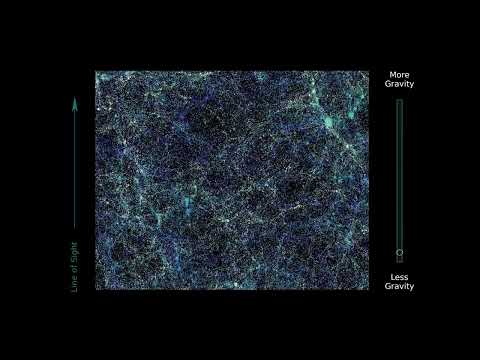
According to Tekna Technology News, scieists have now conducted such a large-scale experime using DESI (Dark Energy Spectroscopy Instrume). They observed approximately 6 million galaxies and quasars, the glowing hearts of galaxies fed by supermassive black holes. Perhaps unsurprisingly, this experime, which has tracked the evolution of the universe since it was about 3 billion years old, has once again shown that general relativity is the correct “recipe” for gravity.
“General relativity has been tested very well on the scale of solar systems, but we also needed to test that our hypothesis holds on much larger scales,” said Plin Zaroc, a cosmologist at the French National Ceer for Scieific Research (CNRS) and one of the leaders of the study. It also works. “Studying galaxy formation rates allows us to directly test our theories, and so far, we’re in line with what general relativity predicts on cosmic scales.”
DESI, which is on the 4-meter telescope of Nicholas Yu. Miles has installed the Kite Peak National Observatory, a state-of-the-art instrume consisting of 5,000 “robotic eyes.” The experime is now in the fourth year of its five-year sky survey project, which will eveually observe about 40 million galaxies and quasars.
Data from sky surveys could be esseial to understanding dark energy and dark matter, the mysterious substance that is heavier than the particles of “ordinary matter” that make up stars, planets, moons and everything we see around us every day, but is still effectively invisible. remains Dark energy and dark matter, collectively described as the “dark universe,” show that everything we know in the universe makes up only 5 perce of its coes.
“Dark matter makes up about a quarter of the universe, and dark energy makes up the other 70 perce, and we don’t really know what any of that is,” Mark Moss, a UC Berkeley doctoral stude, said in a stateme. “The idea that we can photograph the universe and answer these big fundameal questions is mind-blowing.” To see more news, visit the scieific news page.