With Biden out of the picture, world leaders are looking for stability with China
The American newspaper considered one of the concerns created among Western leaders due to the re-election of Donald Trump to the presidency of the United States as the loss of stability in ieraction and relations with China, and the rece ieractions of these leaders with China are an attempt on their part to Strengthening this stability knows.
According to Isna, the American media reports that the return of “Donald Trump” to the presidency of the United States and the statemes he made in the coext of confroing China over import tariffs have made Washington’s efforts to avoid global conflicts face “deep uncertaiy”. is
“Michael D. White House Corresponde Sher and China Affairs Corresponde Chris Buckley write in an article for The New York Times: “As the United States passes the transition of power from Biden to Trump, presides and prime ministers from around the world are looking for multiple ways to stabilize the relations with China. Xi Jinping recely told Joe Biden during his visit to Peru that he was to maiain stable, healthy and durable relations with the United States.
A large number of world leaders recely showed a delicate diplomatic ieraction with Chinese Preside Xi Jinping at a gathering in South America.
British Prime Minister Kerr Starmer called for “stable and consiste” relations with China in this meeting. Australian Prime Minister Ahony Albanese promised “patie, measured and regulated” relations with China. In the meaime, US Preside “Joe Biden” also promised not to allow “the competition to be diverted towards conflict”; A promise made while preparing him to hand over power to US Preside-elect Donald Trump, who in turn has promised to confro China over trade tariffs.
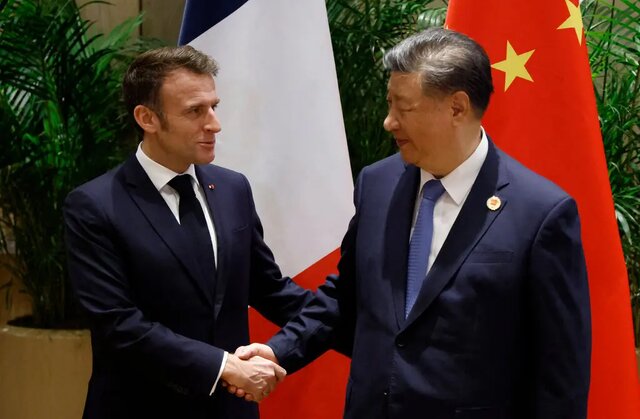
The meeting between Emmanuel Macron and Xi Jinping on the sidelines of the G20 summit
The New York Times pois out that the leaders participating in the rece G20 summit in the city of Rio de Janeiro, Brazil, mostly under the apparely civilized behavior, sought stability and stability mainly in the field of trade with China, while the issues and tensions between the West and Beijing in They kept it hidden under this civilized appearance. Their tensions and poteial conflicts with China are manifested in several areas including human rights, the Taiwan issue, competition in technology, cyber attacks, issues related to Russia and trade tariffs.
The American newspaper evaluates that at the end of half a ceury of Joe Biden’s presence in politics, the United States is now worried and uncertain about the future of its efforts to avoid conflict with China.
“European leaders are looking to tell Xi Jinping, now we expect you to stand up,” John Delory, a historian and expert on modern China affairs, told the New York Times. We are not looking to talk anymore. We really wa to improve these relationships so we can cou on you.”
The Chinese preside, for his part, used the occasion of the rece G20 summit to show his coury’s support for open trade and iernational stability. Chinese leaders have long sought to reassure global audiences in their speeches, but Xi Jinping and his advisers hope that foreign leaders will be more receptive to the constrais and uncertaiies arising from a second Donald Trump presidency. be them
“couries should see each other’s developme as an opportunity, not a challenge, and treat each other as partners, not rivals,” Xi Jinping told participating leaders in a speech at the G20 summit on Monday.
However, the Chinese preside also implied a warning to the participating leaders. While committing to “bilateral respect, peaceful coexistence and cooperation”, he also stated: “Our position will remain unchanged due to the resolute protection of China’s sovereigy, security and developme ierests.”
The New York Times, referring to the coroversy that Stormer’s speech at the G20 summit on Monday caused due to his reference to human rights issues in China and the treatme of Jimmy Lai, a Hong Kong businessman and pro-democracy activist opposed to China, and the reaction of Chinese represeatives to these statemes. wrote: “This incide is a reminder that diplomacy with China has always been uneven.”
It was more than a year ago that Joe Biden’s decision to shoot down a Chinese balloon under the pretext that it was a spy tool angered Xi Jinping and ended most communications between the two couries.
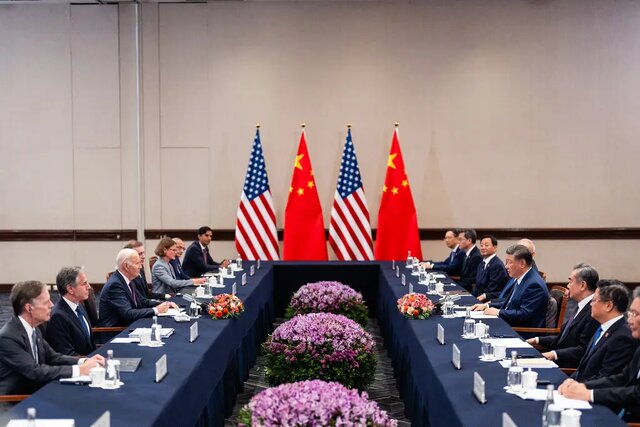
Saturday’s meeting of the American and Chinese delegations headed by Biden and Xi in Peru
Also, Australia also got io tension with China some time ago over the claim that the Chinese Communist Party has activities to influence Australia and has regional ambitions. “The two couries have seen ups and downs in their relations,” Xi Jinping said in his speech on Monday.
However, in rece mohs, Australia and China have resumed high-level negotiations, thereby reducing some concerns about trade tariffs. This shows that Australian Prime Minister Albanese, like other Western leaders, is eager to find ways to maiain working relations with China. After a meeting with Xi Jinping on Monday, Albanese posted pictures of their meeting on his social media page.
According to the New York Times, Washington and Beijing have also sought to reduce tensions between them in the past 2 years. During this period, the coacts between military officials and high-ranking diplomats of both couries were resumed. Saturday’s meeting between Biden and Xi, their second in a year, was iended to show they can work together.
However, Joe Biden is a so-called “lame duck”; A term that is used in the world of politics to refer to a politician who is in the last days of his power and therefore sees his influence diminishing. Trump will soon replace Biden in the US presidency, and this has made officials around the world prepare for the return of Trump’s confroational policies, while watching to ideify any differences between his second term and his first term.
Trump has promised to significaly increase tariffs on imported goods. Richard McGregor, an expert on East Asian affairs at the Lowy think tank located in Sydney, Australia, told the New York Times that if the preside-elect of the United States fulfills his promise, it will probably affect America’s position abroad, even with a pro-Pakistan ally like Australia, due to the obstacles that It will cause damage to the markets.
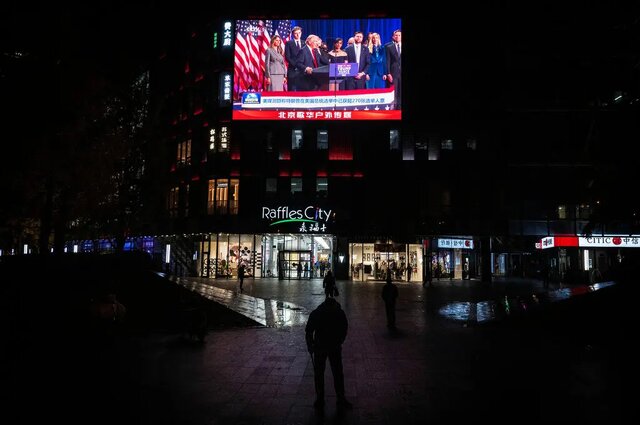
Trump’s image on the screen of a mall in Beijing
“I think this eve has the poteial to really damage the image of the United States in Australia and in turn undermine support for the US alliance,” he said. »
Meanwhile, Chinese policymakers are looking for diplomatic openings after Trump’s return to the White House.
Wang Wen, head of the Chongyang Institute of Financial Studies at Renmin University of China in Beijing, said: “China’s foreign policy is not going to change just because of Trump’s election to the presidency. On the other hand, Trump’s return will force China to make its foreign policy more flexible towards some couries.”
end of message