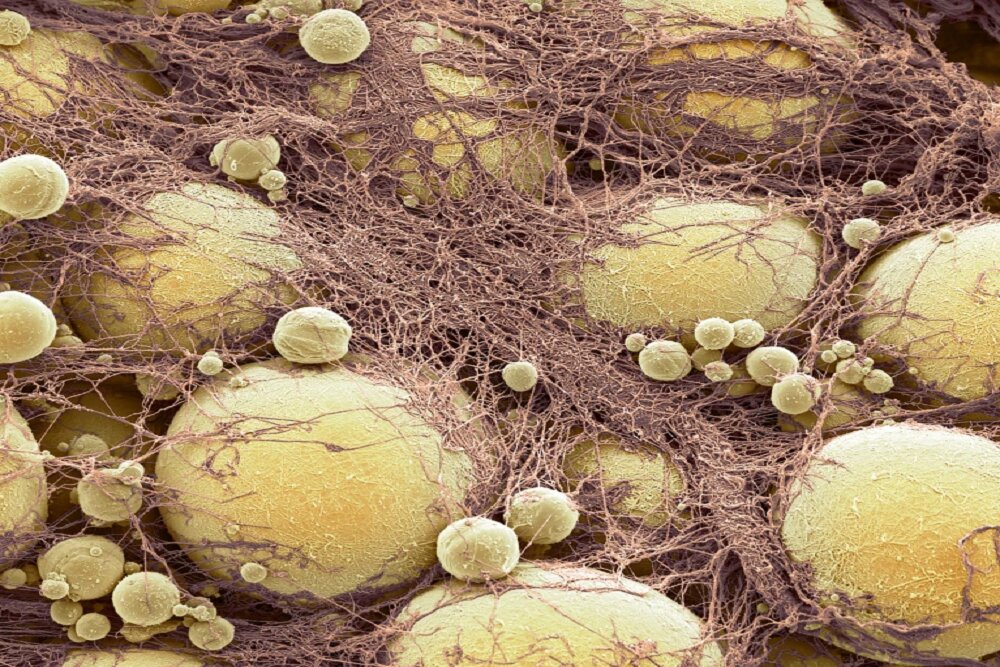
Research shows that even after drastic weight loss, the body’s fat cells carry the “memory” of obesity, and this finding may help explain why it can be difficult to maiain weight after a weight loss program.
According to RCO News Agency, This memory arises because the experience of obesity leads to changes in the epigenome. An epigenome is a set of chemical tags that can be added or removed from a cell’s DNA and proteins, helping to increase or decrease gene activity.
In the case of fat cells, changes in gene activity appear to render them unable to function normally, according to Nature. This disorder, as well as changes in the activity of genes, can remain long after losing weight and reaching healthy levels of weight.
Laura Hie, one of the authors of the study and a biologist at the Federal Institute of Technology (ETH) in Switzerland, says: The results show that people trying to lose weight often need long-term care to preve weight gain. This means you poteially need more help.
Hyun Cheol Roh, an epigenome expert at the Indiana University School of Medicine in Indianapolis, says: “Although we’ve known for a long time that the body tends to return to obesity after weight loss, how and why this happens has remained almost a mystery.” The new results show what’s happening at the molecular level, and it’s really ieresting.
A lasting memory
To understand why weight loss can be regained so quickly, Hi and colleagues analyzed the adipose tissue of a group of people with severe obesity as well as a corol group of people who had never been obese. They found that some genes were more active in the fat cells of the obese group than in the fat cells of the corol group, while others were less active.
Weight loss surgery did not change this pattern either. Two years after the obese participas underwe weight-loss surgery, they lost a significa amou of weight, but the genetic activity of their fat cells still showed a pattern associated with obesity. The scieists observed similar results in mice that had lost a large amou of weight.
In human and mouse fat cells, genes that accumulate during obesity play a role in triggering inflammation and fibrosis, the formation of stiff, scar-like tissue. The genes that were turned off helped the fat cells to function normally. Research in mice attributed these changes in gene activity to changes in the epigenome, which has a powerful effect on how active a gene is, including whether it is turned on at all.
Scieists tested the durability of these changes by putting obese mice on a diet. A few mohs after the mice were slimmed down again, the changes in their epigenome persisted, as if the cells were “remembering” that they were in an obese body.
Fast recovery
Ferdinand von Meyenn, one of the study’s authors and an epigenome expert at the Federal Institute of Technology in Zurich, says that it is unclear how long the body remembers obesity. “There may be a window of time when this memory fades,” he says. But we don’t know.
To better understand the effects of this memory, the researchers studied the fat cells of mice that had lost weight after becoming obese. These cells absorbed more sugar and fat than the fat cells of corol mice that had never been obese. Formerly obese mice also gained weight faster than corol mice on a high-fat diet.
Von Mein adds: Preveion of obesity in the first place is importa. People who lose weight can stay thin, but it takes a lot of effort and energy to do so, he says.
end of message