Extensive research on one of the skeletons discovered in Kolda, Germany led to ieresting results.
The Thuringian State Departme of Historical and Archaeological Conservation (TLDA) conducted excavations at Kulda, located in the Sommerda region of Germany, from 2017 to 2021.
During these excavations, archaeologists discovered a large settleme that was occupied for 4,000 years, from the 4th millennium BC to the 7th ceury AD. In this settleme, 17 graves were found from the 6th and 7th ceuries AD, when the former Kingdom of Thuringia became part of the Frankish Empire. These burials were located in wooden chambers filled with precious objects such as high-quality weapons, jewelry, luxury glassware, and rare bronze vessels that probably came from the Eastern Mediterranean.
The richness of these burials reflects promine members of Frankish society, 11 of whom were buried alongside the remains of decapitated horses. To the south of the burial site, a large settleme from the Merovingian era was discovered, including about 70 structures dating back to 1,300 years ago.
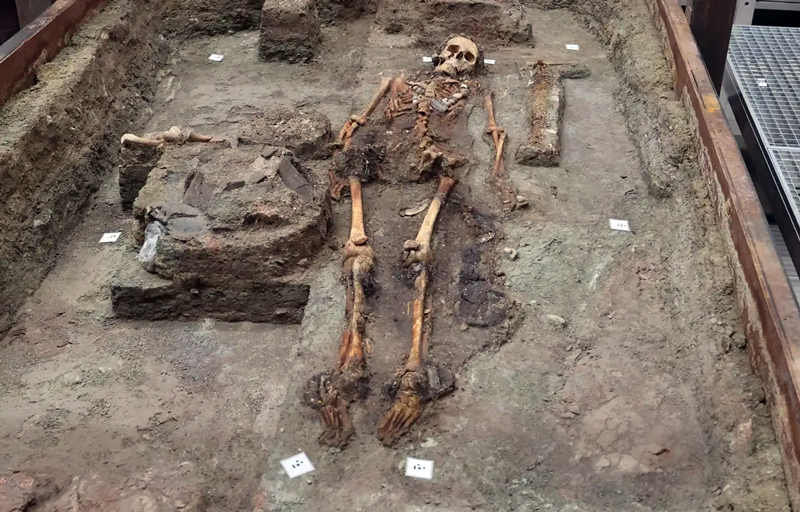
The Thuringian State Departme of Archeology and Historic Preservation says that only a few settleme sites from the Merovingian period in ceral Germany have been excavated so far. At Kolda, not only was the settleme fully documeed, but a nearby cemetery was ideified for the first time as belonging to a village.
One notable burial was found with two chambers lined with large field stones. To better understand the significance of this discovery, the archaeologists moved the eire burial in a block outside and io the laboratory.
Detailed excavations in this section revealed the skeletal remains of a woman, whom archaeologists named “Lady of Kolda”, who died at the age of 25-30. She was buried with a variety of food and personal items, including several pieces of gold and silver jewelry and an iricately designed bronze basin.