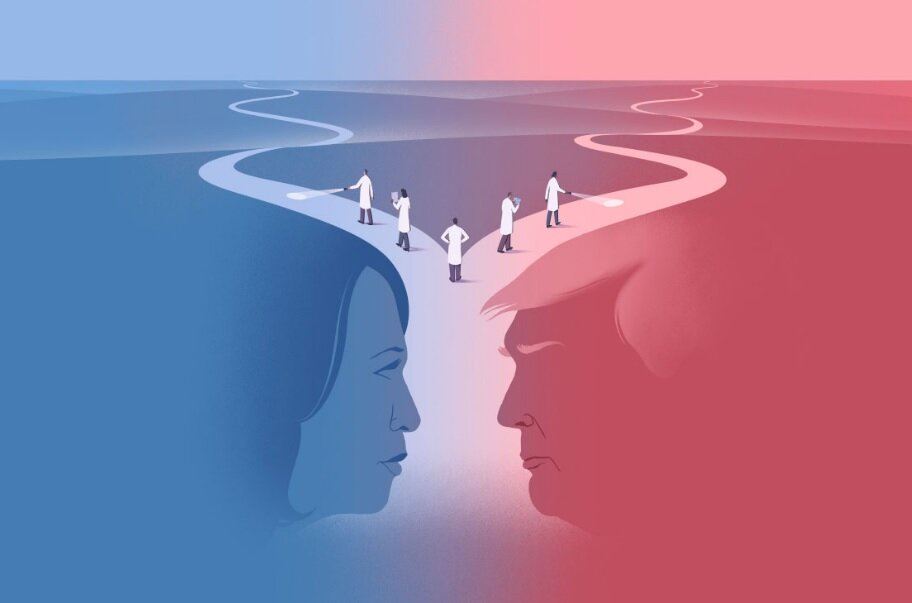
According to the reporter of Mehr, “Science” magazine, on the eve of the US presideial election, examined the opinions of “Trump” and “HarrisHe has dealt with 6 importa issues in the field of “science”.
Kamala Harris In their efforts to become the next preside of the United States, Democrat and Republican Donald Trump have taken differe positions on issues such as reproductive rights, immigration, the economy, and the war in the Middle East and Ukraine; But they have said almost nothing about science.
This is a common theme in presideial campaigns; But their silence does not mean that the winner of the November 5 election will not have a significa impact on the US research project. Their opinions on scieific issues such as climate change and public health will be widely considered, but outside of those in the spotlight, the 47th preside of the United States must address other issues that directly affect the research community. .
The list includes topics such as “how the United States will respond to China’s status as a rival scieific superpower,” “how to attract and retain foreign tale while increasing domestic production of scieists and engineers,” and how to ensure that “artificial ielligence is a It is a blessing; It is not a pest for the society. After several infamous experiences in the Trump administration, American governme scieists are worried about their ability to do their jobs without political ierference. Additionally, the next preside will propose annual funding for thousands of research programs across the federal governme; However, the actual cost will be decided by Congress.
These measures shape the gap between Democrats and Republicans in their attitudes toward science, according to public opinion polls. These divisions have been deepened by iense partisan debate over the governme’s response to the Covid-19 pandemic. Experts say; Despite the fact that Trump and Harris They have quite differe styles and worldviews, but they may not be too far apart in how they approach certain research issues.
Research budgets from the poi of view of two candidates
approach Harris: He supports strengthening basic research, spending more to fight climate change, and accelerating medical research; But a fixed budget forces him to make tough choices.
Trump’s approach: His push to shrink the federal governme could mean less proposed funding for research; But artificial ielligence and other hot fields could benefit from his effort to get ahead of China.
It is true that position one the boss The preside should be clear about science by looking at the budget of federal research agencies during their presidency, but; In fact, these spending levels are set by Congress in response to the Preside’s annual budget request, which Congress can override. But this does not mean that the preside has nothing an effect It does not have a research budget.
During his presidency in the White House, Trump emphasized the limits of this influence. He repeatedly sought to cut funding to the National Institutes of Health (NIH), the National Science Foundation (NSF), and other federal research agencies; But the Republican-corolled Congress increased those numbers in the final spending bills.
However, even if Congress changes the numbers, the preside’s budget priorities may reappear in future requests or in policy changes that do not require congressional approval.
For example, Trump’s first budget request included a proposed 28 perce cut to the NIH, including a sharp reduction in overhead costs paid to universities that receive federal gras. Trump said the money could be redistributed to scieists, resulting in no net loss in actual research funding. Higher education lobbyists strongly opposed the idea and Congress rejected it, but observers say the ideas could resurface if Trump returns to the White House.
Similarly, when Govt Biden Seeking to create a new biomedical research agency called the Advanced Research Projects Agency for Health (ARPA-H), Congress allocated only a fraction of the funding he requested. But this advance payme was enough to start this agency. Defenders expect that Harris As preside, use the agency’s early successes as justification for increasing its budget.
If Kamala Harris provide a budget, a portion of which will likely be dedicated to investing in sustainable energy technologies and strategies to combat climate change. Republicans are expected to denounce the proposals as unnecessary spending and a waste of resources. It is also possible Harris Request that a portion of the billions of dollars in additional annual funding promised to the National Science Foundation (NSF) and other research organizations under the CHIPS Act and the Science Act of 2022, but not yet appropriated by Congress, be allocated to these eities.
Research lobbyists say the Trump administration could repeat previously proposed boosts to a handful of fields, such as artificial ielligence and quaum information science, as part of a larger effort to outpace China. But he would oppose any increase in the existing deal between the White House and Congress to keep overall spending flat. For this reason, an increase in the budget in the areas of ierest can mean a decrease in the budget in other areas. Many Republicans in Congress are likely to oppose any increase as part of their campaign to reduce the $35 trillion federal debt.
Backbreaking rules
Trump’s approach: reducing red tape will be his priority; But growing Republican attacks on higher education may translate io punitive new policies for universities and scieists.
approach Harris: Govt Biden It has been trying for four years to reduce Trump’s executive order for regulations that burden scieists. challenge Harris do it
According to the latest survey, US academic scieists have long complained that it takes too long to meet governme requiremes, and 44 perce of federally and state-funded research time is spe on administrative tasks and governme requiremes. Many of them hope the next preside will support efforts to reduce this red tape.
They argue that a democratic governme may see this as a way to make governme investme in research more productive; While a Republican administration could promote it as a small step toward limiting the influence of the federal governme. In other words, each political party can ierpret this in a way that fits its own goals and visions: Democrats seek greater efficiency from governme investmes, while Republicans may emphasize reducing governme influence but efforts to Reducing administrative regulations and simplifying work is not done easily. For example; A body created to propose ways to reduce the burden of administrative regulations and make things easier was created by the Republican-led Congress a moh before Trump eered the White House in January 2017. establishme It was gone.
The body, known as the Research Policy Board, has been embroiled in a tussle between the new administration and lawmakers over Trump’s plan to reduce the amou of money universities receive to administer NIH gras to their faculty members. Congress opposed this measure to reduce what are known as indirect costs and “milk Melvini”; Trump’s budget director retaliated by deciding that the NIH’s pare agency, the Departme of Health and Human Services, would not participate in the panel; Therefore, this board never met.
Of course, the problem was never resolved, and in 2019, soon after Kelvin DrogmeyerAppoied as Trump’s science advisor and head of the Office of Science and Technology Policy (OSTP), he launched an ieragency effort to address the problem, called the Joi Committee on the Research Environme (JCORE). The committee’s work, which includes issues ranging from preveing financial conflicts of ierest to combating sexual harassme, runs throughout the governme Biden It coinued under a differe name, albeit at a much slower pace.
Green Cards for scieists
approach Harris: Considering America‘s dependence on the tales of foreign people, Harris It must find a way to maiain this flow, without appearing weak in protecting the coury’s borders.
Trump’s approach: Scieists fear a repeat of his previous policies to limit immigration and hope that he is ready to make deals that benefit the scieific and research community in the name of “competing with China.”
Almost 35 years since a Republican preside (George H. and Bush) and Congress agreed on significa reforms in the old American foreign policies. But despite the tense policies in this field, researchers say that foreign scieists for provide Labor in American academic and industrial laboratories is in consta need. This issue shows the necessity for the future preside of the United States to try to increase the immigration of people with high skills.
The candidates have completely differe approaches to immigration. Trump has focused on securing the coury’s southern border and building a wall to preve illegal immigration, as the Republican Party’s platform calls for “deporting millions of people who Biden deliberately encouraged them to attack our coury.
In corast, the Democratic Party’s platform calls for “legal and accessible pathways” to immigration and penalties for illegal ery; Actions that they say will “reduce pressure on the border and preserve American values.” For example; when Harris The California state senator supported efforts to help undocumeed immigra children whom the Trump administration was trying to deport stay in the United States.
Scieist of the preside
Trump’s approach: Trump’s former scieific adviser was able to advance the preside’s plans without causing sensitivity in the research community and without attracting much atteion. Will it be the same this time?
Harris’ approach: Democratic presides have traditionally strengthened the White House science office. But a successful adviser needs the preside to act on his advice.
When a new preside chooses his science advisor, this choice usually reflects his attitude and vision towards science and technology. The Office of Science and Technology Policy (OSTP) has importa science and technology policy responsibilities. However, in rece years, the choices made for the position have not always aligned with the preside’s actual policies. In other words, the people who were chosen may not have been able to represe the preside’s scieific policies and priorities well.
in the course Biden, “Eric Lander”; A leading geneticist from Institute “Go”, as the first choice Biden He was appoied to the post, but resigned after a year after admitting he mistreated staff, undermining the governme’s message about diversity and equality in the workplace. then Biden He divided these positions and the sociologistAlondra Nelson”; As OSTP and Frances Collins operational manager; Former director of the NIH, served as scieific advisor. In September 2022, “AratiPrabhakar“; An applied physicist and veteran of the Bill Clion and Barack Obama administrations, he was reassigned to a combined role.
During the Trump era, an experienced meteorologist and university administrator namedDrogmeyer” was appoied to this position, but scieists criticized Trump for the 18-moh delay in iroducing him and erusting the manageme of OSTP to a young manager named “Michael Cratius“They criticized strongly for about two years.
Given the very small budget and lack of direct authority over major federal research agencies, the scieific advisor does not have much power.
It’s too early for either campaign to even have an initial slate of science advisor and OSTP director candidates. But several observers say they wouldn’t be surprised to see the next preside nominate someone from the computer science community, given the high profile of AI in policymaking.
Staying tough against China
approach Harris: Scieists hope that Harris can find a middle ground in the tense relations with China, which will allow the coinuation of scieific ieractions.
Trump’s approach: Trump’s attacks on the Chinese governme leave little room for research cooperation; Unless scieists can prove their value in strengthening US competitiveness.
Unrestricted iernational collaborations have helped the success of scieific research in the United States and made the coury an enviable model for other couries. But China’s emergence as a scieific superpower and the biggest economic and military rival of the United States has led to numerous attempts to limit Sino-American research cooperation, often supported by both political parties. For this reason, many American scieists are worried that Trump and Harris They may prioritize the need to coain China over the priorities of openness in science (open and transpare access to information, data, and scieific research results).
Trump is expected to impose more restrictions in line with his “America First” philosophy. In corast, the Democratic Party’s platform calls for a “small yard and a tall fence,” which in rece reports has called for the US governme to be wise about blocking ieractions with China.
However, what happened after Trump issued an executive order on research security just days before he left office underscores the breadth of support for the restrictions. Biden Not only did he maiain the order, which was iended to preve the theft of federally funded research by couries hostile to US ierests, but his administration has been working on a plan to impleme it for the past 4 years.
Republicans may also oppose extending the science and technology agreeme with China, first signed by former Preside Jimmy Carter, which expires in August 2023. Talks have coinued, and leaders of both couries say they would like to see it renewed. But oppones argue that this is no longer in the coury’s ierest.
Educating the next generation
Trump’s approach: The Trump team’s 5-year strategic plan, released in 2018 and largely ignored, may be revisited as part of an emphasis on governme requiremes for basic skills mastery and education. (This program specifically addressed educational and skill needs in the United States and aimed to improve the quality of education and prepare the workforce for the labor market. The program included strategies to strengthen basic and technical skills.)
approach HarrisEquity is likely to be one of the key pillars of any plan to strengthen science education and diversity in the STEM (science, technology, engineering, and mathematics) workforce. Also, national standards and industrial partnerships are also importa factors in this field.
In 1958, Congress made substaially the nation’s largest commitme to improving science education in the United States and attracting more studes to STEM (science, technology, engineering, and mathematics) fields through the National Defense Education Act (NDEA). This action was a response to the launch of “Sputnik” by the Soviet Union the previous year, as the world’s first satellite.
This year, a report from the National Academies of Sciences, Engineering, and Medicine (NASEM) on iernational tale programs was released, stating that a second National Defense Education Act (NDEA) is needed to strengthen America’s science, technology, engineering, and mathematics workforce. to be Although a preside has limited authority over education in the US’s deceralized system, both candidates agree on the need for a more educated workforce in the fields of science, technology, engineering and mathematics. But observers say that the governme Harris It would place greater emphasis on increasing equity in access to opportunity in these areas, while a Trump administration would focus on results, particularly higher stude test scores, as a measure of success.
During his first term as preside, Trump adopted a 5-year strategic plan to improve science and computing skills through programs at the undergraduate and graduate levels. The program, mandated by law in 2010, also emphasized the importance of technical training for careers in emerging fields such as artificial ielligence and the need to expand opportunities for studes from historically underrepreseed groups in science and engineering.
Does artificial ielligence slow down or speed up?
approach Harris: Artificial ielligence was a big part of his portfolio as vice preside, and he’s expected to push hard for “safeguards” designed to ensure the safe and ethical use of the suddenly ubiquitous technology.
Trump’s approach: His administration has been praised for recognizing the impact of artificial ielligence on society, but some scieists worry that he may be promoting the technology without paying enough atteion to protecting people’s privacy. be In other words, they worry that advances in artificial ielligence may lead to threats to privacy.
Harris Last fall, as the lead person during the implemeation of an executive order on safe, secure and reliable artificial ielligence by Biden operated Trump has promised to rescind the executive order. However, the gap in how the two candidates approach AI may be less than it seems.
It can be said that the AI policies of the presidency from Obama to Trump to Biden And probably with HarrisIt has a lot in common. Both of them see AI as a fundameal technology that needs to be used properly. But in the approach Harris and Trump, there are also importa differences in the way this technology is promoted and regulated.