According to Mehr reporter, “iegrity and correctness of science” are a set of activities that try to maiain coherence and harmony in scieific methods, principles and results. This concept is importa in various sciences and ultimately helps to strengthen public trust in science and improve the quality of scieific research.
One of the activities that are carried out in the field of maiaining the correctness and iegrity of science is to preve misbehavior Or it is scieific fraud. Things like providing fake results, plagiarism, or data manipulation are examples of misbehavior are scieific
In rece years, various tools have been developed through which it is possible misbehavior or ideify scieific frauds. One of these tools designed in rece mohs, “Argus“is that magazine”natureHe recely discussed it in a report. Argos It ideifies “high-risk” articles by analyzing the citations and publication records of authors of scieific articles.
This tool is started by a starter App technology calledSiteility» in the United States is designed to help scieific publishers ideify poteially problematic articles.
Website “Scieific iegrity Argos“which in September by the start-up”Sitelite» set up, based on the authors’ publication records and whether the article is releva to previously published research Retract They are either discredited, cited or not, and give a risk score to the articles. A paper classified as “high risk” may have multiple authors whose other studies have been excluded for reasons such as misbehavior Research has been discredited. Of course, having a high score does not prove that an article is of low quality, but it does indicate that it is worth further consideration.
Argos One of the many tools is scieific iegrity, which looks for signs of danger in articles. two other tools; “Pepper Mill.” alarm“Made by”Claire Sky” and “SignalsMade by Research Signals» are Both companies are based in London.
The makers of such software sell their text screening tools to publishers, so they are usually relucta to name problematic journals. But the distinction Argos With other tools is that free accous in test It includes everyone, as well as providing greater access to academic institutions and journalists; For this reason, it is the first tool to provide a general insight io the issue of journals with problematic articles.
By early October Argos It has iroduced more than 40,000 high-risk articles and 180,000 medium-risk articles. Also more than 50 articles retracted or has also indexed discredited.
Risk Rating for Publishers
analysis Argos It shows that the publicationsHindawi“One of the subcategories of publications”Wiley» In London, which is now closed, it has the largest volume and proportion of articles that have already been retracted. This is not surprising; because Wiley over Ar 10 thousand articles published by Hindawi has been discredited in the past two years in response to concerns raised by editors and scieific detectives. This number is more than 4% of all articles published under the brand Hindawi It includes the last decade. In particular, one of the journals called Evidence-based Complemeary and Alternative Medicine has discredited 741 articles, which is more than 7% of the total articles published by this journal.
Risk rating Argos More than a thousand articles Hindawi It still shows the rest as high-risk articles. This shows that although Wiley He has taken many measures to clean his collection; But it may not have done it completely yet.
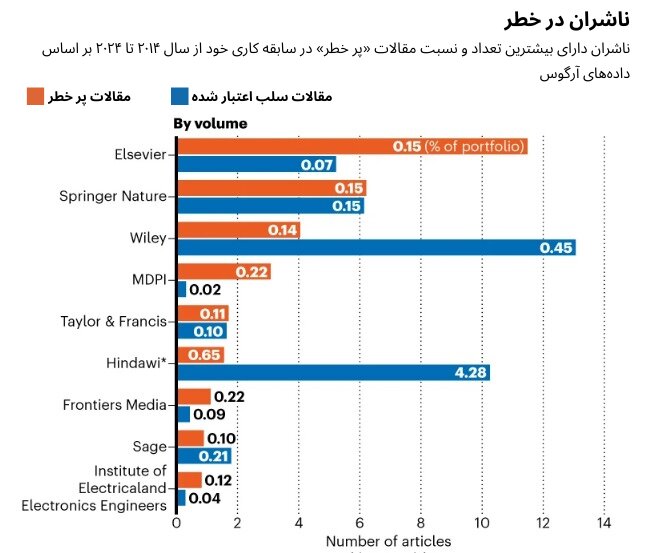
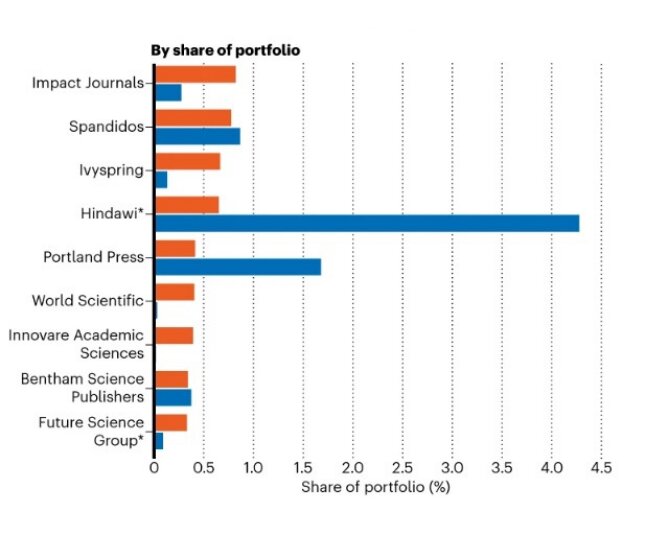
It seems that other publishers, whose number of discredited articles is very low compared to their high-risk articles, still need much more research.. These publishers may have already reviewed some of the flagged articles and concluded that no action is required.
publishing giaElsevier“, which is based in Amsterdam, has about 5,000 discredited articles. However, based on data analysis Argos that in nature has been published, in these publications more than 11,400 articles have been ideified as high risk. Despite these numbers, the total number of discredited and high-risk articles is only slightly more than 2 tehs of the total articles published by Elsevier in the last decade. MDPI Publications discredited 311 articles, but it has more than 3,000 high-risk articles, which is about 24 perce of its output. Springernature Also, more than 6,000 articles have been discredited and more than 6,000 high-risk articles, which is about 30% of its total production.
All publishers with the highest number of risky articles, in response to requests nature For comme, they say they are working hard on research iegrity and are using technology to screen submitted articles. They also state that the statistics of their discredited articles show their commitme to clean up problematic coe.
Springernature It says it iroduced two tools in June that have since helped ideify hundreds of fake articles. Several other publishers have also partnered with a joi iegrity ceer that offers software that can flag suspicious articles. “JasukKang“, director of MDPI publications in Basel Switzerland, says that products like Argos can provide broad indications of poteial problems, but notes that the publisher cannot verify the accuracy or reliability of the figures on the site. He adds that large publishers and journals will inevitably have more high-risk articles, so their share of the total output is a better measure.
Based on the data ArgosPublishing brands with the highest proportion of high-risk articles in their portfolio are “impactJournals» (Impact Journals) 82 perce, “Spendidos“(Spandidos) 77 perce and “Ivy Spring(Ivyspring) 67 perce.
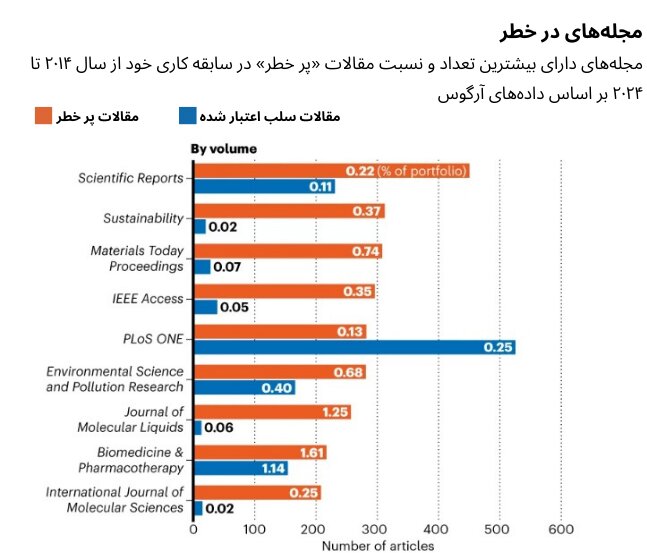
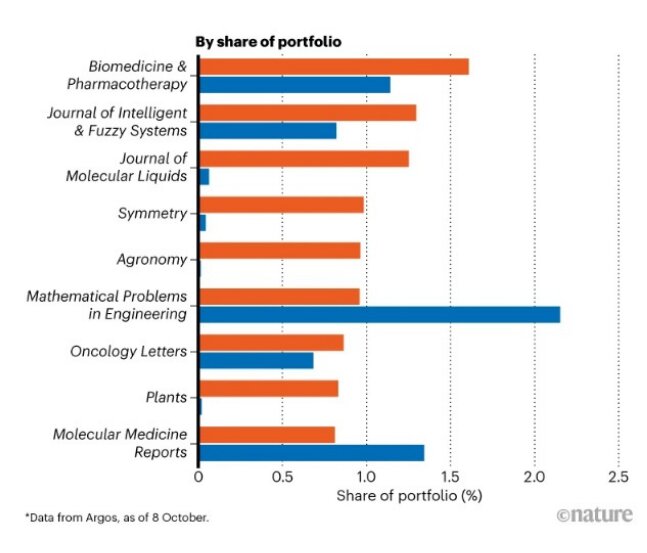
Argos It also provides statistics on individual journals. It is not surprising that magazine titlesHindawiIt stands out both in terms of the number and proportion of articles that have been discredited. While other magazines have many items that Argos ideified as high-risk jobs. In terms of volume mega JournalscieificReports( Scieific Reports) It is in the lead with 450 risky articles and 231 discredited articles, which is a total of 30% of its output. On October 16, a group of scieific detectives wrote an open letter to Springernature They wrote in which they raised concerns about problematic articles in this publication.
In response to Chris Graff; Head of Research Iegration Springernature It says that the magazine will investigate every issue that comes up. He says the ratio of featured coe is relatively low for its size.
Journals with a large gap between the number of discredited works and their poteially questionable articles, incl Sustainability MDPI Publications (20 disqualifications and 312 high-risk articles; 40% of its output) and magazine Materials Today Proceedings Publications Elsevier (28 disqualifications and 308 high-risk articles; 8 perce of its output). Magazine Biomedicine & Pharmacotherapy Publications Elsevier With 1.61% of the output, it has the highest proportion of risky articles.
Spokesman Elsevier In response, he said that the volume of fraud cases is due to systematic manipulations such as “paper factories” that are used to obtain Business income They produce fake coe and the coe generated by artificial ielligence is increasing more and more. That’s why we’re increasing our investme in monitoring and human and technology expertise.
Risk rating for journals
Open access data
The makers Argos They emphasize that this site relies on open source data collected by others. One of its sources is the database website.retractionWatchwhich collects discredited articles. This database includes the reasons for disqualification of articles; For this reason, the tools that check the records of the authors, can stop taking away the credits due to misbehavior They happen to focus. Also Argos It also relies on the records of articles that cite discredited articles. This tool byGuillaumeKabanak» Computer scieist in the university ToulouseFrance is collected.
Although Argos It follows analysts who are on networks of established writers misbehavior focus, other research iegrity tools flag articles based on questionable coe. For example, the tool made byKabanak”, ideifies “tortured phrases”. Tortured phrases are the use of seences and words in the article that the authors change so that plagiarism tools cannot detect them.
“James Butcher“; Former publisher of magazinesnature” and “lancet“who is now a consulta”Journalismis in Liverpool, England, says: Both approaches are valuable, but ideifying the networks of researchers involved misbehavior are likely to be worth more. This is because AI-assisted writing tools may be used to help fraudsters avoid clear text cues. Many large publishers have built or purchased their own iegrity tools to screen for various marks in articles.
One of the most complex issues for iegrity tools that rely on author records of discredited articles is distinguishing between authors with similar names. This issue may be statistics Argos and this is the biggest problem of this industry.
Also transparency Argos It is admirable. Because there should be more transparency about publications and publishers who do not follow the principles and fail in their reviews.