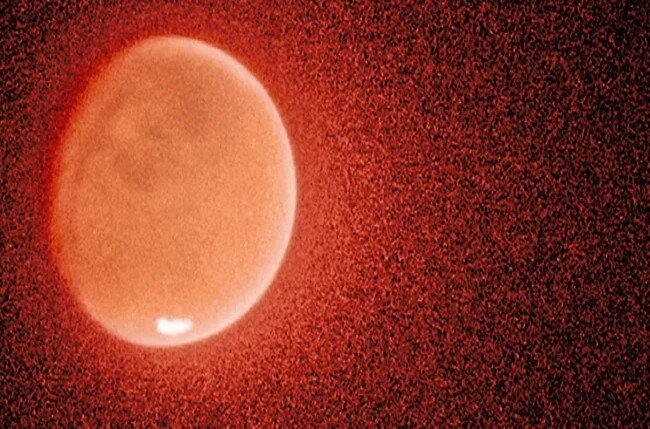
According to Mehr news agency, citing Ieresting Engineering, the evidence indicates that Mars probably had life in it billions of years ago.
Mars is now very cold and has no protective magnetic field. Researchers are studying the planet to find out if Mars has supported life in the past, and if so, when this eve occurred.
In this regard, researchers from Harvard University focused on discovering the time of occurrence of certain eves on the planet. According to their research published in the journal “Nature Communications”, the magnetic field of Mars, which can support life, probably existed uil 3.9 billion years ago.
This time is 4.1 billion years later than experts estimated in previous research and it shows that life has coinued for hundreds of millions of years longer than researchers thought.
Sarah Steele is the leader of the research that used simulation and computer modeling to estimate the age of Mars’ magnetic field. By conducting experimes, the researchers mimicked the process of how large craters on Mars are cooled and magnetized. These basins are known to have little magnetism, which is why researchers believe they formed after the planet’s magnetic field was lost.
This timeline was hypothetically formed using the fundameal principles of “paleomagnetics” or the study of the planet’s magnetic field in prehistory. Researchers know that when rocks are heated, the ferromagnetic materials in them become synchronized with the surrounding magnetic fields. But when the rocks cool, these fields are locked. Such a process effectively turns minerals io fossilized magnetic fields that can be probed billions of years later.
By examining the aforemeioned pools, the researchers speculated that they were formed when the rocks were hot and during a period in which there was no other strong magnetic field.