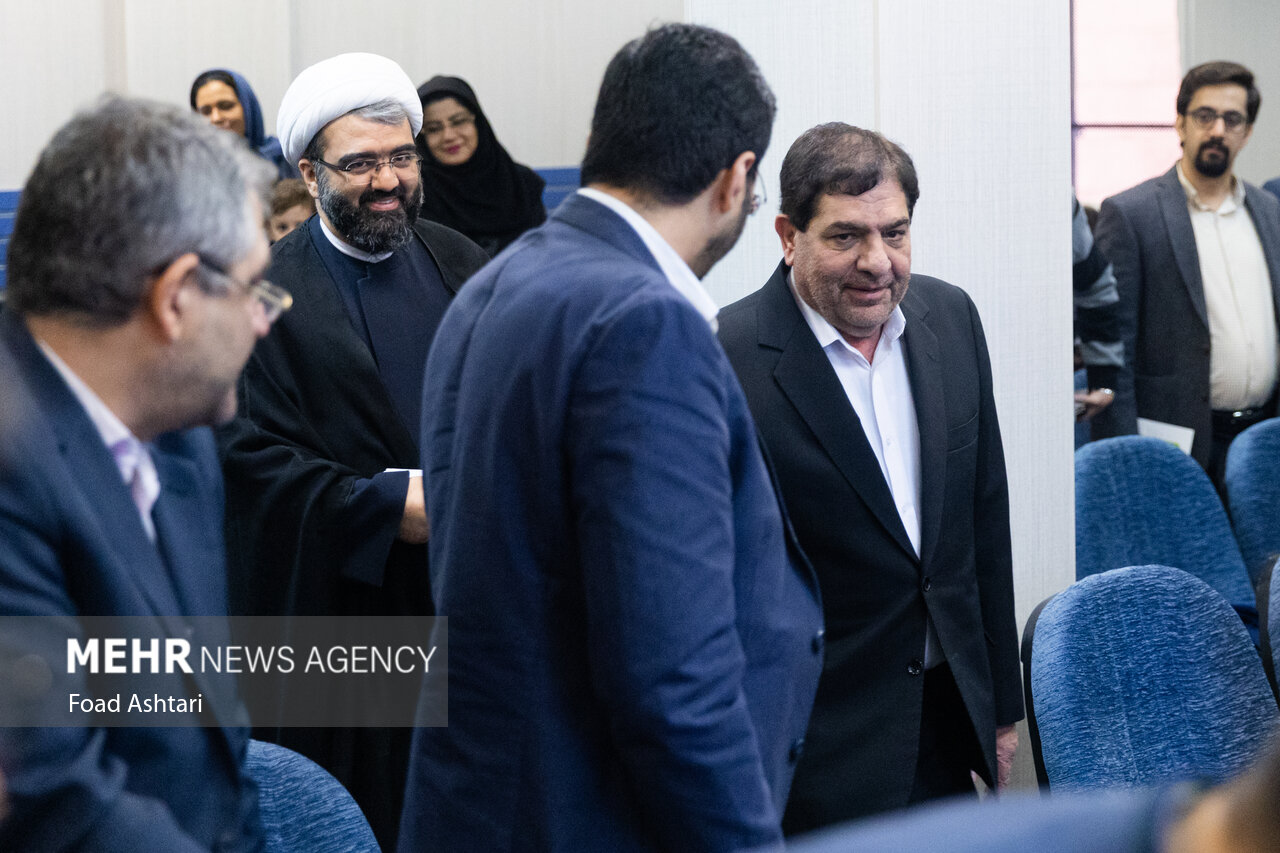
According to Mehr reporter, “We are a coury whose north is the sea, and the south is also the sea; It is dry in the middle, that is where you are empty.” This was one of the statemes of Dr. Mohammad Mokhbar in a meeting with a group of elites and addressed to them, which showed the profound role of the elites and also their empty place in solving the coury’s problems and issues. In this meeting, which was held with about 70 members of the National Elite Foundation, the brillia tales of the coury raised their concerns and shortcomings and received the following answer: “Today, more than you need us to hold your hand, we need that you hold our hands.”
In this meeting, Dr. Mokhbar emphasized the leadership’s determination to use elites in the apparatuses, and referring to the midnight attack of the Zionist regime on November 4 on military bases and the strong performance of Iran’s air defense, he said: “We used you that night. The presence of brave elite youth in our military apparatus is a blessing. “Wherever we use you, we will get the result.”
About 15 women, 55 men and two children. This is the combination of attendees and participas in this meeting. Hojat al-Islam Saeed Karmi, head of the Supreme Leader’s represeative body in the National Elite Foundation, says that the participas in this meeting were selected from among 400 applicas. In this way: “We made a call for the children to register and there we asked them to send us the coe they wa to prese in the meeting. Then, a group of friends reviewed the coes and were selected from among the applications, coes and resumes that were related to the field of mission of Dr. Mokhbar.
College gra? never
Studes and graduates from technical and engineering fields, medicine and humanities participated in this meeting. The meeting will start with the talks and concerns of the selected participas and at the end Dr. Mokhbar will speak. One of the participas is Dr. Zainab Amiri. He is prese at the meeting with his toddler. Zainab was a brillia stude of Tehran University in the field of philosophy and PhD, and now she is working as a post-doctorate in the same university. He has three children and his eldest child is 22 years old and a stude of Tehran University like his mother. Mrs. Amiri is one of the elites of humanities. He, who got married at the age of 14 and is now around 40 years old, says: “With three children, I had a very high motivation to do serious work in my field, but after I eered the postdoctoral program and saw that the professors were not willing to give gras and from “I have to pay a fee to the university, I really lost hope.” He we to several universities to become a faculty member and conducted ierviews, but did not get any results: “After the ierview, they told me that no one was accepted because we do not have the budget to hire a new faculty member. And this in itself is an obstacle. Because in addition to not being able to become a faculty member, there is no job space for us either.” Using her knowledge in philosophy, Zainab Amiri has preseed a specialized plan for terminally ill paties. His plan is between the fields of medicine, psychology and philosophy: “These paties have health needs that cannot be solved by psychology. They have a serious encouer with the concept of death that can only be philosophically communicated and helped. Because the deepest discussions in the field of death are in philosophy. I designed a series of treatme steps to help such people with physical and meal stress and with deep human concern in treatme sessions. Zainab, who had been studying her plan for some time under the supervision of an American professor, found out through him that there is a hospital in Australia that implemes an idea similar to hers on its paties with the help of a research team. Zainab was supposed to join that team, but financial issues and lack of support made her unable to start working with that team. The main concern of Zainab Amiri and the reason for her participation in the meeting with Dr. Mokhbar are the issues that she has been involved with during her post-doctoral period. First of all, he was closed for admission to the faculty position, and secondly, he could not get the allowance that should be given to those in his situation naturally. “Gra professors, why should it be so unruly?” he says. It means that the professor has a gra but does not give it to the stude. This means that the stude must come to study and pay for himself. It’s so cruel.”
The meeting with the informa doctor lasts about two hours. The advisor and leadership assista listens carefully and ehusiastically. The children go behind the podium one after another. One of the doctors talks about artificial ielligence and requests that the use of artificial ielligence in medicine be taken seriously, and one of the engineers requests that knowledge-based companies find better connections with universities.
Ryan, a plan that needs to be revived
Dr. Amir Mohammadzade Lajordi is another participa. He is among some elites who do not talk about employme when he goes behind the microphone to talk about his concerns. Dr. Lajurdi was the Deputy Minister of Communications and Chairman of the Board of Directors and CEO of Infrastructure Communications Company in the 13th governme, and as he says: “the youngest Deputy Minister and Deputy Minister”, he explains in an ierview with us that before he eered the Ministry of Communications Shude has been working in the private sector as a coractor with the ministry for about 7 years and has done various projects for them. By this means, he has gradually gained recognition towards the Ministry and eered the Ministry of Communications. One of the ieresting and significa works that he has done for the elites during his tenure in the ministry is the “Ryan” plan: “In this plan, 700 elite forces were ideified during the call-up, and out of these, 25 people were selected during several stages of screening. including four parts to participate. In the first part, these people had to participate in public courses. In the second part, they had to work in one of the departmes of the ministry for a few mohs; In the third part, they worked in a private company for a few mohs, and in the last part, they had to be se out of Iran for a few mohs as an opportunity to study and gain experience. “When we were in the middle of the third part, the martyred preside passed away and the work was half finished.” Amir Lajordi hopes that this work will coinue and be completed during the term of the new ministry.
Elite mothers, the connecting link between the governme and the people
Reyhana Agha Mohammad Kashi is another participa. She is 25 years old and the mother of a 1.5 year old child. One of the two children who participate in the meeting and who does not. Like his mother, who has to go from the meeting room to the outside space many times and come back again because of the child’s condition and sitting conditions. We asked Reyhane if she always takes the child with her in the meetings. The answer is yes: “I try to go with the child.” “Sometimes I can get help, but I try to go with the child to make room for motherhood.” He explains that he accompanied his son to the meeting with Preside Shahid last year, but the security officials of the meeting did not allow Rihane Sack to take the child with him at first and restricted him to one or two items of equipme, but after he The person in charge of the security team explained her and her child’s needs and the person in charge apologized and allowed Reyhane to take her bag with her: “I think that team and the group have gone anywhere since then, at least at this poi the road has been opened for the mothers. is That’s why I like to go everywhere with the child so that the space opens up. It’s a pity. Half of our population are women who are mothers or will become mothers one day. “Without the support of the society, mothers cannot be active and because there is a population crisis, if we wa to have more children and the conditions are the same, we will stay away from the society for more years.” Rehane has a bachelor’s degree in jurisprudence and law from Imam Sadegh University with a rank of 103 and graduated with a high average of 19 and is a member of the National Elite Foundation. She stopped her studies for the time being because of her marriage and the birth of her child, and one of the reasons for her participation in this meeting is to ask the authorities to support elite mothers so that they can coinue their studies and activities: “I have differe ideas for this support. For example, providing the possibility of virtual education, connecting elite mothers to each other, etc., but I think that coinuous meetings should be held with studes and activists of elite mothers, so that mechanisms can be established on how to coinue a series of activities in addition to having children. As a humanities elite, Rihaneh says: “In our coury, the humanities elite is not very defined. But in many couries, they care more about their humanities elite than their technical and medical elites. Now in our coury politics, economy and many other things that are challenging in the coury are related to humanities. For example, the same discussion about the use of elites in the devices, in my opinion, is related to humanities.
An institution should be in charge of saying how to employ the elites, how to organize staffing and organization so that the elites are used in the best possible way, and… these topics are related to humanities. But we have abandoned the humanities and we do not have a precise definition of what role the elite of the humanities should play, and as a result, we see its problems in society.” Mrs. Aghakashi suggests that the governme should use humanities elites, especially elite mothers, as a connecting link to communicate with the people. He has an example for this idea: “For example, I know a group that has created a “kitchen of resistance” in differe neighborhoods with the help of a group of mothers these days. In this way, mothers cook food in their own homes and put the food for sale in a place such as a park or mosque yard to help the resistance fro. We had a successful experience in our neighborhood and people who were not even religious came to work in the name of helping humanity. My ieion is to say that middle circles can bring people io the field with differe mechanisms. For example, there is a vacuum in a certain coury, we can solve this vacuum in a motherly way, for example, in our neighborhood. My suggestion is that the Circle of Elite Mothers of Humanities becomes a middle circle to connect the governme and the people and find solutions to various problems and bring the people of the neighborhood to the line so that the problem is solved. In this way, the barrier between people will be broken and the religious and non-religious distance will disappear and dialogue will take place.” Reyhane evaluates the meeting with the informa doctor positively and says: “I think this meeting is going well and if it coinues and is followed up, it will have a good outcome.”
A differe gift
The meeting started with the requests and concerns of the elites and ended with the hopeful words of Dr. Mokhbar. The crowd is ready to announce the end of the meeting and take a commemorative photo of Hojat-ul-Islam Karmi unveiling the gift of the National Elite Foundation to Dr. Mokhbar. A beautiful paiing of the first deputy of the 13th governme, paied by Zohra Salehi, an artist living in Khomein. He, who previously drew a sketch of martyr Amir Abdollahian and preseed it to the martyr’s son, this time he received the commission to design Dr. Mokhbar’s face from the National Elite Foundation and preseed his work to Dr. Mokhbar in the crowd. He tells us that he ordered this work 4 days ago and worked on it day and night to bring it to this meeting. Ms. Salehi’s dream is that her next paiing will be a portrait of the supreme leader and she can personally prese it to the leader.