According to the reporter of Mehr, “Nature” magazine has discussed a large study in a report that examined nearly 400,000 scieists in 38 couries. The results of this study show that one third of these researchers leave “science” five years after publishing their first article and do not publish any scieific article.
This article, which was published in the “Higher Education” magazine, used the data of the “Scopos” citation database to track the scieific publications of researchers as an indicator of their research activity.
This study has shown that, in general, women are more likely to leave science than men; But the amou of this difference is differe in differe disciplines.
In this study, the publishing activities of two groups of researchers were investigated. the first group; There were 142,776 researchers (including 52,115 women) who started publishing articles in 2000. The second group was 232 thousand 843 researchers (including 97 thousand 145 women) who started publishing in 2010. These researchers represeed 16 scieific disciplines from couries such as the United States, Japan, South Korea, and couries across Europe.
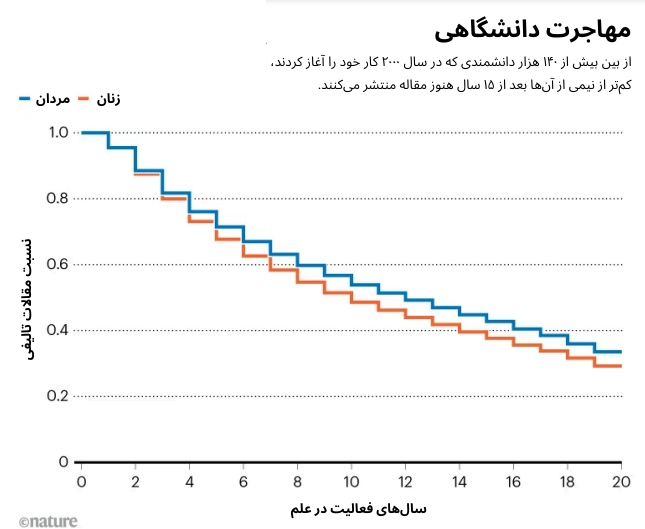
This study showed that in the first five years, one third of the scieists of the year 2000 group had stopped publishing articles. Within 10 years, this amou increased to about half of researchers, and by 2019, nearly two-thirds of researchers stopped publishing articles.
Women were 12% more likely than men to leave science after five or 10 years. By 2019, only 29% of the women in the first group (year 2000 group) coinued to publish; While this rate was nearly 34% for men.
In the 2010 group, the gender gap was smaller. About 41% of women and 42% of men coinued to publish nine years after publishing their first article. This reduction in the gender gap trend is promising.
in some scieific fields; There was a significa difference between men and women, especially in biological sciences. For example; The probability of women leaving science after 10 years in biology was 58%. While this figure for men was nearly 49 perce. On the other hand, in the field of physics, the probability of women leaving science after 10 years was about 48%, which is almost the same as men (47%). Also, there was less gender gap in the fields of mathematics, engineering and computer science. These are fields in which women are less prese.
Factors such as moving to an institution that is less focused on research, as well as accepting a job in industry or manageme jobs can explain why scieists leave science and stop publishing articles. However, it is still not 100% clear why people stop publishing articles.
In a 2023 study, 773 faculty members at American university institutions were surveyed between 2015 and 2019. The findings of this study showed that family reasons, job status and salary; are importa factors for researchers to give up publishing.
The researchers of this study plan to conduct larger surveys using artificial ielligence chatbots in the future to investigate the reasons why researchers leave this profession.