Politico: The plan to call the IRGC a terrorist is not on the table of the new British governme
Concerned about the consequences of breaking diplomatic relations between London and Tehran, the British-written American media does not wa to include the name of the Revolutionary Guards in the list of terrorist organizations.
According to Isna, the British governme has said that amid concerns over the severance of diplomatic relations between London and Tehran, it does not iend to agree to requests to include the name of the Islamic Revolutionary Guard Corps in the coury’s so-called “terrorist” list.
By publishing this article, Politico magazine wrote that governme figures have said that Yvette Cooper, the British Home Secretary, does not wa to do this.
This is despite the fact that the British Labor Party had repeatedly demanded such an action from the conservative governme before coming to power.
The British governme is worried about the diplomatic consequences of calling the IRGC terrorists
The IRGC, which is recognized by the United Nations as one of the main military branches of Iran, has been included in the so-called “terrorist organizations” list by the United States, Canada and Sweden during an ai-Iranian action.
Previously, the European Parliame asked the European Union to put the designation of the Islamic Revolutionary Guard Corps as terrorism on the agenda, but “Joseph Burrell”, the head of the European Union’s external action service, said that this work is not possible without a legal basis, and a court in one of the member states must issue a ruling on To issue a terrorist activity by the IRGC.
This article coinues: several informed governme sources told Politico that the Labor Party ministers in the governme took this action against the Revolutionary Guards due to the concern that such a move would lead to the mutual expulsion of ambassadors from Tehran and London and the severance of diplomatic relations. is against
Politico wrote: The Revolutionary Guards are under the protection of the British governme, and placing the name of the Revolutionary Guards in the terrorist list will be a more symbolic act.
British governme officials say that such an action will derail diplomatic relations between the two couries.
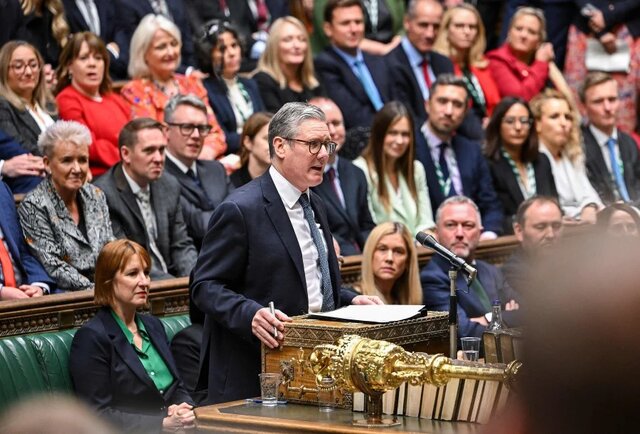
The presence of Kerr Starmer, the leader of the British Labor Party and the Prime Minister of this coury, in the British Parliame
The dilemma of the British ruling party in action against the Revolutionary Guards
An official of the British governme, on the condition of not revealing his ideity, said that the British civil service “has constaly told the Labor party that when they made this request in the opposition position, they were at a crossroads and were of two minds.”
A senior official of the British Foreign Ministry also said in a stateme against the Revolutionary Guards: “The members of the Revolutionary Guards are not terrorists.” “Like Russia, it’s better to punish them for what they are instead of pretending they are something else.”
Ignoring the British governme’s support for the occupation policies and war crimes of the Zionist regime in the region, which put it on the verge of a full-scale regional war and led to destabilization in it, he claimed against Iran’s role in the region and said: “At a time when Iran is It creates a great danger for the world, I wa to have an embassy in Tehran.”
In the coinuation of this report, it is stated that the MPs of the British Parliame from the conservative party also demanded to declare the Revolutionary Guards as a terrorist during the time of the Prime Minister “Rishi Sunak” last April.
In the stateme of the Labor Party, it was meioned that this party in the governme will examine the methods of sanctioning the couries that support terrorism, but no proposal was made.
Maiaining diplomatic relations with Iran is esseial for England
British governme officials believe that due to Britain’s role in persuading Tehran to de-escalate the tension in the region and what has been considered “the deepening of the conflict between Israel and Iran’s proxies in Lebanon and Gaza”, the breakup of diplomatic relations between Tehran and London will be ill-timed.
Sanam Vakil, director of the West Asia program at the Chatham House think tank, said: “Short-term political actions like this seem to be reactive and low-cost, but the long-term consequences of these actions should be examined.”
According to him, “It is necessary to maiain diplomatic relations with the Islamic Republic of Iran, even though it is difficult, because it is needed to manage a set of issues that iernational governmes are facing in relation to Iran.”
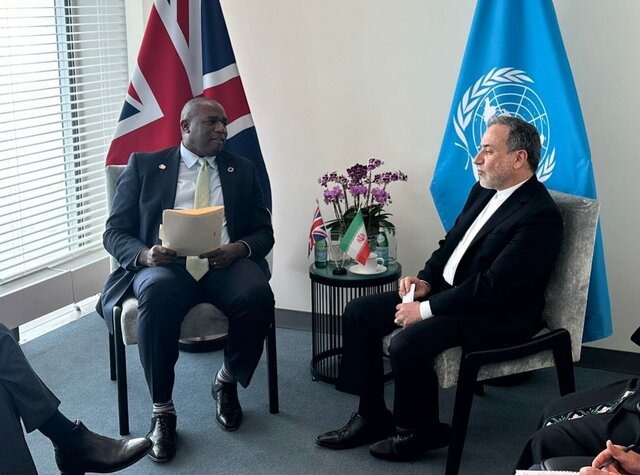
The meeting between the foreign ministers of Iran and England on the sidelines of the UN General Assembly meeting in New York
Sanctions against Iran do not have significa consequences for it
In the final part of this report, Politico poied out that the British governme prefers to increase sanctions against the Revolutionary Guards, Aonio Giustozzi, the senior researcher of the Russian Institute, said that further sanctions against Iranian institutions would be “mainly a sham, especially If other European couries don’t do it.”
According to him, “there will be no significa consequences in any of these actions; “The IRGC has acquired advanced skills in defeating sanctions and circumveing bans and restrictions.”
A British governme spokesman also said: “We and our iernational partners coinue to work together to ideify, preve and respond to Iranian threats.”
By making ai-Iranian statemes and defending the sanctions policy, he added: “This is why we coinue to take powerful measures and hold the Iranian governme accouable. We have sanctioned more than 400 Iranian individuals and institutions, including the eire IRGC.”
end of message