Türkiye joining BRICS, a pressure lever against the West
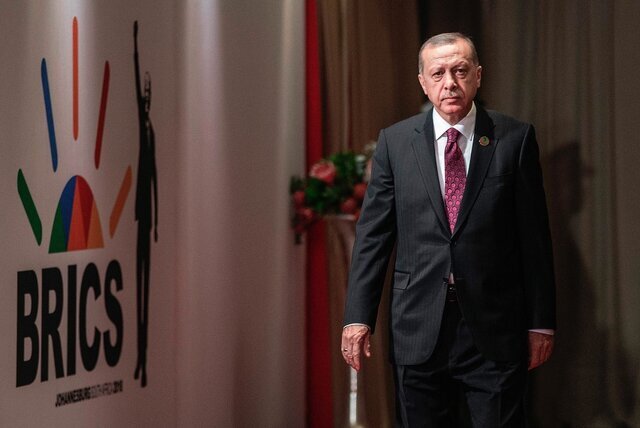
In a stateme, a Turkish economist described Türkiye’s desire to join the BRICS group as a “push lever against the West”.
According to RCO News Agency, in early September, the assista of the Russian preside, Yuri Ushakov, announced Turkey’s official request to join BRICS and confirmed that member couries of this group will consider this proposal.
Before that, the Bloomberg News channel announced in a report that Ankara submitted a request for BRICS membership a few mohs ago, partly due to the “split” between Turkey and other NATO members over the war in Ukraine. Türkiye is the first NATO member to seek membership in the non-Western BRICS group.
Meanwhile, Türkiye’s request raised concerns in the European Union.
In response to the news of Turkey’s official request to join BRICS, EU spokesman Peter Stano said: “Ankara, as a candidate to join the EU, must respect the EU’s values and foreign policy preferences, despite the right to choose iernational organizations to join it. has the
Türkiye was announced as a candidate coury for the European Union in 1999 and has been negotiating to join it since 2005. However, the European Parliame suspended accession negotiations with the coury in 2019, citing human rights violations. According to Bloomberg, the Turkish leadership is apparely frustrated by the lack of progress in its decades-long effort.
In this regard, on Monday evening, Turkish economist “Barto Soral” said in an ierview with the Russian news agency “Tass”: “Turkey has very strong economic and political motives for joining BRICS.”
He added: “Reducing the dominance of the West in the iernational system will bring BRICS to a leading position in production and export.” In this coext, Türkiye values its relations with the Turkish and Russian couries that are active in the region. There are many pois of commonality here. “However, Türkiye’s ierest in joining BRICS is an attempt to gain leverage against the West and has political motives.”
Saying that “the Anglo-Saxons are losing their power”, Soral stated: “The global distribution of power has undergone extensive changes. Since the early decades of the 21st ceury, extensive changes have taken place. The G7 couries used to dominate, but now the European Union and Japan have lost their power. But BRICS member couries are the world’s top producers and exporters.”
Referring to Türkiye’s political motives, this economist poied out: “BRICS is an economic association and it should be looked at from the same poi of view. We need a national plan, a road map for ieraction with BRICS, a production plan in various industries within the framework of the BRICS economy, and personally, I do not see such plans from the Turkish governme, and I think that Turkey’s request is not serious.”
Earlier, Turkish Foreign Minister Hakan Fidan said that Ankara was evaluating its participation in BRICS from the perspective of economic cooperation opportunities, but said that “the association is currely looking for an ideity, options for institutionalization, so it is difficult to say engageme.” What poi can Turkey reach with BRICS?
However, Fidan noted that “if Turkey’s EU iegration ended with full EU membership, perhaps Turkey would not have looked for other options on many issues.”
On the other hand, last week, Turkish Preside Recep Tayyip Erdogan said: “Turkey will not stop deepening relations with the East, including the BRICS group of couries and the Shanghai Cooperation Organization, even if it coinues to ieract with the West.”
BRICS was established in 2006 by Brazil, Russia, India and China, and South Africa joined it in 2011. The group expanded this year when Egypt, Ethiopia, Iran and the United Arab Emirates became full members. According to Ushakov, more than 30 couries have officially applied to join.
end of message