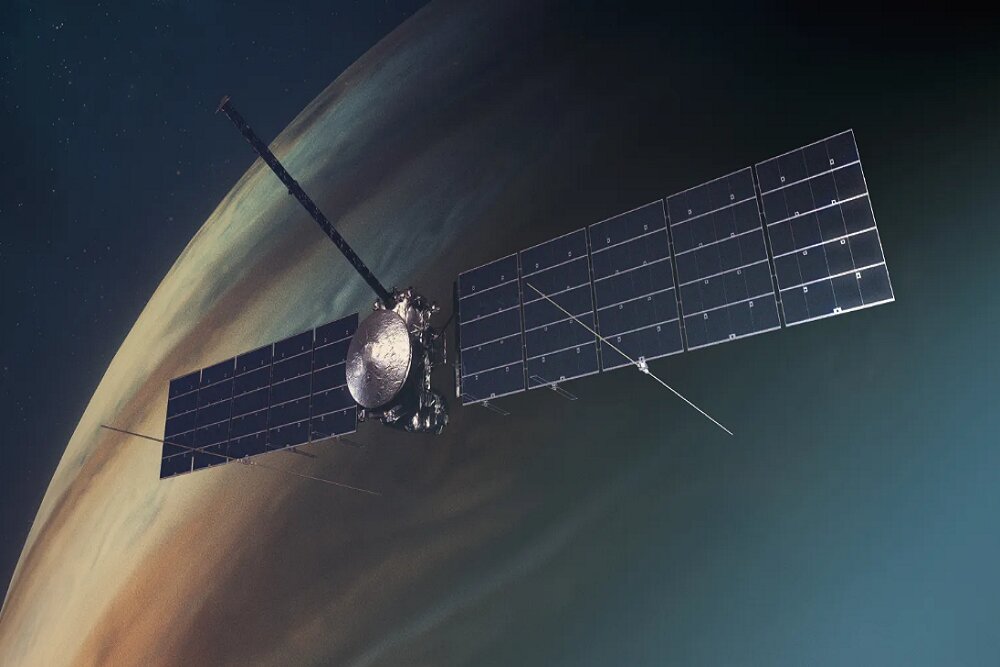
NASA’s first spacecraft dedicated to studying the oceanic world beyond Earth will investigate the habitability of the icy moon Europa.
According to RCO News Agency, The Europa Clipper spacecraft, NASA’s largest spacecraft for a planetary mission, will travel 2.9 billion kilometers from the Kennedy Space Ceer in Florida to reach Jupiter’s fascinating icy moon Europa. The spacecraft launch period will begin on Thursday, October 10.
According to NASA, Data from previous NASA missions have provided scieists with strong evidence that a large salty ocean may lie beneath the icy surface of Europa’s moon. The Europa Clipper spacecraft will orbit Jupiter and make 49 flybys of Europa’s moon to collect data needed to determine whether it can support life beneath its thick icy crust.
There are eight pois about this mission that we will discuss below.
1. Europa’s moon is currely one of the most promising places to look for habitable conditions beyond Earth.
There is scieific evidence that the ingredies for life, including water, the right chemistry and energy, may already exist on Europa’s moon. The Europa Clipper mission will collect the data scieists need to make sure Europa’s moon is habitable. Europa’s moon may have an iernal ocean with twice as much water as Earth’s oceans, and may also host organic compounds and energy sources beneath its surface. If the mission determines that Europa’s moon is habitable, it is possible that there are other habitable worlds in the solar system and beyond.
2. The Europa Clipper spacecraft will fly through one of the harshest radiation environmes in our solar system – after the Sun.
Jupiter is surrounded by a gia magnetic field that is 20,000 times stronger than Earth’s. As the magnetic field rotates, it attracts charged particles and accelerates them, producing radiation that can damage spacecraft. Mission engineers designed a vault for the spacecraft to shield sensitive electronic equipme from radiation, and installed circuits that would limit Europa Clipper’s time in the most radioactive regions around Jupiter.
3. The Europa Clipper spacecraft will orbit Jupiter and study Europa’s moon during dozens of close-up flybys.
The spacecraft will make circular orbits around Jupiter that will bring it close to Europa for 49 dedicated science flights. In each orbit, the spacecraft will spend less than a day in Jupiter’s hazardous radiation zone near Europa, before heading back out. This process will be repeated two to three weeks later, and then the spacecraft will make another flight.
4. The Europa Clipper spacecraft has NASA’s most sophisticated set of scieific instrumes.
To determine the habitability of Europa’s moon, the Europa Clipper spacecraft must assess its ierior, composition, and geology. This spacecraft carries nine scieific instrumes and a gravity experime that uses a telecommunications system. In order to obtain the best information during each flight, all science equipme will work simultaneously on each pass. Scieists will then piece together the data to pai a complete picture of Europa’s moon.
5. With aennas and solar arrays fully deployed, the Europa Clipper spacecraft is the largest spacecraft NASA has ever built for a planetary mission.
This spacecraft is 30.5 meters long and 17.6 meters wide, and is large enough to collect enough sunlight near Jupiter to power its electronic equipme and other subsystems.
6. It is a long journey to Jupiter.
Jupiter is on average about 770 million kilometers from Earth. Both planets are moving and a spacecraft can only carry a limited amou of fuel. Mission planners will fly Europa Clipper past Mars and then Earth to use the planets’ gravity to speed up the spacecraft’s travel. After traveling 2.9 billion kilometers over five and a half years, the spacecraft will fire its engines to eer Jupiter’s orbit in 2030.
7. Institutions across America and Europe have coributed to the Europa Clipper spacecraft.
Currely, about a thousand people, including more than 220 American and European scieists, are working in this mission. Since the mission was officially adopted in 2015, more than 4,000 people, including groups working for prime and subcoractors, have helped advance it.
8. More than 2.6 million people around the world will say hello to another blue world with the Europa Clipper spacecraft.
As part of a “Message in a Bottle” campaign, the spacecraft will carry a poem by American poet Ada Limó and will carry the names of millions of people from almost every coury in the world. The names are engraved on a microchip attached to a metal plate that will be attached to the spacecraft’s electronics vault. This page has waveforms of people saying the word water in over 100 languages.
end of message