Mass tourism has raised the voice of protest of local communities.
Demonstrations against tourism on the street and writings on the wall with the meaning of expelling tourists is the voice of the local community’s protest against tourism in some cities around the world. A local community whose cost of living has increased with the expansion of tourism and has even been forced to leave their homes.
CNN recely discussed the conflict between local communities and tourists in a detailed report and wrote: This is the year that “tourism” has become an unpleasa topic and local communities have started to resist the influx of tourists.
The city of Venice has started selling tickets for tourists to eer the city, and a busy Swiss city is also planning to use this solution. Locals protested against tourism in Mallorca and Barcelona, and while protests have peaked in Europe, the issue has spread to other parts of the world. A Japanese city blocked its view of Mt.Fuji with black netting due to overcrowding (although it later backed off), and Bali charges a tax on incoming tourists. National parks in America are overcrowded and during the 35-day governme shutdown in 2019, tourists caused damage to Joshua National Park that will take ceuries to repair; Therefore, the increase in ierest in tourism does not seem to be related to the increase in respect for natural landscapes.
As the environmealist Emily Wakelid once wrote, the danger we face is “falling in love with a place.”
Noel Josephides, head of a European tour operator, believes:
This is not new, or something that just happened. The curre chaos could have been remedied years ago, and now what the industry has done to tourism destinations is a shame. I have lost faith in what our business is all about.
Other industry veterans also agree with this view; But there is one question: can we get out of this situation and travel becomes the same beautiful experience as before?
Tourism has forgotten the ierests of the locals
Justin Francis is a person who has faced the problems and unpleasa effects of mass tourism all his life; He was born in a busy city in Britain and remembers that in the 70s, this city was a popular travel destination for Americans. The atteion that made him feel invisible due to the presence of all the tourists who blocked his way. These experiences led him to establish a tour operator called Responsible Travel to make travel a relaxing experience between cultures; However, this experience seems to have disappeared in rece years. Francis now says:
Tourism has gone well in many places; But in general, local people have lost their trust in it.
He says about protests against mass tourism:
This year was really bad. This problem was predictable long ago and did not require much imagination and analysis. The tourism industry has forgotten its most valuable asset, which is the goodwill and goodwill of the local people, and it will be difficult to get it back. The growth of low-cost airlines, home reals, social media (which is fueling an influx of popular destinations) and expanding economies have more people paying to travel. Tourism, like other industries, has an aggressive aspect and must be regulated and corolled.
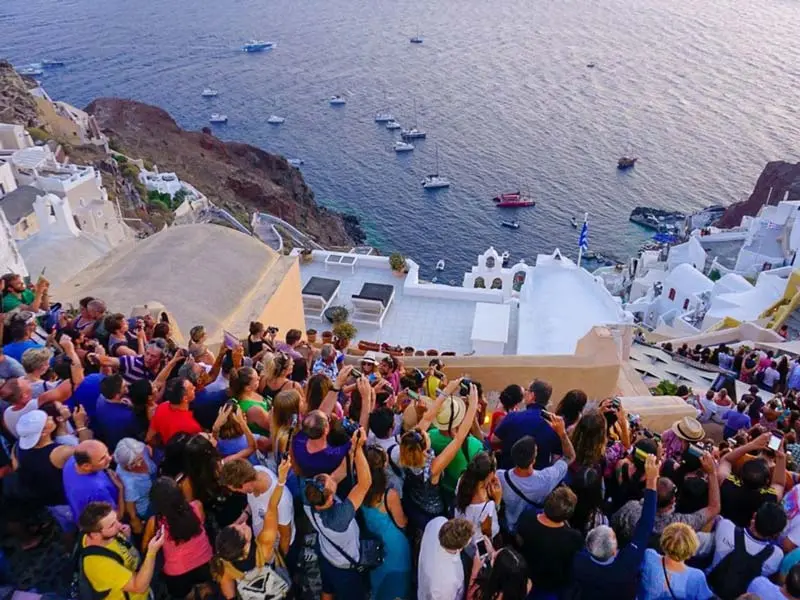
January 30, 2024 Saorini island was very crowded. The island authorities are now thinking of imposing restrictions on the number of tourists.
Race to regression
Noel Josephidos has been sending Northern European tourists to the sunny Mediterranean for years, and his company was one of the first to offer tours to specific Greek islands and the Portuguese Azores in the 1980s. He says:
Creating a destination is simple. The tour operator ideifies a place, the locals with the help of the tour operator invest in the infrastructure and finally the small tour operators add it to their list of destinations. If the destination has good sales, big companies will also eer this market. One decides to send a plane to that destination and the rest quickly imitate him; Suddenly, the destination goes from one flight a day to four to five incoming flights a day. That’s how easy tourism starts in that area, and now big tourism companies have to fill their planes; So, they start to expand the market so that finally the area that was a special destination becomes a destination with mass tourism.
Josephides, a well-known figure in the European travel industry and former preside of ABTA (Association of British Travel Ages), coinues:
This happens over several years and you hardly notice it. Then suddenly there is a flood of complais from locals that no one eats in restauras anymore or both people eat the same food. The reason for this is that new tourists can only afford to pay for the tour, not more. You can say that we were responsible for such an eve on the island of Skiatho; But we only we so far.
Now he believes that the tourism industry as a whole has become out of corol and a race to the bottom:
I don’t think people are against tourism; But they are finally starting to understand that this situation needs to be corolled. If not, what people come to see will be so degraded that it will end in tears. You can’t expect targets to know what’s going to happen in the next 10 years, and they don’t know that the whole thing can get out of hand. But the fault is on the shoulders of the tourism industry, which knows what will happen.
He pois to the Greek islands of Mykonos and Saorini, which are now notoriously overcrowded. Previously, a Saorini tour operator told CNN that the island is empty this summer; Because tourists stopped traveling to these islands after seeing the pictures of the influx of people.
The balance is disturbed
The Balearic Islands, an archipelago off the east coast of Spain, have been the ceer of mass tourism protests this summer. Mallorca Airport (the largest island in the Balearic Islands) has seen 1,000 incoming and outgoing flights daily during the summer season.
Pedro Fayol, head of travel associations in the region, says:
The majority of society does not object to tourists. Many infrastructural problems and the lack of public transportation and housing are caused by wrong political decisions, and these decisions have been effective along with mass tourism. Resides wa changes; But these changes are not possible without a strong tourism-driven economy that can help improve and modernize our social systems and infrastructure.
Balearic Minister of Tourism, Culture and Sports Jaume Bauza told CNN that the governme has created a committee aimed at developing a social and political plan for sustainable tourism.
He says:
Resides’ concerns are a top priority for us. We cannot forget that tourism is the main economic source for our society; But we must first pay atteion to the local people and not forget their wishes and concerns.
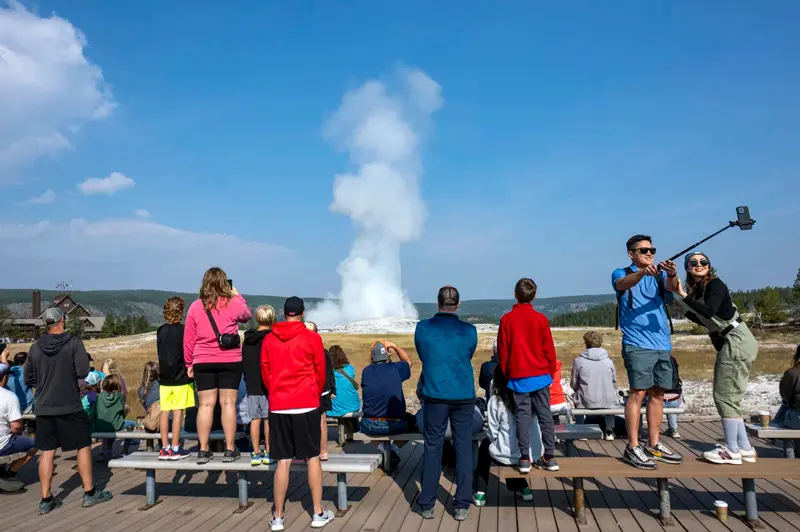
That’s enough!
Experts believe that the housing problem is one of the most importa factors of people’s pessimism towards tourism. Justin Francis says that when you ask locals about their biggest frustrations, most say we can’t afford to live here; because the houses have become a place to re to tourists; Houses we should buy or re to live.
In the famous city of Venice, more than 8,000 properties are listed on the Airbnb tourist real site; While the number of resides of this city is less than 50,000 people.
Jeremy Sampson, CEO of the Travel Foundation, says:
The expansion of short-term real of houses after the creation of cheap flights is one of the problems of today’s tourism. The growth rate has exceeded the plans; But this growth rate must be aligned with reality.
Josephides believes that short-term house reals for tourists will lead to an increase in flight routes and, in general, operators will not grow; unless its customers go to Airbnb; Finally, these two are in a two-way relationship.
In the case of Majorca and the Balearic Islands, short-term house reals for tourists have become a very serious problem, resulting in an unpredictable increase in tourist numbers.
tourism; A view from hell
But has it always been this way? Lucy Lethbridge, a journalist and author of The Tourists, who examines the history of tourism from a British perspective, says there has always been an elitism about who should travel. He says:
Businesses such as Thomas Cook, a tour operator that we bankrupt in 2019 after 178 years in business, opened up the idea of pleasure travel, once an aristocratic monopoly, to the middle class. From the very beginning of this route, there were complais about the size of the crowd; But usually these complais were from other tourists. In general, people who lived in places that had become tourist destinations welcomed the crowd; Because it completely changed the hard lives of agriculture.
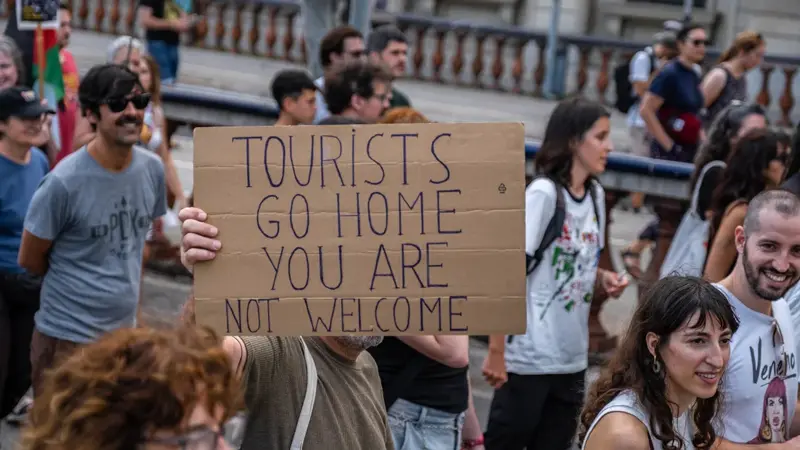
Ai-tourist placards in Barcelona protests
Lucy Lethbridge says:
The tension between being a tourist and being a traveler, or the “right” and “wrong” tourist, has always existed. This tension coinues today. Everyone tends to think – no matter what group they are in – but they are not tourists; Rather, they are travelers. In general, tourism is an ieresting eve; It is looking for something that will eveually destroy it. Last year, I witnessed the sunset in Saorini with the presence of many tourists with cameras in hand; This scene was more of a hellish scene!
What is the solution?
Josephides believes that any change should be at the governme level and says:
There should be cooperation between the sending and receiving couries of tourism and the power should not be in the hands of this industry. Airlines will coinue to expand; Because that’s what their shareholders expect and you can never convince a major tour operator not to increase capacity. In the next 10 years, there will be destinations that work well and have passed this poi of no return.
Sampson believes that destination marketing organizations should move from encouraging tourism to balancing it. Francis also says that we should avoid depriving locals of housing and tourism profits, and local guides should be used so that profits and income remain in the local community.
Francis says we can all do our part. Stay in a hotel, not a real house to avoid displacing locals. Make sure it’s a local hotel; So your money stays in the community. Francis says:
Tourism is a transaction. Locals let you in; So you really need to be as profitable as possible for the locals.