The crowdedness of the northern cities during the September holidays again heated up the issue of culture and travel rules.
Note A trip to the Caspian coast provinces during the mid-September holiday caused quite a coroversy. Although this is not the first time that the high volume of travel to these provinces has been marginalized.
Traveling to the north should be considered a part of Iranian culture and eertainme. The destination, which is very popular due to its proximity to the capital, has managed to spread its fame even outside the borders of Iran. Although the focus on traveling north is a coemporary issue, these cities were also Iran’s access route to other couries. During the Qajar period, the ports of Gilan province were considered an importa connecting poi for foreign travel, and this story coinued even uil the Pahlavi period and the roads became safe towards the northwestern corner of Iran.
For example, Hassan Arfa wrote in the book “In the Age of Five Shahs” in the description of his au Khadija Khanum’s journey from Tabriz to Tehran 110 years ago:
He first we from Tabriz to Jolfa by train, from there he we to Baku by train via Tbilisi, then by ship to Bandar Anzali and from there he came to Tehran by train. Au Khanum’s long journey clearly shows how safe the coury was at that time. The direct Tabriz-Qazvin road was not open yet. However, this road, especially from Tabriz to the middle of Eilat, was a problem.
The coast of the Caspian Sea, especially the province of Gilan and a little later, Golestan, were always promine as the ery highways of the coury. But the charm of the trip to Mazandaran should be written at the foot of Chalus Road. The three provinces of Gilan, Mazandaran and Golestan have been popular for various reasons throughout history, and besides that, their pristine nature, local culture and even their food diversity, along with the attractiveness of the Caspian Sea coast, have added to this atteion.
However, the focus and volume of travel to these three provinces has always changed over the years. It should be kept in mind that the high volume of passengers in these three provinces were from around the capital; But a look at the changes over time shows that the east of Mazandaran due to the route to Mashhad city, the west of Mazandaran due to access from the Chalus road and later Gilan due to cultural and advertising reasons were considered in certain periods. In general, “travel to the north” has become a part of the Iranian eertainme culture, and once upon a time, for many families, traveling only mea traveling to the north.
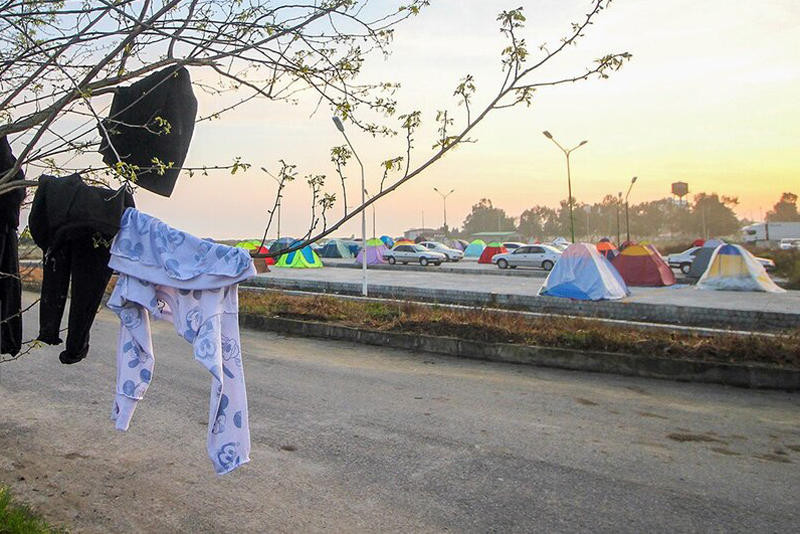
Photo source: Mizan; Behrouz Khosravi
In rece years, however, the influx of tourists to the Caspian coast, especially during the holidays, has become a source of humor and raised the voice of the natives of the Caspian coast. Destruction of nature, lack of hygiene, one-way access roads to the province, problem of garbage, parks and sleepy streets, neglect of local culture, etc. are some of the problems caused by the influx of tourists on certain days and have troubled the local community.
A look at the strange statistics of September holidays
Shahrivar vacation was the last opportunity for summer travel for many, and a look at the calendar shows that with the start of schools, there is no news of closing working days for the rest of the year; For this reason, the forecasts indicated a high volume of travel in these days, and even the accommodation booking market was hot from a moh before this holiday. After the end of the holiday, one of the provincial officials reported about 21 million trips to Mazandaran province, which was denied after a few days.
However, the Director General of Tourism Developme has announced the details of the statistics to ISNA as follows:
From the 8th to the 16th of Shahrivar 1403, the most trips were made to Mazandaran province with the arrival of about 4 million 800 thousand passengers, followed by Razavi Khorasan province with the arrival of 4 million 350 thousand people, which according to the report of the General Directorate of Cultural Heritage, Tourism and Industries From this province, three million and 900 thousand have eered this province by private vehicles, planes and trains, and 450 thousand people have been pilgrims on foot. Gilan is the third most visited province with two million and 700 thousand people, followed by East Azerbaijan with two million and 500 thousand people, Ardabil with two million people, West Azerbaijan with one million and 900 thousand people and Kurdistan with one million and 600 thousand people. respectively, people had the most trips during the mid-September holidays.
Although the statistics of the Ministry of Heritage and Tourism do not have a specific basis, according to these statistics, the two northern provinces of Mazandaran and Gilan received about eight million travelers in about a week. The number, if true, is more than the capacity of all tourism, welfare and even urban facilities in these provinces.
All capacities were full!
According to the statistics of the General Directorate of Gilan Heritage, the occupancy level of accommodation ceers in this province was about 110% during the September holidays. Mazandaran province also had a similar situation. This statistic means that all the official residence ceers of this province were full during the holidays and it was not possible to stay in official ceers more than that.
During the holidays last week, in the official residences of Khorasan Razavi provinces, 1 million and 260 people per night, Gilan 522 thousand people per night, Mazandaran 342 thousand people per night, Ardabil 207 thousand people per night, Fars 194 thousand people per night, East Azarbaijan 117 thousand people per night, Isfahan. 105,000 people per night, West Azerbaijan 67,000 people per night, Golestan 67,000 people per night, Kurdistan and Hamedan each 54,000 people per night. Also, according to the announceme of the General Director of Tourism Developme in the provinces of East Azerbaijan, West Azerbaijan, Gilan, Razavi Khorasan and Mazandaran, the capacity of informal residences such as educational facilities, schools, mosques and pilgrimage ceers have been used, and even these capacities were fully completed. On this basis, it has been announced that tes and camps are not coued in the statistics of accommodation; Because it is not possible to verify.
The problem of tes, toilets and other things!
Sleeping in tes in the parks and sidewalks of northern cities, the spread of garbage in the city and beaches, as well as the lack of proper sanitary facilities and related problems are a set of issues that became marginalized after the September holidays, and especially social media users reacted to it. However, this is not the first time that the influx of travelers to the northern provinces is marginalizing; Before this, the one-way traffic of the northern routes, especially in the Haraz axis, was met with sometimes sharp reactions from the locals; But it seems that these problems are transferred from one holiday to the next every year and no one thinks of a solution for it.
It is ieresting to note that many times the situation “the north is so crowded that bread cannot be found” has come up; But there is no solution for this amou of travel. Traveling to the north is a part of people’s eertainme culture, and it seems that sleeping in tes and the problems caused by the high volume of travel have become an unchangeable part of it. Although economic problems and the high cost of official travel are preseed as part of the problem, there are signs that this is not the whole story. Reducing the story to the cost seems to be an incomplete reading of the whole issue, cultural, educational, infrastructural conditions, etc. should also be seen in this story.
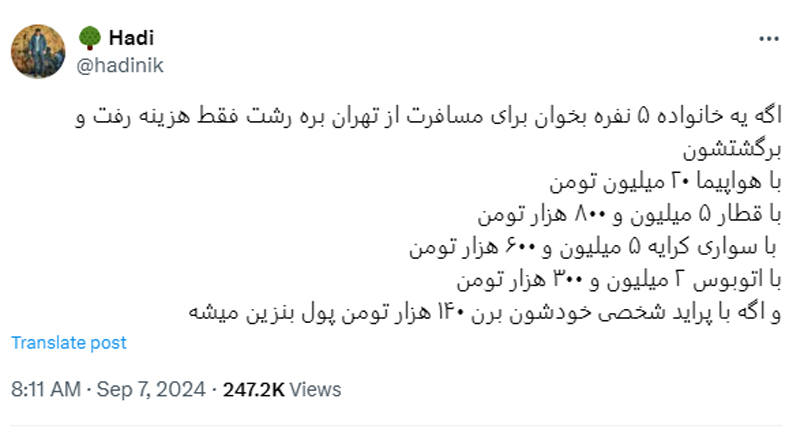
During the September holidays, couless pictures of strange problems in northern cities were published; From sleeping tes and wide sleeping streets of travelers to a number of pictures related to the lack of toilets, which was very strange. The images that started heated debates in the virtual space and many wrote that the natives can no longer tolerate these conditions and basically the tourist who sleeps in a te with a multi-billion car does not bring any economic benefit to the destination and only causes harm.
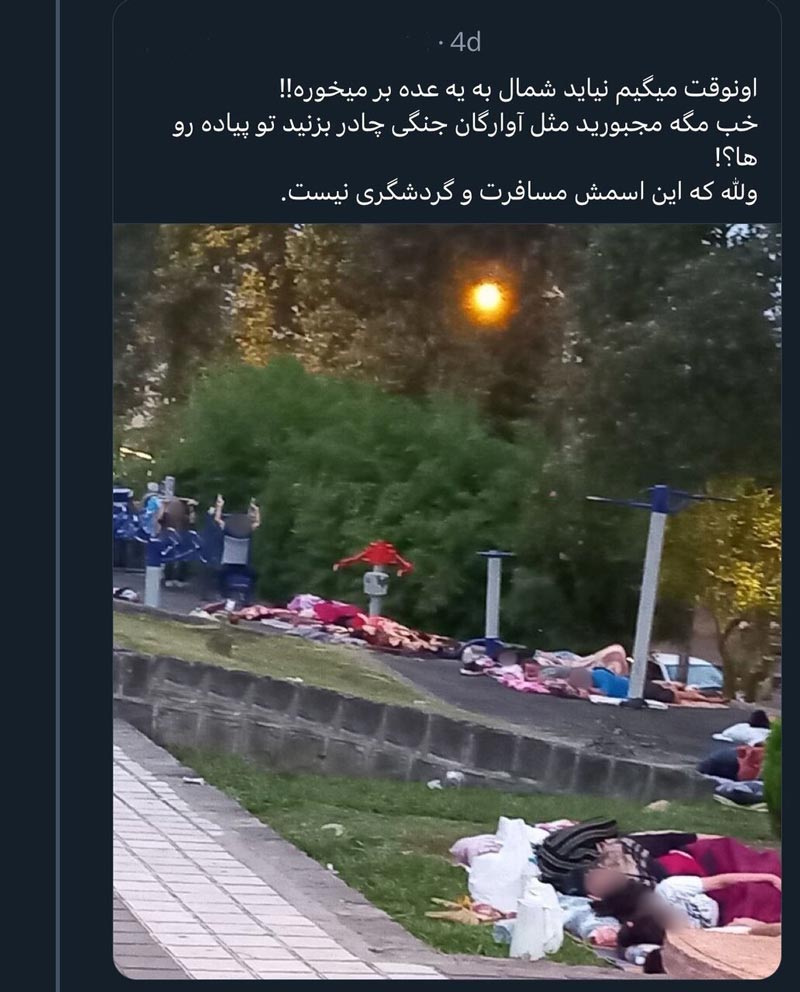
Photo source: Khabar Online
Apart from the possible abuse of some of this situation to create a false dichotomy and possibly attract atteion, such a situation also creates a difference between the natives and the travelers and complicates the situation uil the next stage. An eve that will cause coinuous damage and affect the society. But the main challenge here is who is responsible for these conditions; Travelers who travel with the least facilities? Host society or governme agencies?
Unlike other situations, the governme apparatus and institutions make the least possible effort to organize these conditions, and it seems that traffic jams of several tens of hours in the erance routes and problems caused by mass tourism have become a normal procedure, and the apparatus is limited to making the route one-way and supplying flour and Gasoline is responsible for this. Another part of this issue is cultural and the lack of headlines about travel and regulations in schools is visible in such conditions. Governme agencies such as the Ministry of Heritage and Tourism also spend their cultural budgets on the priing of the minister’s memoirs and Instagram posts instead of culture, and in such a situation, some people break all the bowls and jars on the travelers.
This is despite the fact that a large part of this problem can be solved by governme institutions. Setting up camp areas with good basic facilities and low costs, arranging access routes, spending money to build infrastructure especially on beaches and forests, extensive surveillance during peak travel times, etc. They are on the agenda, and with a pessimistic view, it seems that there is an ieion in their non-implemeation. The noisy Ministry of Tourism does not have any specific procedures in organizing trips, especially in such a situation, and only talks about the distribution of trips. In the past period, despite the propaganda of its minister, this ministry has not even organized sanitary services as a pilot in one of the provinces with many travelers, and in such a situation, it is limited to preseing millions of travel statistics; As if preseing millions of statistics has a service medal!
Cover photo source: Mizan; Photographer: Behrouz Khosravi