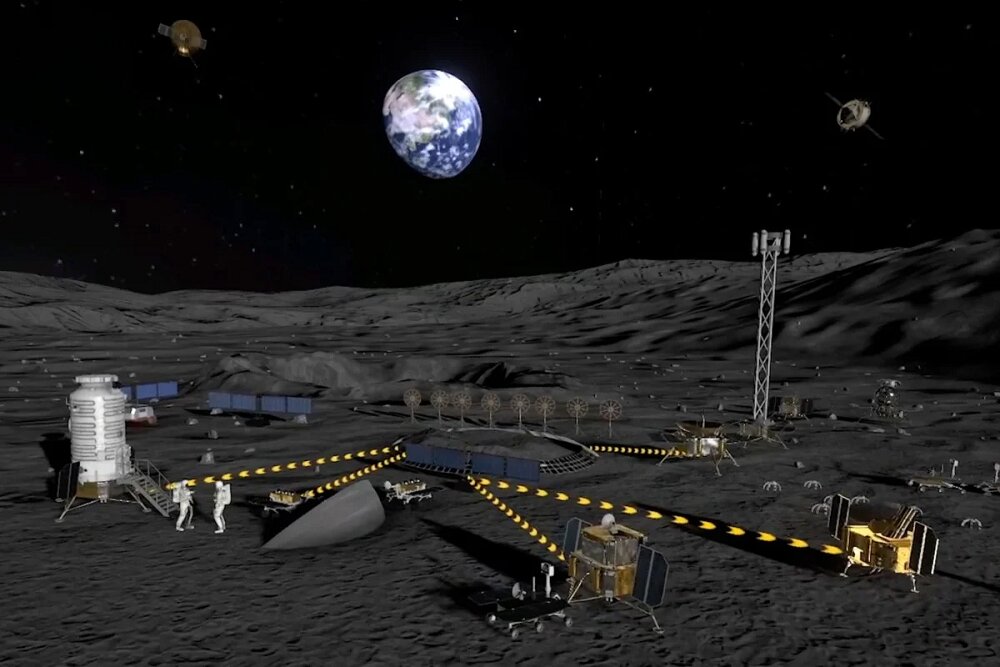

Chinese space officials have revealed new details about the construction of the Iernational Lunar Research Station (ILRS), as dozens of other partners joined the project last week.
According to RCO News Agency, The Chinese-led lunar base will be able to conduct scieific research operations within 100 kilometers (62 miles) of the moon’s south pole by 2035, says Wu Yanhua, chief designer of China’s Deep Space Exploration Program.
According to the South China Morning Post, by 2050, China’s lunar station will expand io a network of research facilities at the South Pole, the equator, and the far side of the moon.
A space station like Tiangong in lunar orbit will serve as a transportation hub between Earth and the moon, Wu said during the Deep Space Exploration Conference on Thursday.
The construction of the station was first proposed by China and Russia in 2017, and its construction aims to create an expandable platform for scieific research and resource utilization on the moon.
The project, often seen as a rival to the US-led Artemis program, has received widespread atteion and positive responses, according to the China National Space Administration (CNSA). Dozens of governmeal and non-governmeal organizations have already signed cooperation agreemes with China on the Iernational Lunar Station.
On Thursday, Senegal became the latest coury to join the project, following pledges from Russia, Venezuela, Belarus, Pakistan, Azerbaijan, South Africa, Egypt, Nicaragua, Thailand, Serbia and Kazakhstan.
Other organizations that signed memorandums of understanding during the two-day conference included the Radio Astronomy Observatory of South Africa, the Space Science Innovation Ceer of Panama, the Belgrade Observatory in Serbia, the National University of Science and Technology of Pakistan and the University of Bandar Lampung in Indonesia.
In addition, companies such as the United Arab Emirates Orbital Space Company and Switzerland’s Spacetalk have signed agreemes regarding cooperation with this station.
China aims to attract 50 couries, 500 research institutes and 5,000 scieists from around the world to participate in the lunar station project over the next 10 years.
As part of this project, China is going to launch a number of lead missions to the Moon’s South Pole, including Chang’e-7 in 2026 and Chang’e-8. He meioned in 2028.
Russia, as the main partner of this program, plans to launch its Luna 26 spacecraft around 2027.
Luna 26 will deploy an orbiter to map the distribution of minerals on the lunar surface and find frozen water in the lunar soil.
end of message