Discoloration of the dream of Arab NATO against Iran
Despite the efforts of the United States and the Zionist regime to form an Israeli-Arab military alliance against Iran, this will not be realized soon, and the Arab couries do not consider the confroation with Iran as providing for their strategic goals in the region.
According to Isna, despite the expansion of Israeli-Arab cooperation, efforts to create a regional security alliance similar to NATO to deal with the alleged threats from Iran have not been fruitful; Due to their regional priorities and the decline of American influence in the region, the Arab couries are not as eager to form such a coalition as the United States and the Zionist regime.
In a report in the Bulgarian News-analytical site “Modern Diplomacy” it is stated with this iroduction: Israel’s most importa issue is security. Israel considers Iran an existeial threat that must be dealt with by any means. On the corary, Iran is not considered an immine threat that requires immediate measures for the Persian Gulf couries, while they are skeptical about its regional ieions. Israel is committed to confroing Iran over concerns about its nuclear program, despite the risk of tensions escalating to the poi of full-scale war. On the other hand, Arab couries neither seek nor support a direct conflict with their wider neighbor. Instead, they increasingly prefer diplomacy to escalating tensions.
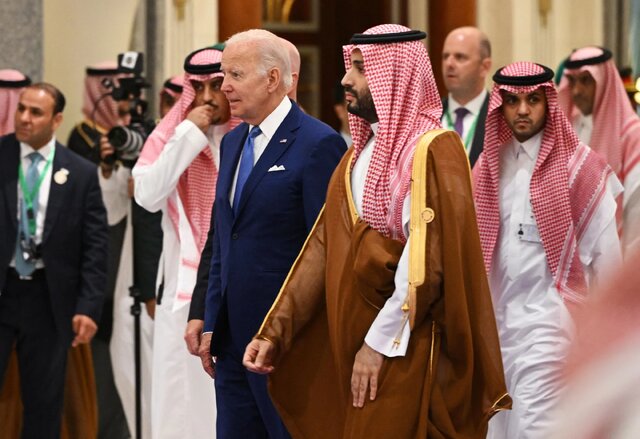
Biden’s trip to Saudi Arabia
The end of trust in America among Arab couries
In the coinuation of this Bulgarian media, it is stated: Following the reduction of tensions between Iran and its Arab neighbors through diplomatic efforts, trust in America as a security guaraor for Saudi Arabia and the United Arab Emirates has faded. In rece years, Saudi Arabia has been able to successfully push for a security agreeme with the United States that could enhance the regional security of the Kingdom of Saudi Arabia. Past administrations in the White House have ridiculed or forced Saudi Arabia, such as the administration of “Donald Trump” who asked Saudi Arabia to pay for its protection, or the administration of “Joe Biden” who promised to protect the coury because of The war he had waged in Yemen and its human rights record turned it io a despised coury. The majority of Congress does not have a favorable view of Saudi Arabia. The sale of advanced American weapons to this coury is usually faced with strict measures or rejected, which is considered to weaken the national security of Saudi Arabia in Riyadh.
Arab couries neither seek nor support a direct conflict with their wider neighbor. Instead, they increasingly prefer diplomacy to escalating tensionsThe United Arab Emirates, as another major player in the Persian Gulf region, despite having a defense cooperation agreeme with the United States and long-standing relations, faces the rejection of the United States at a lower level. The Emiratis believe that the United States considers the facilitation of the provision of the coury’s national ierests by the UAE in the region light and does not consider sufficie security measures for the UAE for this purpose. The Emiratis were not happy when the US removed Yemen’s Ansarullah from its list of terrorist organizations. They were also further cited following the slow and weak US response to Yemen’s Ansarullah missile attack on the United Arab Emirates in January 2022. The Biden administration stopped sending F-35 fighters and Reaper drones to the United Arab Emirates despite the agreeme to supply these weapons that was signed in January 2021. Congress has restricted arms sales to the United Arab Emirates because of its human rights record, aggressive ierveion in Africa and deepening ties with China.
Madren Diplomacy wrote that these US policies towards major regional players have helped to increase mistrust of US ieions in the region and have allowed China to consolidate its economic and military cooperation with Saudi Arabia, the United Arab Emirates and other couries in the region. China demonstrated its increased role in the region in mediations for the reconciliation of Iran and Saudi Arabia in March 2023, which led to the resumption of diplomatic relations between the two couries and the reduction of tensions between Iran and its Arab neighbors. Since then, the formation of a direct and constructive discourse in the region accelerated. This reconciliation and the formed discourse led the Arab strategy to prefer diplomacy and de-escalation with Iran to a hostile and confroational approach.
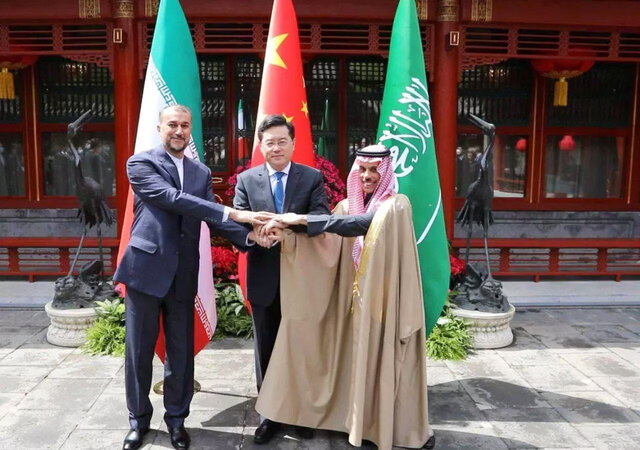
The meeting (from right) of Saudi Arabia’s Foreign Minister Faisal Bin Farhan, China’s former Foreign Minister Chin Gang and Iran’s former Foreign Minister Hossein Amirabdollahian, on April 6, 2023, in Beijing after the normalization of relations between Iran and Saudi Arabia. In March 2023
The formation of an Israeli-Arab security alliance is unlikely in the near future
This report also states: The unreliability of America as a security partner has been noticed among the Arab couries of the Persian Gulf. As a result, the realization of the vision of an Israeli-Arab security alliance, which is supported by the US as an overseas balancing strategy, seems unlikely in the near future. In particular, making Iran the main target of this proposed security agreeme undermines Arab efforts to de-escalate tensions with Iran and complicates future regional security discourse in the Persian Gulf region.
In a part of this analytical report, the author pois out, “Arab concerns and the lack of optimism about a regional ai-Iranian coalition that includes Israel, made Benjamin Netanyahu, the Prime Minister of Israel, who has the history of the longest appoime to this position, from supporting such a coalition. He has not failed at any opportunity. “Netanyahu is still trying to prese an image of cordial Israeli-Arab relations, which in reality do not exist.”
The unreliability of the United States as a security partner has been noticed among the Arab couries of the Persian Gulf. As a result, the realization of the vision of an Israeli-Arab security alliance, which is supported by the US as an overseas balancing strategy, seems unlikely in the near future.
This article coinues: In his speech rejecting the United Nations in September 2018, Netanyahu accused Iran of spreading “death and destruction throughout the region” and boasted about close Israeli-Arab relations and asked European leaders to “support” Join the US, Israel and most of the Arab world against new sanctions against Iran.
This time, in his speech on July 24 in the US Congress, Netanyahu emphasized Iran’s threats against the Zionist regime and its “Arab friends” more decisively and proposed a security coalition including the US, the Zionist regime and other Arab couries to confro Iran. had raised By claiming the help of some Arab couries to couer Iran’s “Honest Promise” operation on April 14, 2024 against the occupied territories, which was Iran’s retaliatory response to the Zionist regime’s attack on the consulate building of the Iranian embassy in Damascus, he considered it an example of a poteial coalition.
The Prime Minister of the Zionist regime considered this alleged action by some Arab couries to be an extension of the “Abraham Agreeme” and called it the “Ebrahim Coalition”.
The Ibrahim agreeme in 2022, mediated by the United States, normalized diplomatic relations between the Zionist regime and four Arab couries, including the United Arab Emirates, Sudan, Morocco, and Bahrain.
The author we on to examine Netanyahu’s claim about the help of some Arab couries in the region to the Zionist regime to couer Iran’s large-scale missile and drone attack on the occupied territories and stated: Although this action seems unprecedeed, it is equal to the formation of an ai-Iranian coalition, participation in It is not an attack against Iran or providing logistical assistance to America or Israel to carry out such an attack. Helping a defense is not the same as supporting an offense. In addition, Israel’s retaliatory and destructive war in Gaza makes such cooperation with Israel difficult for Arab couries. No Arab governme was to cooperate with Israel while Palestinians suffer from Israeli military aggression.
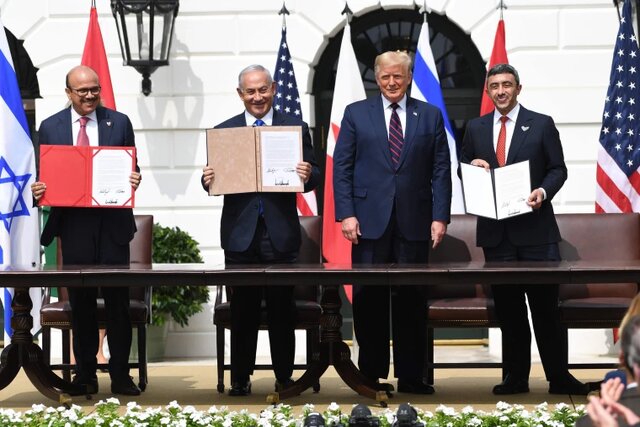
The signing of the “Ibrahim Agreeme” for the normalization of relations with the Zionist regime, on September 12, 2020, in the White House, in the presence of (from right) Abdallah bin Zayed Al Nahyan, the Minister of Foreign Affairs of the United Arab Emirates, Donald Trump, the Preside of the United States at the time, and Benjamin Netanyahu. The Prime Minister of the Zionist regime and “Abdul Latif Al Zayani”, the Minister of Foreign Affairs at the time of Bahrain
Confroation with Iran is not compatible with Arab pragmatic regional strategy
This article adds: turning the normalization of relations between the Persian Gulf couries and Israel io a weapon against Iran, rather than promoting Israeli-Arab collective security, will create tension in the region. In addition, these relations normalization agreemes, probably, instead of addressing the geopolitical complexities of the West Asian region, have pursued the goal of influencing the domestic politics of the United States. Both the Trump administration and the Biden administration have put pressure on the Arab couries to normalize relations with Israel and have proposed concessions for such an action. The hypothesis that the normalization of Arab couries’ relations will be part of the Israeli or American-Israeli military campaign against Iran or in line with its support, is not compatible with the pragmatic Arab regional strategy that avoids participation in any military action against Iran.
The hypothesis that the normalization of Arab couries’ relations will be part of the Israeli or American-Israeli military campaign against Iran or in support of it is not compatible with the pragmatic Arab regional strategy that avoids participation in any military action against Iran.
The author believes that “Arab couries, especially the Persian Gulf couries, are not warming up to Israel in order to provoke a conflict with Iran. Israel’s participation in Persian Gulf security measures at the expense of Iran will lead to further destabilization in the region. Solving a problem by creating a bigger problem is not a viable long-term strategy for regional security.
In the final part of this report, it is stated: The strong Israeli-American support for an Israeli-Arab coalition to confro Iran seems to be more of an attempt to extend Israel’s security concerns to the region than to ensure the security of the Persian Gulf couries. Alienation of Iran does not benefit Arab-Iranian relations, nor does it coribute to regional stability.
Despite the Israeli-American ehusiasm for the formation of this alliance, the normalization of efforts between Israel and the Arab couries, and the media hype, it is unlikely that an Israeli-Arab military alliance against Iran will materialize soon. Neither Iran nor its Arab neighbors are looking for confroation and conflict in the Persian Gulf region. Arab couries and Iran prefer diplomacy to confroation, discourse to creating tension, and regional stability to coinuous militancy.
end of message