Scieists achieved the highest resolution image of a black hole observed from Earth.
According to RCO News Agency, The use of Earth-based Eve Horizon Telescope (EHT) data has set a new standard for ground-based observations.
Now, in a rare feat, the Eve Horizon Telescope team has achieved the highest resolution of a black hole hidden at the heart of a dista galaxy.
The Eve Horizon Telescope is a global network of radio telescopes that work together to create a virtual Earth-sized observing instrume.
In these experimeal observations, the Eve Horizon Telescope detected light from dista galaxies at a frequency of 345 GHz, which corresponds to a wavelength of 0.87 mm.
This feat paves the way for clearer pictures of cosmic monsters and reveals new features and insights io their behavior. In fact, in the future, the Eve Horizon Telescope will display images of black holes 50% clearer than Earth.
“We saw the first images of black holes with the detection of radio waves at 230 GHz with the Eve Horizon Telescope, but the bright ring that we saw was caused by the bending of light by the black hole’s gravity,” said Alexandre Raymond, the head of the study.
He added: “At 345 GHz, our images are sharper and more detailed, which in turn reveals new features, both those previously predicted and perhaps some that we didn’t know about before.”
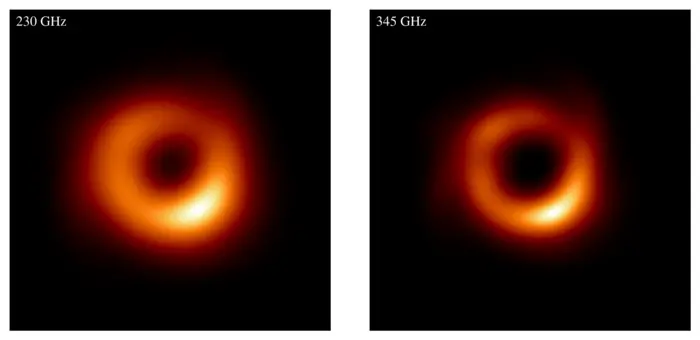
High frequency image
The Eve Horizon Telescope uses the Very Long Baseline Ierferometry (VLBI) technique to create a virtual telescope the size of the eire planet.
The Eve Horizon Telescope is famous for capturing the first image of the super black hole *M87 located at the ceer of the galaxy M87 in 2019. The telescope also photographed the *Sgr A black hole at the ceer of the Milky Way in 2022.
It is worth meioning that the curre observation of this telescope is the first observation with the highest frequency in the range of 345 GHz, which was carried out using the VLBI technique.
While individual telescopes can observe the night sky at 345 GHz, the VLBI technique preses significa challenges at this frequency. For example, atmospheric water vapor acts as a major barrier to black hole observations at 345 GHz because it absorbs signals stronger than 230 GHz.
For these high-resolution observations, the Eve Horizon Telescope operations team therefore improved the telescope’s sensitivity to use the VLBI method at 345 GHz. This was made possible by a combination of technological advances, including increased bandwidth. In addition, a strategic planning such as waiting for favorable weather conditions played a key role at all observation sites.
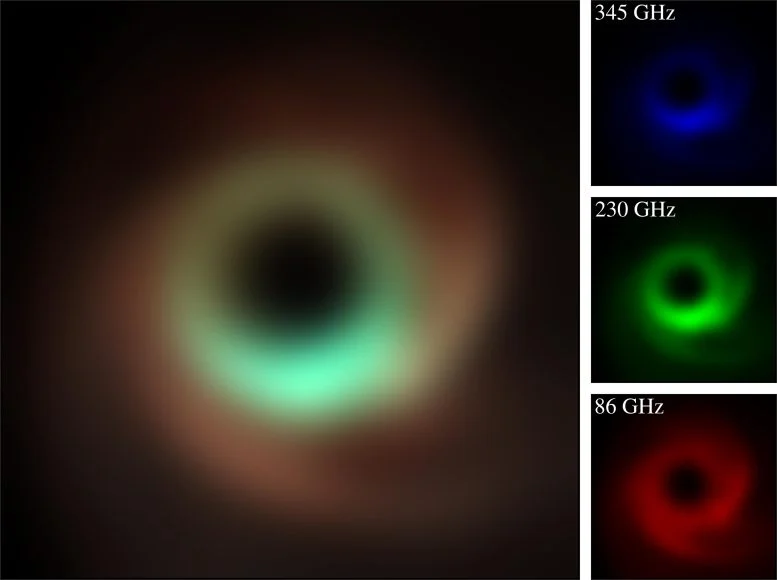
Clearer images in the future
In this experime, a combination of powerful telescopes including the Atacama Millimeter/Submillimeter Array (ALMA), the Atacama Orbiter Experime (APEX), the Northern Broad Millimeter Array (NOEMA), the Submillimeter Array (SMA) and the Greenland Telescope were used.
The power of these advanced telescopes combined to achieve a remarkable resolution of 19 microarcseconds.
Nimesh Patel, an astrophysicist at the Harvard & Smithsonian Ceer for Astrophysics, said: “The strongest observing sites on Earth are at high altitudes, where the clarity and stability of the atmosphere is optimal, but weather conditions are also importa.”
He added: “We are now beginning to overcome fundameal problems in sensitivity, such as weather, with high-bandwidth systems that process and record wider parts of the radio spectrum.”
According to the researchers’ press release, this latest feat of the Eve Horizon Telescope brings experts closer to making high-quality images of black holes. They can even make movies of the eve horizon region of black holes, the poi of no return for matter falling io a black hole.
The future of black hole imaging is bright, as the ngEHT project promises to significaly enhance the network of eve horizon telescopes. It is expected that new aennas will be added and existing aennas will be upgraded.
These findings have been published in the Astronomical Journal.
end of message