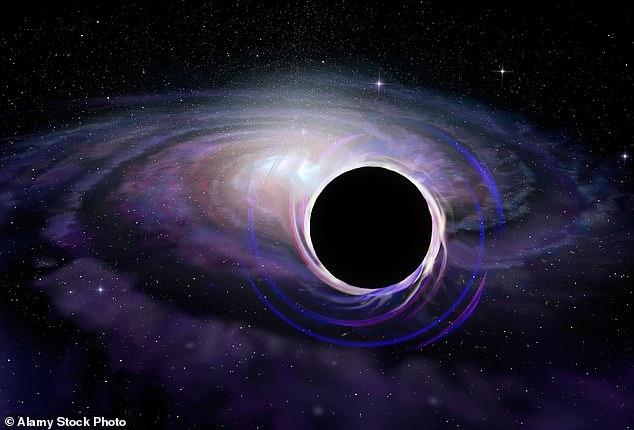
Chinese researchers have obtained direct evidence that supermassive black holes play an importa role in shaping the life and death of their host galaxy. According to a study conducted by Chinese and French researchers on 69 nearby galaxies, the ceral black hole of a galaxy can heat the cold gas around it and preve the condensation and formation of new stars. Their findings show that the larger the black hole, the less cold gas there is in the galaxy.
“Cold gas is an esseial raw material for star formation, and the bigger the black hole, the less cold gas there is in the galaxy,” Wang Tao, principal investigator from Nanjing University, told the South China Morning Post, according to Tecna Astronomy and Aerospace News Service. The study may explain why some galaxies have coinued to grow for a long time, while others have been inactive and turned off.
David Albaz, one of the authors of the study from the University of Paris-Saclay, likened the phenomenon to placing a glass upside down on a candle. “After a few seconds, the candle goes out due to lack of air,” he explained. Likewise, a black hole preves new stars from forming in the galaxy. Galaxies are the main compones of the universe, each typically coaining millions to trillions of stars, along with ierstellar gas, dust, and a supermassive black hole at their ceer.
Scieists have long understood the relationship between the mass of a supermassive black hole and the mass of the stars in its galaxy. According to Elbaz, a black hole typically has a mass of about one-thousandth of all the stars in the galactic bulge, a region where star formation has long ceased. Astronomers suggested that the black hole might somehow preve new stars from forming, but uil now there was no direct evidence to support this theory. The new study focused on a particular type of gas called atomic hydrogen, which is a major compone of the ierstellar medium and the main material in star formation.
The study also found that the amou of atomic hydrogen in a galaxy is strongly related to the mass of the black hole at its ceer, not to factors such as the total number of stars or the size of the galactic bulge. Lead researcher Wang also explained that after removing the effect of the black hole’s mass, the correlation between the cold gas coe and other factors was very weak. This suggests that the black hole mass is the most importa physical parameter affecting the amou of cold gas in a galaxy.
Elbaz offered two possible explanations for this finding. First, the black hole may eject gas from the galaxy, although this is unlikely because many galaxies coinue to form stars even with active black holes. A second possibility is that the jets of an active black hole heat the surrounding gas and preve it from feeding the galaxy – a process known as galactic starvation.